

















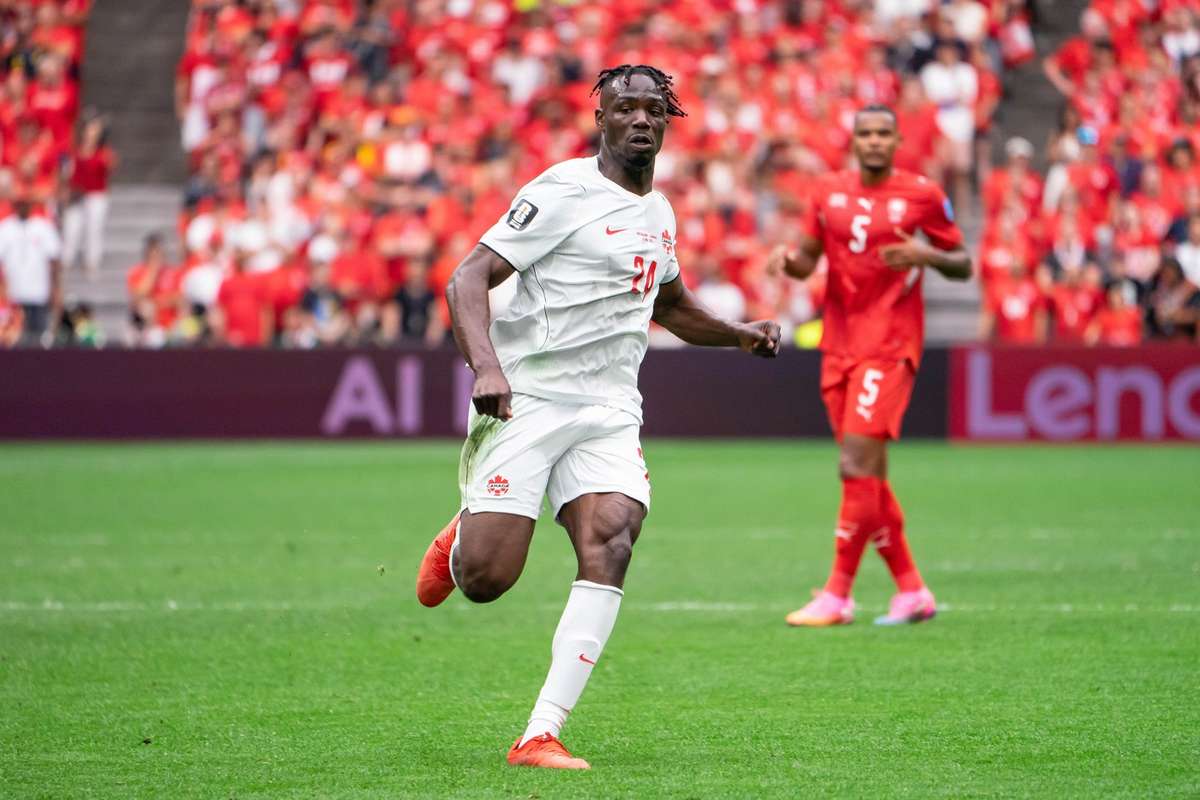
His name is Promise—and that is a promise. Now, that promise sounds more like a prophecy.
Long before stepping onto the turf at Vancouver's BC Place to face Switzerland, Canada forward Promise David told those around him that he would score in this city. Months earlier, he admitted he had a "strange ability" to sense before scoring—"I don't know which match, but it will definitely happen in Vancouver." On June 24, in the 76th minute, the ball flew into the Swiss net. Promise delivered.
That night, Canada still lost 1-2 to Switzerland, surrendering Group B's top spot in the final World Cup group-stage match. But amid defeat, David scored his first World Cup goal: coming on as a substitute for Tajon Buchanan in the 74th minute, he shot on his first touch—even before the stadium announcer finished reading the substitution, the ball was already rolling into the net.
A textbook centre-forward finish
From a data standpoint, the match showed a sharp contrast in efficiency. Switzerland recorded 55% possession, 6 shots, 4 on target, and 2 goals; Canada had 13 shots, 7 on target, and 45% possession, lining up in a 4-4-2 against their opponent's 4-2-3-1—more attacks, but unable to turn the advantage into a win. David's goal was the opening carved through this "many shots, few goals" bind.
The goal came from a superb aerial combination. Luc De Fougerolles played a long diagonal ball from his own half. Nathan Saliba stretched to control it and whipped in a volleyed cross toward goal. David, sprinting in at full speed, dipped to power a header home—the quintessential centre-forward finish: timing, space, and use of the body, all in one.
After the match, David explained his movement: "As the move unfolded, I deliberately held a slightly offside position to give myself a few yards of space, because I knew the ball would go wide. Saliba's run inside was excellent, and his touch was immaculate. Once he had the ball, I didn't need any further signal—the moment he looked up for me, I knew the plan. At that point I had two options: go to the near post or stay on the far post."
This anticipation of passing lines and teammates' field of vision is precisely what separates a technical striker from one who relies solely on physical gifts. A "false offside" position near the offside line left the decisive burst of acceleration for the final run.
From Brampton to Vancouver, via Croatia and Malta
David was born in Brampton, Ontario—the same city as Tajon Buchanan and Cyle Larin. Born in 2001 to parents from Nigeria, he spent several years living with his grandparents there in early childhood before returning to Canada at around seven. Football soon became his passion.
Toronto FC's youth academy once spotted this youngster, but at fifteen he was let go—the club judged him "not good enough." After that, a winding journey took him to Malta, Estonia, Croatia, and Belgium. From Brampton to the Canadian national team, there were no shortcuts.
In 2019, at eighteen, he set out for Europe. A trial camp organized by Croatian second-tier side NK Trnje Zagrab in the Oakville suburbs opened a door for him. Two weeks later he moved to Croatia, but that experience quickly turned into a nightmare—the local coach's discriminatory attitude left young David facing pressure far beyond football itself in a foreign land.
The makings of a knockout-round impact player
Currently ranked 30th by FIFA, Canada has already shown attacking creativity capable of matching stronger sides against 19th-ranked Switzerland. David scored just two minutes after coming off the bench—a striking level of efficiency. In the knockout stage, when opponents' fitness fades and defensive lines loosen, a striker who can win aerial duels, read the game, and possesses "first-touch finishing" is precisely the weapon the coaching staff craves most.
Promise David's name has never been mere coincidence. That night in Vancouver, he proved with a goal that youths discarded by academies can still write their own chapter on the World Cup stage. The knockout round is approaching, and Canada needs more than just more shots—it needs someone who can turn shots into goals. And Promise is waiting to deliver on his promise once again.