













Belgium did not need a courtroom to settle the argument that dominated the hours before kickoff. They needed 90 minutes, a four-goal performance, and a place in the World Cup quarter-finals. The 4-1 defeat of the United States on Monday delivered all three, and it arrived in the shadow of one of the tournament's most contested disciplinary rulings.
Midfielder Nicolas Raskin was the clearest voice in the Belgian camp after the final whistle. He did not claim the result rewrote FIFA procedure. He did suggest that football, on the night, had answered a grievance his federation could not overturn through formal channels.
Article 27 and the One-Match Ban That Never Sat
The dispute began in the previous round, when United States striker Folarin Balogun was sent off against Bosnia and Herzegovina. Under ordinary FIFA discipline, a straight red in knockout football triggers an automatic one-match suspension. Balogun would have missed the last-16 tie against Belgium.
That sequence changed when FIFA's disciplinary committee invoked Article 27 of the Disciplinary Code, which grants the body authority to suspend a ban. The committee exercised that power. Balogun was cleared to play hours before kickoff, despite the Belgian football federation's last-minute challenge to his eligibility.
The procedural frame matters here, and it is worth separating cleanly. Article 27 is not a blanket escape hatch for every dismissal. It is a discretionary instrument: the disciplinary committee may pause enforcement of a sanction when its own review concludes that step is warranted. FIFA stated that its judicial bodies operate independently. President Gianni Infantino publicly noted that the Balogun case remained within an ongoing legal process when political pressure entered the conversation.
Whether that independence fully insulated the decision from external scrutiny is a question Belgium clearly answered in the negative. Their federation protested. Their players carried the frustration onto the pitch. The law, however, stood as written for match day: Balogun was eligible, the tie would be played under those terms, and Belgium would have to respond with performance rather than paperwork.
Four Goals, One Message: Reading the 4-1 Win
On the field, Belgium made the eligibility debate secondary. The 4-1 scoreline was emphatic enough to remove ambiguity about which side controlled the tie.
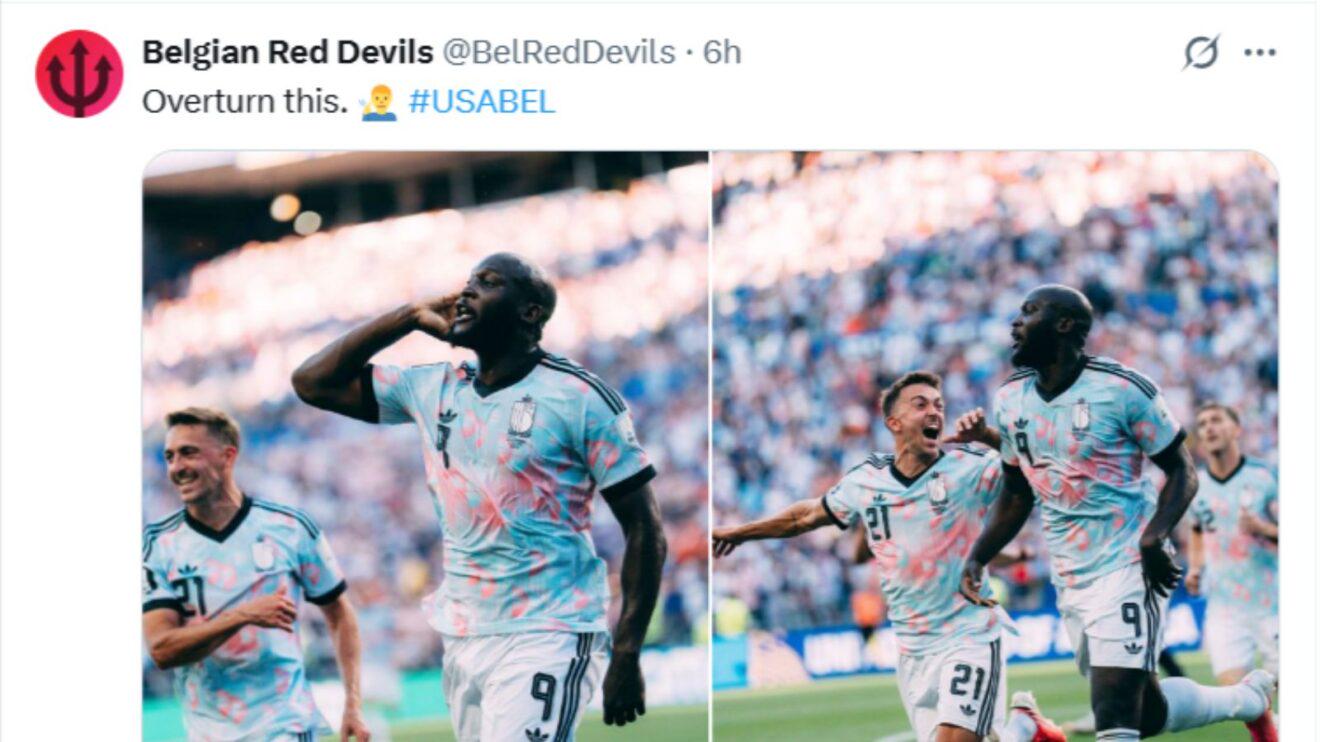
Romelu Lukaku's involvement in the closing goal became the visual punctuation. Belgium's official channels amplified the moment with a short caption—"Overturn this"—attached to a celebration image. Read literally, it was a taunt aimed at the ruling Belgium could not reverse administratively. Read competitively, it was a statement that the only overturn worth discussing had happened between the white lines.
The broader data profile of Belgium's World Cup campaign supports the idea that this was not a fortunate night but a continuation of direct attacking habits. Across their tournament sample, Belgium have produced multi-goal wins with sustained shot volume even when possession has tilted against them—15 attempts and seven on target in one victory where they held only 44% of the ball, and three goals in another outing built on more than 50% possession and nearly 700 passes. FIFA ranks Belgium ninth in the world entering this phase, stable at that position with 1734.71 rating points. The last-16 performance matched that profile: efficient in the final third, willing to accept a slightly lower share of the ball if the chance quality remained high.
The United States, playing as hosts, needed a tighter defensive block and cleaner transition moments. They got neither at the level required. Four conceded goals in a knockout round is not a margin that survives procedural controversy on the other side. Belgium advanced. The United States exited.
Raskin's 'Justice' Frame—and Its Limits
Raskin chose careful language that still carried edge. He told reporters he believed "there was always a justice somewhere in life," and that Belgium did not consider the Balogun decision fair. He framed the win as something that "brings us a little bit of luck" while insisting the team still had to execute: "We needed to win the game and the message throughout."
That phrasing is characteristic of a player trying to honor emotion without overclaiming legal vindication. Article 27 was not struck from the code on Monday night. No precedent was formally reversed in a tribunal. What changed was Belgium's tournament trajectory. They will face Spain in Los Angeles on Friday for a semi-final berth.
The distinction is important for how this story will be remembered. Sporting narratives often compress administrative disputes into moral verdicts. Raskin leaned toward that compression. The result supports his mood. It does not, by itself, rewrite FIFA governance.
Garcia Keeps the Row Out of the Dressing Room
Head coach Rudi Garcia offered the counterweight. Asked whether the eligibility fight had fuelled his players, he said it was "not needed or necessary" and that Belgium's game plan remained the priority. That is a manager protecting competitive focus with one week left in a knockout bracket.
Garcia also disclosed a post-match conversation with Balogun. The striker approached him after the final whistle. Garcia said he told Balogun directly that the forward was "not the one to blame." It was a small but telling detail: Garcia separated the player from the institution that cleared him, refusing to turn a personal exchange into another public escalation.
That restraint may prove more valuable than any social post. Quarter-final football against Spain is a different examination. FIFA ranks Spain second globally, one place below their recent peak at 1876.40 points, and their World Cup technical returns show sustained control—55% and 65% possession in sampled wins, pass success rates above 88%, and shot totals that regularly climb into the twenties.
Friday in Los Angeles: Rules Settled, Football Remains
Belgium enter the Spain tie carrying two narratives at once. The first is emotional: a squad that felt wronged by a discretionary suspension pause and answered with four goals. The second is analytical: a team whose knockout credentials rest on finishing quality rather than territorial dominance.
Spain will not need to re-litigate Article 27. They will need to solve Lukaku in the box, manage Belgium's transition threat, and avoid the kind of defensive lapses that made Monday's 4-1 unavoidable for the hosts.
The disciplinary chapter on Balogun may linger in federation corridors and media cycles. For Belgium, the practical outcome is simpler. They are one win from the semi-finals. The ruling they could not overturn administratively has already been answered where it counts most—on the scoreboard.