
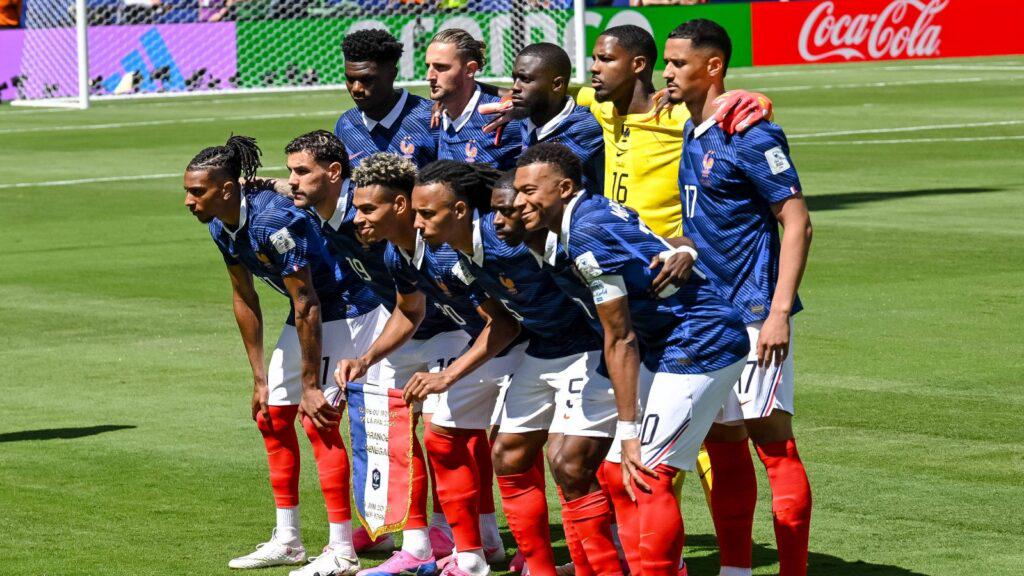
According to information we have, France are pushing toward their goal of reaching the World Cup final for a third consecutive time. The 2026 FIFA World Cup will be jointly hosted by the United States, Canada, and Mexico. Aside from the hosts, Les Bleus remain one of the title contenders drawing the most outside attention. Squad depth, historical pedigree, and the social influence of their star players all intertwine, placing Les Bleus under extraordinary scrutiny even during the tournament's buildup.
Our frontline reporting suggests that current discussion around France can be broadly grouped into four main threads: Kylian Mbappé in the star-player discourse, head coach Didier Deschamps' tenure, the collective goal of consecutive title runs, and the public expectations tied to their world No. 1 ranking. These four lines are linked and together will determine whether France can turn on-paper strength into a trophy.
Mbappé: The Media Scrutiny Behind 42 Goals
Mbappé has produced 42 goals in 44 matches this season, with his competitive output showing no signs of decline. Yet controversy over his role across both national team and club identities has only grown louder as the schedule has progressed. Some Real Madrid fans have questioned whether he is slowing the team's rhythm, while others have interpreted his forward positioning in a photo alongside French President Emmanuel Macron as "personal spotlight overshadowing the collective." Such debates do not directly change the tactical board, but they can affect the trust between players and fans on a psychological level.
From a social impact perspective, Mbappé is no longer just a striker. Every public appearance and every statement he makes is magnified as a slice of "French football's image." For a player who shouldered the national team's attacking burden at just 24, negative public opinion is both pressure and potentially extra motivation on the World Cup stage. We believe that if he can lead the team further with decisive performances at the 2026 World Cup, much of the off-field debate will naturally cool; otherwise, the swirl of public opinion will continue to drain the team's cohesion.
Deschamps' Last Dance? Zidane Succession Talk Emerges
Another storyline with far-reaching implications centers on whether head coach Didier Deschamps will stay or go. As a player, Deschamps was part of France's 1998 World Cup-winning squad; after taking charge of the national team in 2012, he gradually molded Les Bleus into one of the most dominant sides in recent years. Rising from the lows of a group-stage exit at the 2010 World Cup and disappointment at Euro 2012, he then built a championship-caliber core—his managerial arc has largely been building toward this very moment.
Reports suggest this World Cup could be Deschamps' final shot at lifting the trophy, and players and fans alike are broadly willing to rally behind the legendary coach to fulfill that dream. At the same time, talk has begun to circulate about Zinedine Zidane potentially taking over the national team—though the precise timing remains unclear, the prospect of a "post-Deschamps era" has already made France's long-term planning a subject of public debate. For the squad, the short-term goal is winning the title; the long-term aim is a smooth handover of power—and those two timelines do not always align.
Third Final in a Row: A Historic Pressure Test
France's last failure to reach a World Cup final dates back even further; having made back-to-back finals, the 2026 mission has been elevated to "historic" heights: appearing on the final stage for a third consecutive time means this team must maintain rare stability across psychology, fitness, and scheduling. The World Cup format is brutal—knockout ties are decided in a single game, and the slightest dip can alter the entire trajectory.
In-site data show France currently sit top of the FIFA rankings on 1,877.32 points, up two places from the previous edition. That rise reflects recent form in international matches, yet a run of 0-0 draws in the buildup against the likes of Turkey, Italy and Belgium has also reminded observers that when the elite refuse to yield, breaking down packed defenses will be a real test on the road to the title. In parts of the 2020 season, France won with possession rates ranging from 36% to 50%, showing they can convert efficiently when holding less of the ball—a quality especially valuable in World Cup knockout football.
Social Expectations Surrounding the World's Best Squad
Beyond individual storylines, France's collective strength is equally a central theme of this tournament. Reporting indicates that Les Bleus boast one of the most star-studded squads among the participating teams; a blend of historical pedigree and present-day talent has made them widely regarded as among the favorites to lift the trophy. Such expectations extend far beyond the footballing world—in French society at large, the national team's results are often invested with symbolic meaning that transcends sport, especially in a multicultural context, where the narrative of unity on the pitch holds unique public value.
For us, France's story in 2026 is both a sporting quest for the title and a broader narrative of how public figures respond to the public eye, how a veteran coach writes his swan song, and how a generation of players carries the weight of national expectation. As the World Cup curtain rises, whether these four focal points can align in the same direction is a question that can only be answered on the pitch.