






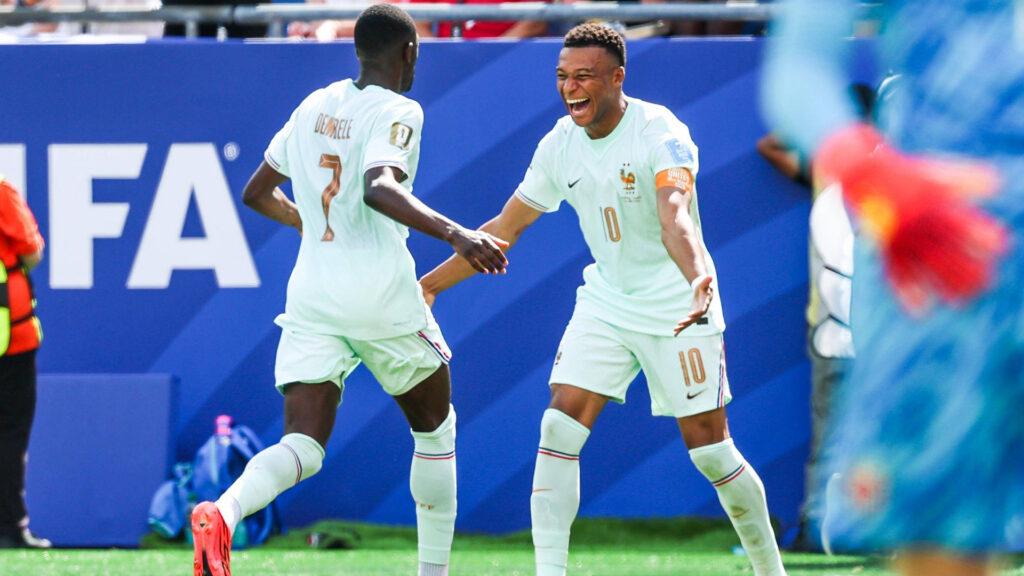
When a team with title ambitions invests its firepower up front, management usually looks first not at goals in a single game, but at whether “this line can keep producing.” With the 2026 World Cup group stage still underway, France has offered a preliminary answer in hard numbers: all four members of the front line posted ScoreZ ratings above 6.90, and Deschamps no longer has to keep experimenting with “who finishes.”
Front-line health under the rating system
The defensive density of World Cup play often reduces many paper-strong attacking lines to scattered individual flashes. France’s front four on this trip—Mbappé, Dembélé, Olise, and Doué—showed rare uniformity in ScoreZ’s quantitative framework: ratings of 8.23, 8.57, 7.40, and 6.93, all above the 6.90 threshold.
For the coaching staff, that is more telling than a single four-goal or three-goal game. FIFA rankings show France has risen to No. 1, with 1,877.32 points, up from the previous update—a team profile that matches steady output up front. When the star and his supporting cast sit in high rating bands together, tactics need not lean too heavily on one moment of inspiration, and responsibility in the locker room is clearer.
Mbappé: the rhythm behind 8.23
Mbappé’s current ScoreZ rating of 8.23 already ranks as elite striker level in a World Cup context. The number reflects not just goals, but how often he shifts the game—whether by finishing himself or pressing to force mistakes. When a No. 9 stays consistently in the 8 range, the whole attack plays with confidence.
Deschamps has made frequent personnel tweaks between the No. 9 and second-striker roles in recent years, and ahead of the World Cup he clearly handed finishing duties to Mbappé—essentially a bet on concentrating control of the rhythm. The data so far suggest the move paid off: when the core no longer has to bail the team out with individual moments of brilliance every 90 minutes, teammates behind him also move and pass with greater decisiveness.
Dembélé 8.57: The accelerator on the right in transition
The highest-rated member of the quartet is Dembélé at 8.57. His value lies in fusing direct dribbling with the final pass—against the low blocks common at World Cups, France need someone who can beat a man one-on-one out wide and then deliver into the box. When Dembélé is in form, counters often become shooting chances within two or three passes.
That does not contradict France’s pattern at other major tournaments of building through possession layer by layer; it adds another way to break through. With Olise’s on-ball creativity on the left and Dembélé’s vertical thrust on the right, opponents struggle to lock Les Bleus down with a single defensive approach.
Olise and Doué: Division of labor and cover, not stealing the spotlight
Olise’s 7.40 rating reflects a different kind of creativity—combining dribbling advances with passes into the final third, so France’s front line is no longer only about speed. Doué’s 6.93 is the lowest of the four but still above the 6.90 baseline; his linking between the half-spaces and the rest of the pitch gives Mbappé and Dembélé a second-wave outlet.
All four are above the line, which for Deschamps’ tactical ledger means that if someone has an off night, the attack does not have to shut down entirely. World Cup knockout ties are decided in one game—such redundancy is often worth more than the paper starting XI.
Deschamps’ view: From firepower to output
If you put France’s World Cup start in the coaching staff’s working language, the keyword would be reliable finishing. Deschamps’ experience across recent tournaments tells him possession and shot volume do not automatically equal a title; what really decides momentum is whether high-quality chances are converted consistently. The current rating curve of the front four shows the finishing end is delivering predictable returns.
Of course, the group-stage sample size is still limited, and opponent strength will only rise as the schedule progresses. If France wants to replicate its 2018 title-winning path, it still needs to prove itself in the knockout rounds: when space is compressed further, can these four sustain 7+ ratings for a full 90 minutes and even into extra time?
Summary: The numbers are strong, but the title still comes down to match-day execution
As things stand, France’s front four is one of the most cohesive attacking units at this World Cup. Mbappé sets the tone, Dembélé adds pace, Olise provides variation, and Doué links the play—the four have clearly defined roles, collective ratings above 6.90, giving Deschamps rare tactical security.
What bears watching is whether ScoreZ ratings hold up against stronger opposition, and whether Deschamps will fine-tune the quartet’s positioning and ball distribution in the knockout stage. If this line can carry its current momentum into the deeper rounds, France has every reason to put itself at the center of the title conversation.