

















A Round of 16 meeting at Lumen Field in Seattle has delivered exactly the kind of first half that separates programs built for knockout football from those still assembling one. Belgium lead the United States 2-1 at the interval, with Charles De Ketelaere scoring twice in nine minutes of action spread across the opening 45. Malik Tillman pulled one back for the hosts, yet the underlying numbers suggest Belgium arrived with a clearer operational plan — and executed it with the efficiency of a side that has spent years refining how it converts talent into results.
For federation executives and sporting directors watching from the industry side, this is not merely a scoreboard story. It is a live case study in how World Cup infrastructure, squad construction, and in-game adaptability compound under the brightest pressure.
Scoreline and Momentum at the Break
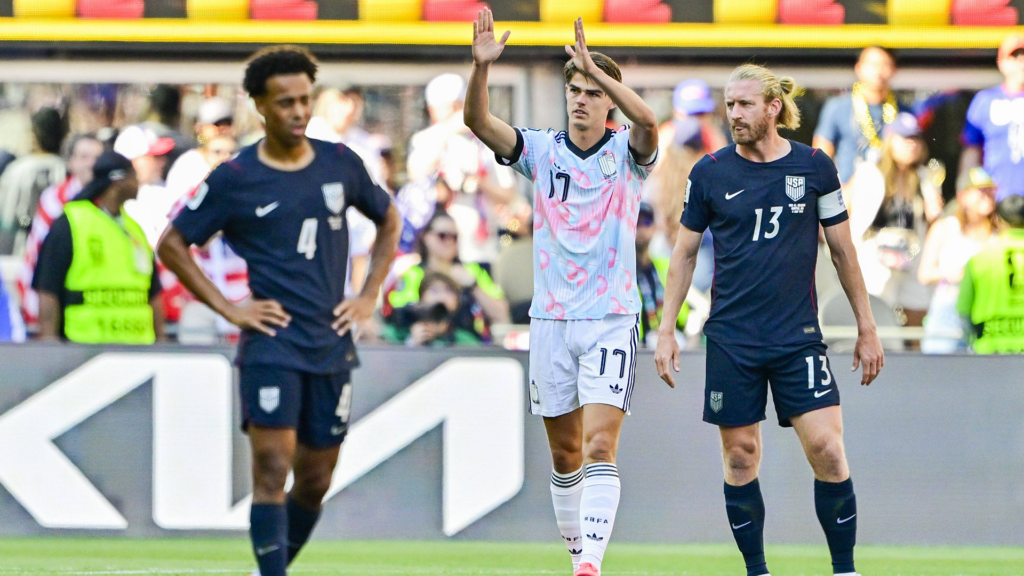
Belgium struck first in the 9th minute when Nicolas Raskin slipped a precise pass into De Ketelaere’s path, and the forward finished cleanly for 1-0. The Americans steadied their rhythm and found a response in the 31st minute as Tillman converted their only shot on target to level the emotional tone inside the stadium. Parity lasted barely two minutes. Leandro Trossard delivered another incisive ball, De Ketelaere finished again, and Belgium walked to the tunnel with a 2-1 advantage.
The half ended after six minutes of stoppage time, a reflection of how relentlessly both sides contested every phase. Yet the statistical portrait at the break told a sharper story than the one-goal margin alone. Belgium held 53% possession, generated an expected-goals total of 1.90 against 0.42 for the hosts, and led 11-3 in shots with a 5-1 edge on target. Those margins are not noise. They are the product of repeatable attacking habits.
Belgium: Depth as an Operating Advantage
Belgium entered this tie ranked ninth in the FIFA world rankings, unchanged from their previous position at 1734.71 points. That stability matters in tournament football because it usually signals a federation that has protected its competitive base rather than rebuilding mid-cycle. On the pitch, that foundation showed up in chance volume: four big chances created in the half, 14 penalty-area touches to the United States’ four, and seven of 11 shots taken from inside the box.
De Ketelaere was the decisive operator. All three of his attempts were on target, both goals found the net, and his personal expected-goals figure sat at 1.22 with an expected-goals-on-target mark of 1.98 — numbers that describe not just volume, but shot quality and placement. Support arrived from across the front line. Trossard and Timothy Castagne each created a big chance. Raskin supplied two key passes including the opening assist. Youri Tielemans, arriving late into space, added 0.34 expected goals and two shots of his own.
The operational test came earlier when Amadou Onana left through injury in the 21st minute. Hans Vanaken came on, and Belgium’s attacking rhythm did not fracture. That is the kind of squad elasticity federations spend years trying to build — a replacement who slots into a high-tempo knockout environment without forcing a tactical reset. Belgium also missed two big chances, so the half was not flawless. But the pressure was sustained enough to keep the United States pinned in survival mode for long stretches.
Crossing efficiency added another layer. Belgium completed five of 10 deliveries into dangerous areas, giving their front line multiple routes to threaten a back four that was frequently occupied. In a World Cup Round of 16, that variety is a competitive asset built through years of player development and tactical repetition, not improvised on match day.
United States: Response Without Structural Reward
USA arrived ranked 16th in the world, down one place from their previous position at 1673.13 points. The slip is small on paper, but knockout football punishes the gap between ranking and execution. Tillman’s equalizer proved the hosts could land a punch when they reached the final third. The problem was frequency. One shot on target across an entire half is not a platform for sustained parity against a side creating chances at nearly five times the expected-goals rate.
From an organizational standpoint, the first half raised familiar questions about how the program converts growing talent pools into consistent chance creation at the highest level. The Americans showed resilience after falling behind early, and Tillman’s finish demonstrated that individual quality exists within the roster. What was missing was the chain of actions — buildup patterns, box entries, and shot volume — that Belgium produced as a matter of routine.
Discipline held for most of the half, though Weston McKennie was booked in the 35th minute, adding a layer of risk for a midfield already chasing the game. In knockout tournaments, yellow cards are not just refereeing footnotes. They shape substitution decisions, pressing intensity, and how aggressively a player can engage in the second half. The United States will need cleaner defensive actions if they hope to overturn the deficit.
What the Data Says About the Wider Tie
Looking beyond the halftime score, this match sits inside a broader competitive arc between the two nations at the World Cup. Belgium’s profile in the tournament has leaned on directness in transition and efficiency in the penalty area. Their earlier group-stage performances in this competition featured multi-goal outputs built on high shot counts and disciplined finishing — including a 4-1 result against the United States in which they scored four goals from 14 shots despite holding only 44% possession. The first half in Seattle echoed that identity: less concerned with territorial dominance than with making every entry count.
The United States, by contrast, have shown they can control stretches of play. In a prior group meeting against Belgium, they held 56% possession and completed 87% of their passes. Possession, however, did not translate into goals that night, and the same translation problem resurfaced here. For a federation investing heavily in youth pipelines, academies, and international visibility, the recurring challenge is not talent identification. It is turning technical progress into repeatable attacking output when the world is watching.
Expected goals are not destiny, but they are a useful management metric. A 1.90 to 0.42 split at halftime is the kind of gap sporting directors recognize immediately. It signals that one program is generating high-probability scenarios while the other is relying on isolated moments. Closing that gap in 45 minutes requires more than motivation. It requires tactical adjustment, fresher attacking combinations, and likely greater risk acceptance from a back line that cannot afford further disruption.
Second-Half Stakes for Both Federations
For Belgium, the industry question is whether they can protect a lead built on superior chance quality without retreating into a shell that invites American momentum. Their federation has invested in maintaining a golden-generation pipeline even as individual stars have rotated. Vanaken’s seamless introduction after Onana’s injury underscored that continuity. Finishing the job would validate years of work keeping Belgium inside the global elite despite periodic transition phases.
For the United States, the stakes are structural. A Round of 16 exit after a competitive but statistically lopsided half would still represent progress in some cycles, yet the manner of the deficit — limited box presence, minimal shot threat — would fuel internal reviews about how the program’s long-term investments translate into World Cup knockout performances. Head coaches come and go. Federation strategy persists. This second half is a public audit of that strategy.
Key First-Half Timeline
Belgium’s opener arrived in the 9th minute through Raskin and De Ketelaere. Onana departed injured in the 21st minute, with Vanaken replacing him. Tillman equalized in the 31st minute, only for Trossard and De Ketelaere to restore Belgium’s lead in the 33rd. McKennie was cautioned in the 35th minute before six minutes of added time closed the half.
Bottom Line
At halftime, Belgium lead 2-1 with a performance that reflects both individual brilliance and organizational depth. De Ketelaere’s brace set the tone, but the underlying expected-goals margin, penalty-area presence, and injury-time response after losing Onana paint a fuller picture of why Belgium look like a program built for this stage. The United States have 45 minutes to prove their development model can produce not just spirit, but the sustained chance creation that knockout football demands. The score is close. The structural gap, for now, is not.