














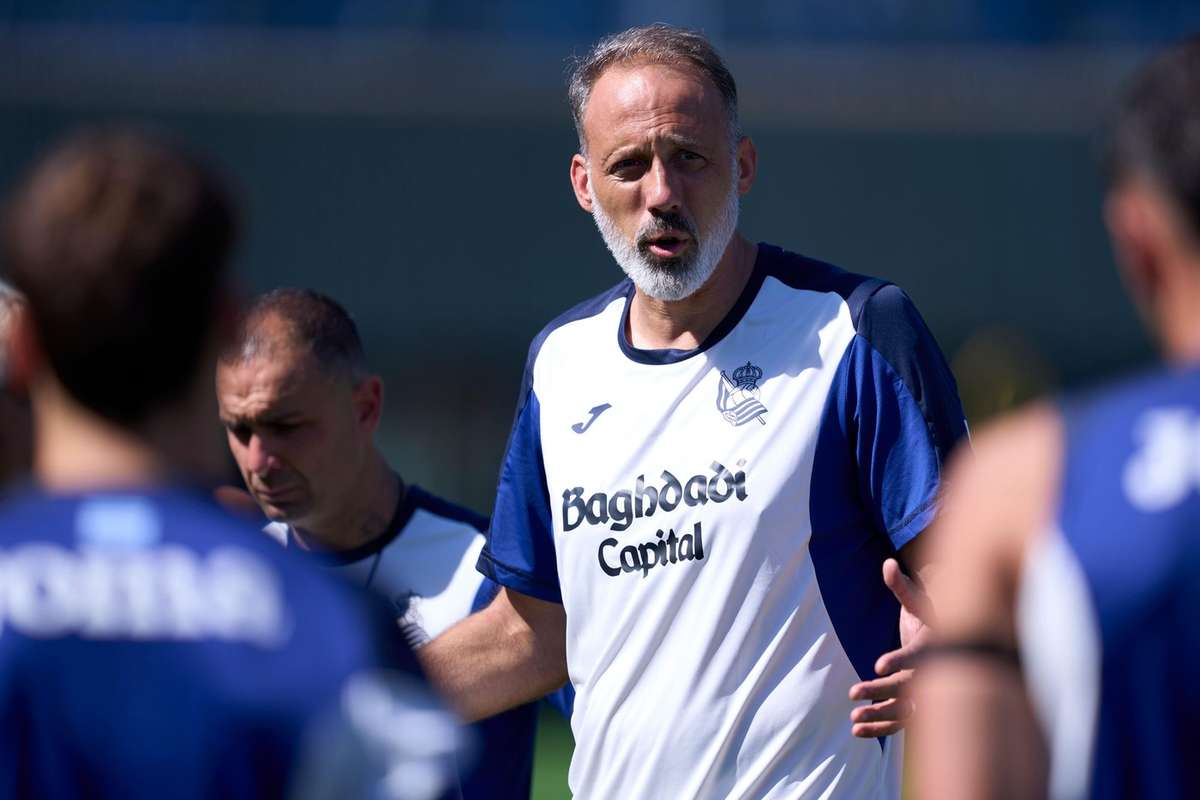
When the last whistle blew in the Copa del Rey final, the noise did not feel like a single celebration. It sounded like relief finally finding room to breathe. Real Sociedad had carried a heavy season into one night against Atletico Madrid, and Pellegrino Matarazzo stood where few outsiders ever stand in Spanish football — holding a major trophy, not as a guest, but as the man who had steered the club through it.
The club moved quickly after that win. Matarazzo’s contract extension is less a surprise than a statement of alignment: what worked in the spring is what Real Sociedad want to protect before the next chapter begins. For a coach who arrived in December with the team hovering near the La Liga relegation zone, the decision reads as trust earned in the hardest months of the calendar, not praise handed out in hindsight.
A December Arrival and a Different Kind of Pressure
Matarazzo did not inherit a project mid-season; he inherited a room full of people trying not to look at the table too often. Real Sociedad were close enough to the bottom that every dropped point carried a different weight. Training sessions still had structure, the dressing room still had pride, but the daily question was simpler and crueler: can we stay up?
At 48, Matarazzo brought a temperament that fit a club built on patience and identity. He did not try to rewrite Real Sociedad in a month. He listened first — to players who had been living under pressure since autumn, to staff who knew every habit of the club, to a region that does not hand affection to strangers quickly. That approach mattered because survival in December and belief in May are not the same skill. One requires discipline. The other requires connection.
The numbers tell part of the story without telling all of it. Matarazzo guided the team to a tenth-place finish on 46 points — a climb that would have sounded optimistic when he first walked through the door. Tenth place is not a headline trophy, but for a squad that had been staring at the relegation zone, it was proof that the work had direction. The table stopped being a threat and became a platform.
The Final That Rewrote the Season
The Copa del Rey final against Atletico Madrid was the line between a respectable rescue and a season people will remember for years. Real Sociedad did not just win a cup match on a big stage. They beat an opponent built for nights like that — organized, experienced, difficult to break down when the occasion tightens.
In the hours after the victory, the achievement carried a wider meaning inside European football. Matarazzo became the first American head coach to win a major trophy in one of the continent’s top five leagues. That distinction is often reduced to nationality, but inside the club it landed differently. It was evidence that a coach from outside the usual pathways could earn authority in a place where tradition runs deep — not by volume or spectacle, but by fitting the people he worked with.
The trophy also opened a door on the continent. Real Sociedad secured a place in next season’s Europa League, adding European nights to a calendar that already asks for consistency across two fronts. For players and staff who spent months fighting for breathing space in the league, that reward changes the emotional math of the summer. The work no longer ends at survival. It continues into another test.
Why the Extension Fits the Room Matarazzo Built
In the club’s announcement, Matarazzo sounded less like a man selling a vision and more like someone describing a relationship that had already taken root.
"I connected very well with the people of Gipuzkoa, with the players, with the people at the club. I share similar values with them, which makes it easier to connect," he said.
That language matters in San Sebastián. Real Sociedad are not a club that responds well to performance alone if the daily fit is wrong. The region, the squad, and the internal culture expect coherence — on the training ground, in meetings, in the way a coach handles a bad week. Matarazzo’s extension suggests the club saw that coherence in the months after December, not only in the final.
There is a quieter story inside the public one. Behind the cup run were the ordinary routines that keep a season from breaking: medical staff managing tired legs, analysts adjusting for opponents who changed shape every week, veterans steadying younger players when the table turned ugly. Matarazzo’s name is on the trophy, but the season turned because the whole operation stopped waiting for rescue and started behaving like a group with something to defend.
What Comes Next
The immediate future is already on the calendar. Real Sociedad begin their 2026/27 La Liga campaign away to Real Madrid on August 17 at the Santiago Bernabeu — an opening assignment that leaves little room for a slow start. After a cup final and a contract extension, the first league night will measure whether the confidence built in May can travel into a season with higher expectations.
Europa League qualification adds another layer. European football asks for rotation, recovery, and emotional control across weeks that do not pause for sentiment. Matarazzo’s task is no longer only to stabilize a club in trouble. It is to turn a rescued season into a sustainable one.
For now, the extension is the club’s answer to a simple question: who should lead that next step? Real Sociedad have chosen the coach who arrived in winter, changed the mood in Gipuzkoa, lifted a major trophy, and left the team tenth in the league with a continental place secured. The cup final changed everything. The contract is Real Sociedad’s way of saying they want the person who changed it to stay.