

















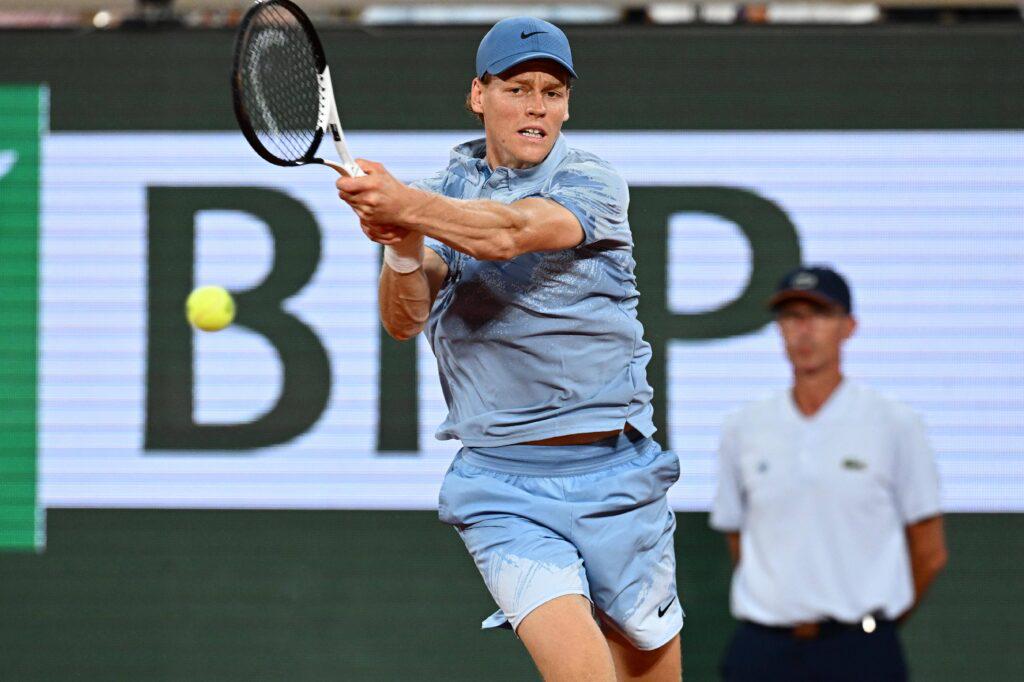
The 2026 French Open men’s singles second round (Round of 64) is set for a marquee clash at Roland Garros in Paris: world No. 1 and top seed Jannik Sinner will face Argentina’s left-handed Juan Manuel Cerundolo, currently ranked 55th. The match is scheduled for the tournament’s showpiece court, Philippe Chatrier, in best-of-five format; the clay surface demands greater serving precision and rally patience.
For both players, this is their second match at this year’s French Open. The champion will earn 2,000 ranking points, and as the rounds progress, every step of tactical execution is magnified. Sinner enters this round with elite-level competitiveness; Cerundolo must rely on his movement on clay and left-handed shot patterns to pass a higher-tier pressure test.
Sinner’s first round: serving output almost flawless
Sinner’s first-round technical report was rock-solid. First-serve percentage 65.8%, first-serve points won 80%, second-serve points won 73.1%, eight aces with only one double fault. More importantly, he did not face a single break point—on clay in a best-of-five match, that means he maintained exceptional stability on both return and serve. On the attack, he converted five of 13 break chances (38.5%); his forehand pace and depth produced 41 winners against 25 unforced errors, with offensive efficiency clearly outweighing errors.
The 1.91m right-hander has turned pro since 2018, with career prize money in the region of €56.27 million and €5.83 million earned this season. Training year-round in Monte Carlo, his clay-season fitness base and movement patterns provide the physical foundation to sustain a high-quality first serve.
Cerundolo: left-handed angles and tie-break resilience
Cerundolo's first-round numbers paint a different picture. His first-serve percentage of 66.7% was almost level with Sinner's, but his first-serve points won (73.0%) and second-serve points won (62.2%) both trailed slightly; six aces against four double faults meant serve consistency remained a concern. On return he converted 4 of 11 break chances (36.4%) while facing eight break points and saving 75% of them—a stark contrast with Sinner's clean sheet on serve. Twenty-seven winners and 28 unforced errors left his offensive output and mistakes almost even, underscoring that the match was still in a high-variance phase; he won both tiebreaks, so his clutch play in long exchanges bears watching.
The 1.83m left-hander was born in Buenos Aires, with career prize money of around €1.8 million and €366,000 this season. His left-handed kick and heavy topspin naturally create angles on clay, but against the world No. 1's return depth and ball quality, he must carry the decisiveness from his first-round tiebreaks into ordinary games.
Stat comparison and trajectory
On break points, conversion rates were close (Sinner 38.5% vs Cerundolo 36.4%); the real divide was on the pressure side: Sinner was not broken in the opening round, while Cerundolo had already faced eight break points. Philippe Chatrier's larger court often rewards players with clear first-serve placement and tighter error control in rallies—aligning with Sinner's 41–25 winner-to-unforced-error ratio in round one.
From a tactical execution standpoint, if Sinner keeps producing first-serve points won around the 80% mark, Cerundolo will struggle to open the match with sporadic breaks; conversely, if the Argentine injects his tiebreak touch into key points around the third set, the contest could still tighten. Tracking first-serve percentage, second-serve points won, and break-point conversion in real time—those two dimensions will likely decide the trend. For an upset, Cerundolo must cut double faults, lift second-serve points won, and push his 36.4% break conversion higher on return games; Sinner need only maintain his first-round error control to hold the initiative over five sets.