

















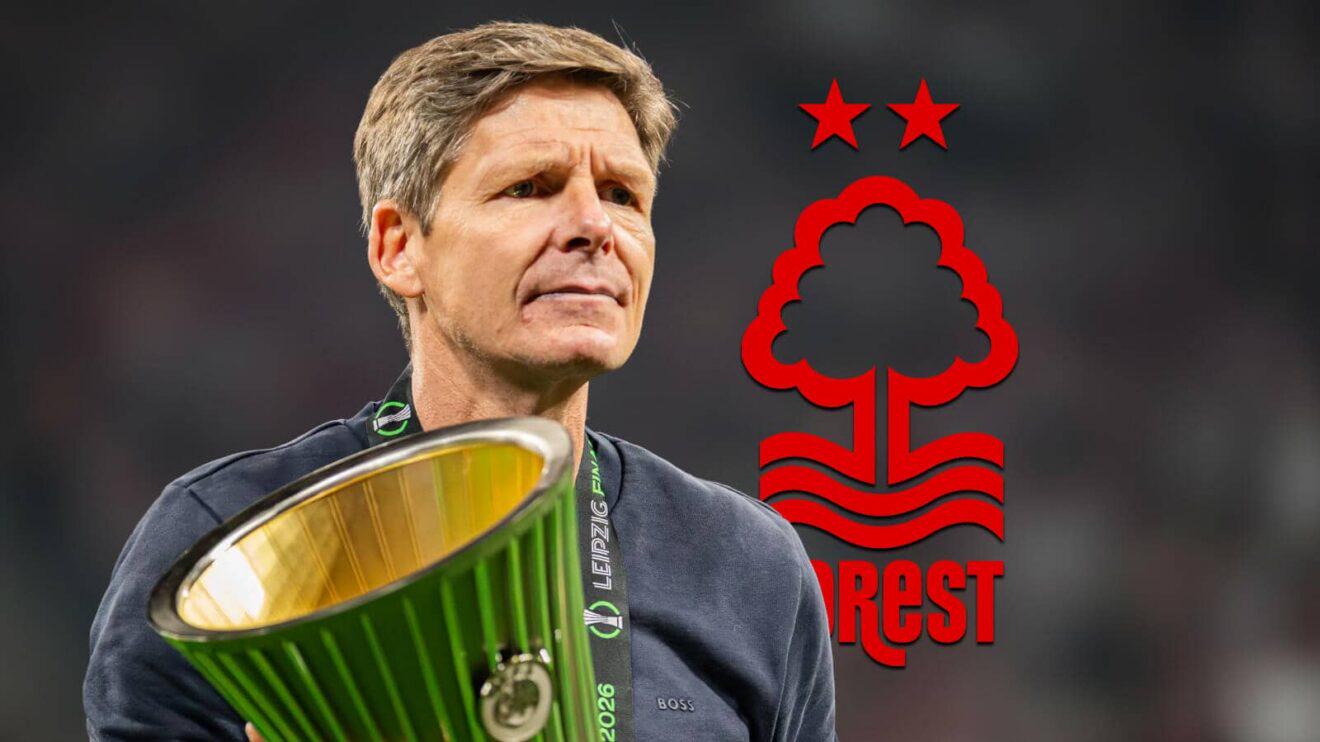
Nottingham Forest have made the defining leadership call of their summer by appointing Oliver Glasner as head coach, ending a frantic search that began the moment Vitor Pereira’s tenure collapsed at the contract line.
The 51-year-old Austrian arrives at The City Ground as the club’s fifth permanent appointment in less than twelve months — a sequence that began with Nuno Espirito Santo, continued through Ange Postecoglou and Sean Dyche, and now lands on a manager who left Crystal Palace at the end of last season with a reputation for clarity, structure and competitive edge.
For Nottingham Forest, the decision is less about novelty and more about stopping the drift. Pereira was dismissed on Tuesday after the club triggered a clause in his deal, informing him of their decision just two minutes before it was due to expire in June. Contact with Glasner had already been initiated earlier in the summer. Forest did not wait for the market to settle; they moved toward a coach they believed could impose direction where recent months had offered only rotation.
The Decision That Had to Be Made
Leadership at Forest has become a story of urgency rather than patience. Nuno Espirito Santo opened last season in charge. By September, the club had already cycled through Postecoglou and Dyche before settling, briefly, on Pereira. Each change carried its own logic in the moment — tactical reset, cultural shift, short-term stabilization — but the cumulative effect was instability at the very level meant to provide it.
Triggering Pereira’s clause was not a cosmetic move. It was an admission that the previous bet had run its course and that the 2026/27 campaign could not begin under a coach the ownership no longer trusted to build long term. Forest chose speed and certainty over ambiguity, and Glasner was the name already on the table.
That context matters when judging this appointment. Marinakis is not hiring a first-time experiment. He is hiring a manager who has already navigated a Premier League dressing room, implemented a recognizable system, and delivered results against top-tier opposition. The owner’s message is straightforward: the revolving door stops here, at least in intention.
Why Glasner Said Yes
Oliver Glasner did not need persuading on Forest’s history. He needed persuading on Forest’s future.
In his first public statement after the appointment, Glasner emphasized trust as the decisive factor. Conversations with Marinakis and the leadership group, he said, revealed a clear vision for the club and full backing for him and his staff to build over the long term rather than survive week to week.
“I’m delighted to join Nottingham Forest as head coach,” Glasner said. “From my very first conversations with the owner and the leadership team, it was evident to me that they have a clear vision for this football club and complete trust and belief in me and my staff to build a strong future together over the long term. That trust and shared commitment, together with the potential that I see within the squad, were key factors for me and I am excited about what we can achieve together.”
The language is deliberate. Glasner is framing this as a partnership, not a rescue mission. He referenced Forest’s European pedigree and passionate support base, then turned immediately to practical ambition: a team supporters can be proud of and a club pushed to the next level over the coming years.
His immediate priority is familiar to any coach taking charge in July — meet the players, embed staff, begin pre-season without delay. Forest’s recent friendly results, including scoreless draws as preparations continue, underline how little time exists before competitive demands return. Glasner’s task is to convert a talented but unsettled group into a coherent unit quickly enough to compete in the Premier League from the opening weeks.
Marinakis and the Three Qualities
Marinakis has been equally explicit about why Glasner fit the profile Forest needed after Pereira’s exit.
“In our discussions with Oliver, it was clear that we share the same vision, the same ambition and the same relentless desire to succeed,” the owner said.
He pointed to three defining qualities. First, alignment — a shared appetite for progress rather than incremental survival. Second, team-building — a career pattern of constructing sides capable of sustained performance rather than one-off runs. Third, proof against elite competition — a track record of delivering when stakes and standards are highest.
Those qualities map cleanly onto Forest’s problem. The club has not lacked individual quality in recent seasons; it has lacked a stable framework through which that quality expresses itself consistently. Marinakis is effectively betting that Glasner’s leadership can supply the structure previous appointments could not hold in place.
From Selhurst Park to the City Ground
Glasner’s departure from Crystal Palace closed one chapter and opened another almost immediately. Palace ended last season with a 1-2 defeat on the final Premier League matchday, a result that captured the emotional volatility of a campaign shaped by Glasner’s methods but ultimately defined by margins. Earlier in the season, Palace had shown the attacking volume and territorial control his system can generate — including performances with more than 60 percent possession, high passing accuracy and heavy shot counts from a 3-4-3 base.
Forest, meanwhile, closed their league season with a 1-1 draw on the same final day — a scoreline that reflected a team capable of competing but still searching for a definitive identity under constant managerial change.
The contrast is instructive. Palace under Glasner often controlled rhythm and space even when results fluctuated. Forest under four coaches in a year struggled to maintain any single rhythm at all. Marinakis is buying the coach who created the former environment, hoping it translates into the latter squad.
What Success Looks Like From Here
Forest’s 2026/27 project now rests on a simple leadership test: can Glasner make the next managerial change the last one for the foreseeable future?
Postecoglou’s brief spell and the shorter tenures of Dyche and Pereira suggest the squad responds to bold ideas but has not yet found a voice it trusts for the long haul. Glasner’s challenge is to become that voice — through training-ground detail, matchday composure and the kind of weekly consistency that turns a talented group into a reliable Premier League side.
Supporters have seen ambition from ownership and flux in the dugout. This appointment is Marinakis attempting to reconcile the two. Glasner’s credentials offer a credible path. The next months will determine whether Forest finally commit to a direction strong enough to outlast the next crisis.
Pre-season is underway. The players will meet their fifth head coach in a year. For once, the club’s leadership is asking them to believe not in another reset, but in a decision meant to last.