












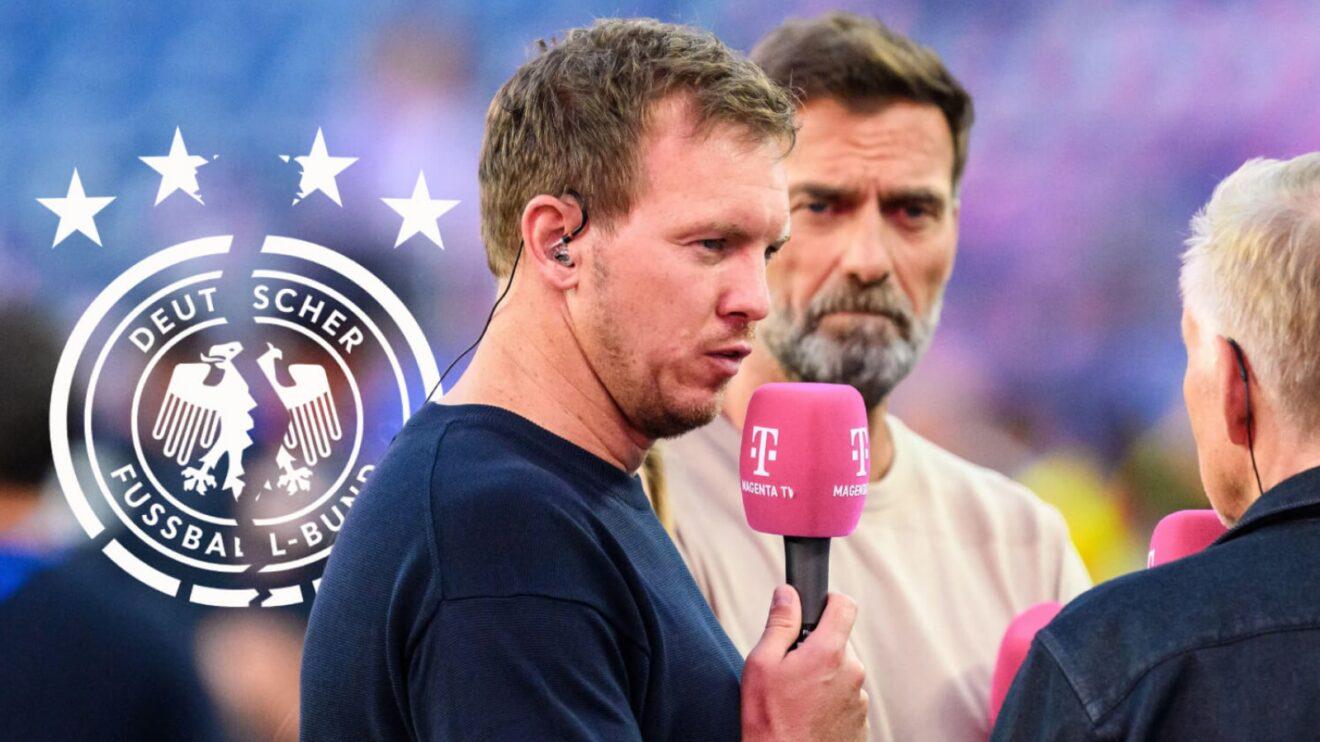
The structural conditions for a German national team reset have been building for weeks. What began as speculation after a painful World Cup exit now reads like a coordinated transition: Julian Nagelsmann is out, and Jurgen Klopp — idle in the dugout since leaving Liverpool in 2024 — is reportedly the agreed successor.
Multiple insider accounts suggest Klopp has already committed to the role. The remaining steps are contractual formalities with the DFB and assembling a backroom staff. For a federation ranked tenth in FIFA's latest standings with 1,730.37 points, the hire would represent more than a headline grab. It would be a bet that possession-heavy football without enough cutting edge can be reprogrammed under a coach whose entire career has been built on intensity, pressing triggers, and emotional buy-in.
The World Cup Data That Forced a Reckoning
Germany's World Cup campaign did not collapse in one isolated moment, but the round-of-32 penalty defeat to Paraguay became the inflection point everyone could see. Before that night, the underlying metrics already told a familiar story: control without conversion.
Across two World Cup fixtures captured in our database, Germany averaged more than 68 percent possession while managing just one goal from a combined 32 attempts and nine shots on target. In one loss operating from a 4-4-2, Die Mannschaft completed 799 passes at 90 percent accuracy, won 16 corners, and still walked off with a single goal. In another defeat using a 3-4-2-1, they held 61 percent of the ball, connected on 87 percent of passes, and again found the net only once.
Those numbers illustrate a profile modern analysts recognize immediately: territorial dominance, safe circulation, and a failure to translate final-third entries into high-quality chances. Paraguay did not need to out-possess Germany. They needed to survive the volume, stay organized through extra time, and win the lottery from 12 yards. That is exactly what happened.
The penalty shootout is cruel precisely because it strips away the narrative of gradual superiority. Germany's underlying process metrics looked acceptable on paper. The outcome metric — elimination before the quarter-finals — was not. Federations rarely tolerate that gap for long when the talent pool remains deep and expectations remain fixed at semi-final level or higher.
Nagelsmann's Tenure Under the Microscope
When Julian Nagelsmann took charge, the brief was modernization: flexible shapes, faster rest-defense transitions, and a squad comfortable rotating between back-three and back-four frameworks. Our match data shows he experimented accordingly — 4-4-2 in one World Cup fixture, 3-4-2-1 in another — yet the output column stayed flat.
That is not an automatic indictment of the coach. International football compresses sample sizes brutally. A manager might improve expected-goals differential across three group games and still lose a knockout tie decided by fine margins. But federation politics rarely waits for larger samples. Once the Paraguay result landed, two storylines emerged simultaneously: Nagelsmann's future was in question, and Klopp's name moved from hypothetical to operational.
Reports now indicate Nagelsmann has been asked to step down. Whether that decision was made immediately after the shootout or following internal review, the speed of subsequent movement toward Klopp suggests the DFB had a preferred contingency in place. That kind of pre-planning is common at elite level even when public messaging stays vague.
Why Klopp Fits the Structural Problem
Strip away the romance of a German icon returning home and the appointment still solves a specific tactical problem visible in the data.
Germany's World Cup losses featured strong pass completion and high corner counts, but low shot accuracy relative to volume. That pattern often signals passive progression — teams arrive in wide areas, recycle possession, and lack coordinated rest-attack movements that create central overloads. Klopp's Liverpool sides, by contrast, were engineered to turn defensive actions into vertical attacks within seconds. His best teams did not merely press; they timed the press so the first pass after recovery was already toward goal.
Consider the contrast in plain terms. Germany's 75-percent-possession defeat included 21 shots and six on target — a 28.6 percent accuracy rate from open play and set pieces combined. Klopp's peak Liverpool teams routinely generated higher shot quality from fewer total possessions because chance creation was embedded in the defensive scheme itself. That philosophical gap is exactly what Nagelsmann's possession-oriented approach, however modern, failed to close in knockout football.
There is also a human variable the metrics cannot fully capture. Klopp's Liverpool exit in 2024 came after nine years and sustained emotional investment. Players routinely ran through structural limits for him because the collective identity was clear. International squads are harder to mold — short camps, club loyalties, layered egos — but Germany's roster still contains world-class talent that has underperformed relative to market value in recent tournaments. A coach who installs non-negotiable intensity standards could unlock marginal gains that show up first in transition speed and defensive aggression, then later in finishing efficiency.
The Liverpool Benchmark
Klopp's Anfield decade remains the clearest proof of concept. He inherited a squad outside the top four and built a machine that combined gegenpressing with structured build-up, producing sustained top-two finishes and a Champions League title. The through-line was never complex positional theory for its own sake. It was identifiable triggers: where to press, when to spring forward, which full-back overlap was pre-planned based on the opponent's weak-side spacing.
That clarity matters for Germany because the current squad does not lack technicians. It lacks a unifying tactical signature that survives game-state changes. Klopp would not need months of theoretical workshops. He would install behaviors — first touch forward after turnover, immediate counterpress after losing the ball in the attacking third, winger width tied to full-back inversion — that can be drilled in short international windows if buy-in is total.
The Red Bull Clause and the Management Gap
Since leaving Liverpool, Klopp has operated as Head of Global Soccer for Red Bull, a role that kept him inside the sport's ecosystem without the weekly grind of matchday management. Publicly, he has seemed content in that executive lane. Privately, reports suggest he was not actively seeking a return until the Germany post became viable.
The critical operational detail is contractual. Klopp's Red Bull agreement reportedly contains a clause permitting him to leave for the Germany national team job specifically. That language removes a common friction point in cross-organization moves and explains how quickly substantive talks could follow Nagelsmann's departure. Without such a clause, compensation negotiations and release timelines might delay an appointment across a summer calendar already compressed by club preseason schedules and international friendly windows.
Fabrizio Romano outlined the dynamic weeks ago: Klopp would be open if the federation decided to move on from Nagelsmann. The federation has apparently made that decision. The next phase — formal DFB agreement, contract length, staff appointments — is administrative but not trivial. Backroom hires often signal tactical direction as loudly as the head coach himself.
What Would Change on the Sideline
If the appointment is finalized, expect immediate emphasis on three measurable areas.
First, defensive actions high up the pitch. Germany's World Cup data showed they could keep the ball but not always force errors in dangerous zones. Klopp's teams historically ranked among Europe's best for possessions won in the final third. That single metric correlates strongly with quick chances because the opponent is disorganized when turnover occurs.
Second, shot quality over shot quantity. Six shots on target from 21 attempts is not catastrophic, but it is insufficient for a nation targeting deep runs. Klopp would likely accept lower raw possession if the trade-off produced higher expected-goals per sequence. The 4-4-2 and 3-4-2-1 experiments under Nagelsmann might give way to a more fixed 4-3-3 or 4-2-3-1 base with clearer pressing lanes.
Third, psychological reset. Germany's recent 0-0 draws with the Netherlands in qualifying fixtures underscore a broader pattern: technically clean performances that stall before decisive moments. A new voice with Champions League and Premier League pedigree — and a native understanding of federation expectations — can reframe standards without pretending previous work never happened.
Timeline and Open Questions
How quickly the DFB announces the move remains uncertain, but the reporting trajectory points toward imminent confirmation rather than exploratory talks. Klopp is said to be ready to discuss contract terms and staff composition immediately.
Several questions will define whether this hire succeeds where recent cycles have stalled. Can Klopp replicate club-level emotional investment across a fragmented calendar? Will the Red Bull clause expedite his start date enough to influence the next competitive window? And critically, can Germany's attacking players convert the faster tempo he demands into the goals the possession metrics always promised but rarely delivered?
For now, the data painted a problem — plenty of the ball, not enough end product — and the market responded with a coach whose entire résumé is built on solving exactly that imbalance. If the reports hold, German football is not merely changing managers. It is choosing a different performance model, one measured not by pass charts alone but by whether controlled dominance finally becomes decisive dominance when the stakes are highest.