







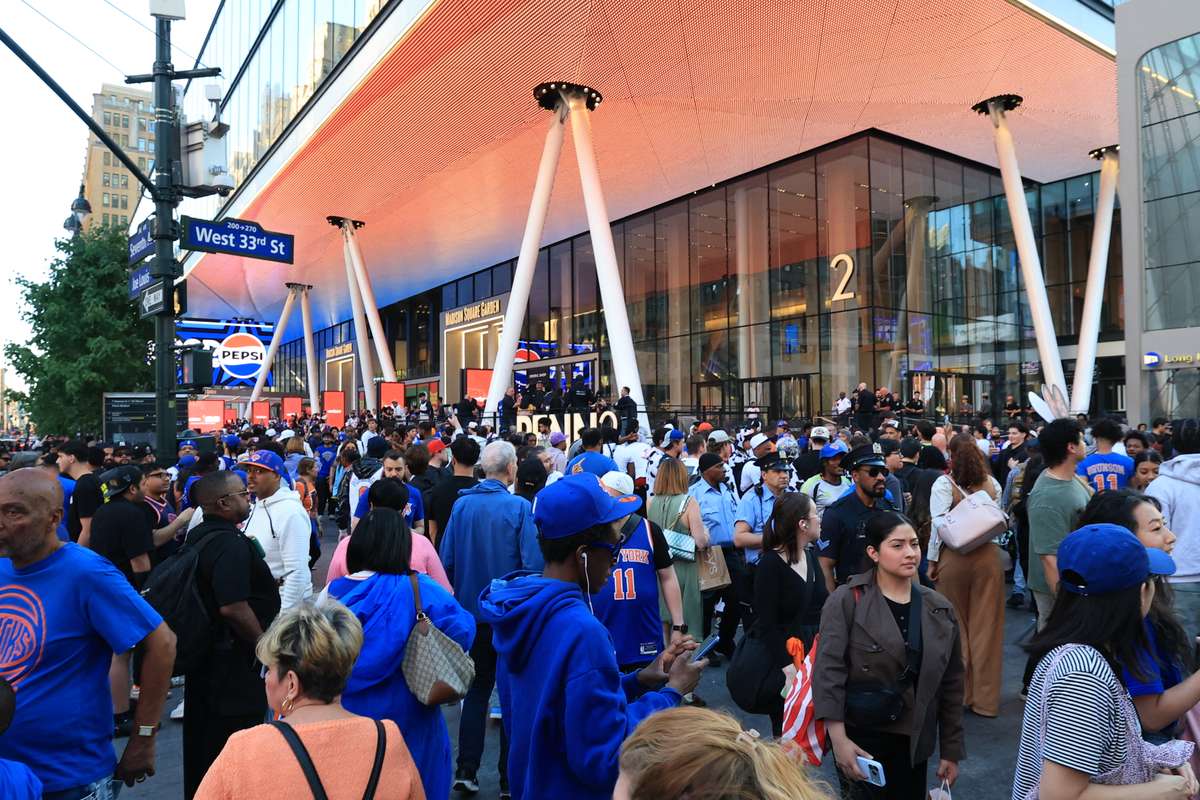
New York is answering a question in the colors of an entire city: when a basketball team returns to the Finals stage after years away, along which paths will that buzz break out beyond the usual fanbase? On Wednesday local time, large crowds of Knicks fans gathered outside Madison Square Garden to watch Game 1 against the San Antonio Spurs in Texas on the big screens; beyond the arena, orange and blue have been written into subway announcements, street art, municipal notices, and what fans wear.
A chain of buzz that starts outside the Garden
Fifty-three-year-old fan Graham spoke to AFP outside the Garden wearing glittery, basketball-patterned shoes, an oversized team badge pendant on her chest, and the blue Knicks cap that has been nearly everywhere lately. She said: “This is our season, this is our moment—we’re going all the way.” For her, the Knicks’ run to the franchise’s first NBA Finals since 1999 is pulling New Yorkers who usually go their own separate ways back under the same flag.
“New Yorkers are pretty intense normally—everyone’s in a rush, jostling around,” Graham said, “but the second someone sees you’re wearing team gear, they’ll hit you with: ‘Let’s go, Knicks!’” With the team’s last championship dating back to 1973, this return to the Finals has pushed the city’s mood beyond the sports pages into a public conversation fit for photos, reposts, and punchlines from passersby.
How orange and blue took over the city’s surfaces
The excitement is soaking New York in the Knicks’ signature palette. In subway stations, actor and comedian Tracy Morgan’s voice cuts over the crowded platforms, shouting “Orange and blue skies, baby!” and “Let’s go New York, let’s go!”—short lines that strangers easily mimic, clip into short videos for resharing, and that pull even casual commuters into the fandom on their way to work.
Mayor Zohran Mamdani joined the conversation with a tongue-in-cheek executive order: temporarily "abolishing bedtime" so kids could stay up for the late-night games. The municipal gesture seemed playful on the surface, but it pushed "the whole city is watching the Knicks" from fan circles into family rooms and public-policy debate, further amplifying the Finals' social visibility.
Subway Entrance Becomes a Temporary Landmark
A subway station near the Garden has been painted orange and blue by the city as a tribute to the team. Damani Daring, a 22-year-old communications major, admitted he isn't a die-hard Knicks follower but backs New York sports—the city's last major title still dates back to the New York Giants' Super Bowl in 2012. "Finally we've got a team that might actually win something for us," he said. "You can feel the good energy—everyone's showing up for the team."
Katie Thomas, a 29-year-old professional illustrator, was sketching there with friends. Wearing a Knicks cap, she told reporters: "It's so rare to see the whole city this excited, this invested in the ritual." The scene she described was itself like a miniature chain of transmission: people would rather linger around the subway station taking photos and shooting each other than hurry to board—"everyone's creating those little moments that end up on social media."
How People Watch Is Also Rewriting the Conversation's Reach
Many fans will soak up the early road-game atmosphere through offline watch parties before the team returns to its New York home court next week. Official watch events organized by the Garden sold out within an hour, showing that core fans' ability to gather offline remains strong; another group of supporters chose to camp outside the arena by the big screen—turning "no ticket, still there" into a shareable, performative display of fan identity.
For media narratives, the chain is clear: a Finals berth revives collective memory (back in the Finals for the first time since 1999, last title in 1973), emotions first crystallize at high-density landmarks like the Garden and subway stations, then reach everyday public life through celebrity voicemails, mayor memes, and street murals, before watch parties and street gatherings complete the visual loop of “everyone is talking about this.” With the Spurs appearing as Finals opponents in the context of Game 1 on the road, the “New York vs. the nation” narrative also expands from intra-city passion to a nationally watched matchup frame.
After breaking into the mainstream, what is New York still missing?
From a communications standpoint, the Knicks’ surge this round isn’t simply because they reached the Finals again—it’s because New York hasn’t had a pro team that could deliver on championship expectations in so long. Since the Giants’ 2012 run, many young people are experiencing the collective thrill of “our team might actually win” for the first time. The orange-and-blue wave is both outcome and city self-marketing: sports talk has given New York a friendly shared shorthand again.
Over the coming week, as the series returns to New York, whether the crowds inside and outside the Garden, sold-out watch parties, and street murals can keep momentum will determine whether this wave is a fleeting city-wide makeover or settles into longer-term home-court cultural assets. For fans, the opening road game already lit the emotional fuse via big screens; the real home narrative is still ahead.
At a Glance
Game 1 is in Texas; locally, New York channels fan energy through big screens outside the Garden and orange-and-blue landmarks at subway entrances. When the Knicks return home next week, street parties and crowds outside the arena are expected to keep pushing social buzz. Watch for: whether meme-driven campaigns involving City Hall and celebrities keep rolling, whether casual young viewers convert into steady game-day fans, and how in-arena seats and street crowds together shape New York’s citywide face during the Finals.