














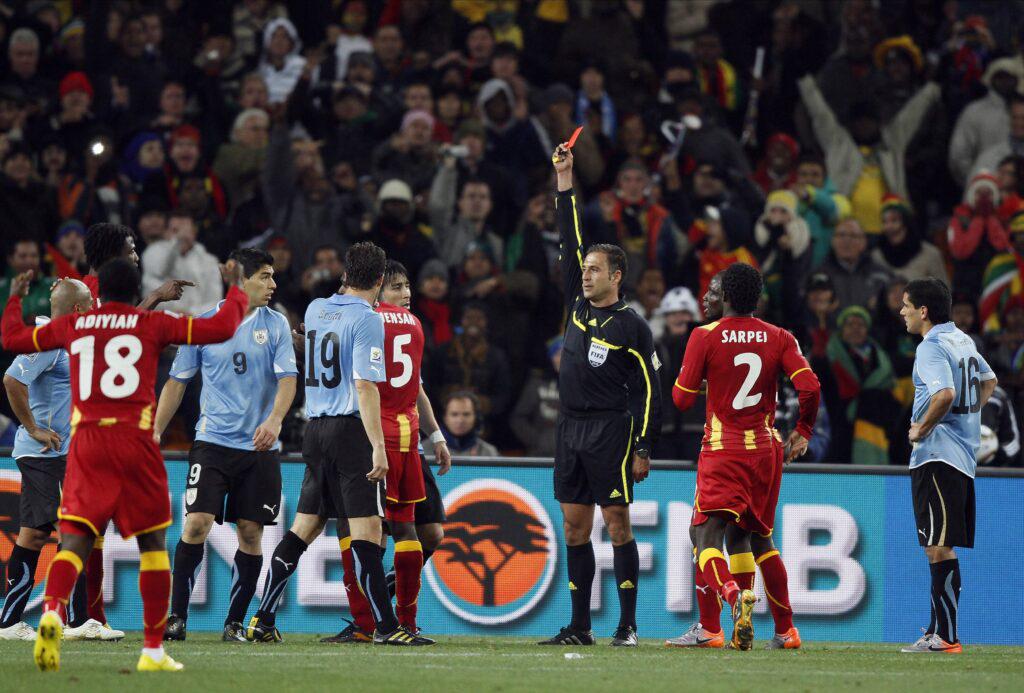
On July 2, 2010, a FIFA World Cup quarterfinal at FNB Stadium in Johannesburg stretched across 120 minutes and a penalty shootout before Uruguay advanced 4-2 on spot-kicks following a 1-1 draw with Ghana. The scoreline alone cannot capture what happened to the human body under extreme stress that night — nor why the match still triggers arguments about fairness, fatigue, and split-second neuromuscular response.
Two Halves, One Escalating Physical Load
Before the controversy arrived, the tie unfolded as a study in contrasting energy expenditure. Ghana controlled more of the ball across the full match — finishing with 56% possession and 26 shots to Uruguay's 15 over 120 minutes — yet could not convert territorial pressure into a decisive lead.
Sulley Muntari's strike in first-half stoppage time, assisted by Asamoah Gyan, came after Ghana had edged possession 52% to 48% in the opening 45 minutes. From a biomechanical standpoint, Muntari's left-footed curler demanded precise hip rotation and ankle stabilization at the end of a half when glycogen stores were already depleting. Scoring in added time is rarely about fresh legs; it is about maintaining technical precision while lactate accumulation rises.
Uruguay's response ten minutes after the interval — Diego Forlán's whipped right-footed finish into the corner — illustrated how a team can reset tactically after losing captain Diego Lugano to injury in the 38th minute. Lugano's departure forced structural adjustment under Óscar Tabárez, shifting defensive responsibilities and increasing the collective workload on remaining center backs and midfield screeners.
Extra Time: When the Nervous System Pays the Price
The second half and extra time magnified the physiological gap between effort and outcome. Uruguay managed nine shots to Ghana's ten after the break but created their only big chance of regulation. Ghana, meanwhile, generated five big chances across the entire match and missed all five — a finishing failure that has less to do with luck than with degraded decision-making under rising cortisol levels.
Research on prolonged high-intensity exercise shows that cognitive processing speed drops as core temperature and neuromuscular fatigue accumulate. In the first period of extra time, Ghana carved the night's clearest opening. In the second, they controlled 72% of possession, fired six shots, and created four big chances. Those numbers describe a team pushing through the final stages of aerobic and anaerobic reserves — repeatedly entering the penalty area, completing 88 of 143 final-third actions for 62% efficiency, and touching the ball 29 times in the opposition box compared to Uruguay's 15.
Yet the body does not reward volume alone. Under sustained adrenaline, fine motor control in finishing — the micro-adjustments of the striking foot, the timing of the plant leg — becomes harder to repeat. Ghana's five missed big chances are the statistical footprint of exhausted precision.
Uruguay's Defensive Load and Duel Success
Uruguay's route to survival was more direct and physically confrontational. They won 57% of all duels, including 58% of aerial contests, and completed 11 of 27 dribbles compared to Ghana's 6 of 24. Defensively, La Celeste recorded 54 clearances to Ghana's 27 and 34 tackles to 24 — evidence of a back line absorbing pressure through repeated explosive extensions, lateral shuffles, and recovery sprints.
Each clearance is not a passive touch; it is a full-chain movement requiring hamstring engagement, trunk bracing, and rapid visual tracking of a descending ball traveling at speed. Over 120 minutes, that cumulative load contributes to slower reaction times in the closing moments — which makes what happened next even more physiologically remarkable.
The 120th Minute: Instinct on the Goal Line
With seconds remaining in the second period of extra time, Luis Suárez was sent off for deliberate handball on the goal line. The incident sits at the intersection of sport science and rulebook ethics. When a shot travels toward an open net at close range, a defender's nervous system often bypasses conscious strategy. The arm can rise reflexively — a protective extension learned across years of training and childhood play — before the prefrontal cortex fully processes that the cost of stopping the ball with a hand is expulsion.
Suárez's action was not a heading duel or a shoulder challenge; it was a last-resort interception using the one body part guaranteed to cover the largest surface area in the shortest time. Referees classify it as professional fouling because the intent is outcome-driven: sacrifice the individual to preserve the team. From a safety perspective, handballs at goal-line speed also carry wrist and finger impact risk, though elite players accept that trade-off instinctively.
Gyan stepped up for the resulting penalty with the match — and a nation's hopes — on his instep. Penalty kicks under extreme psychological load activate stress responses that tighten hip flexors and alter strike trajectory. Gyan's effort struck the crossbar. The woodwork rejection was not merely dramatic; it represented the narrow margin between calibrated muscle memory and millimeters of misalignment when pressure peaks.
Shootout success correlates with heart-rate recovery and the ability to re-enter a parasympathetic state between attempts. After 120 minutes of sprinting, jumping, and colliding, neither squad was biologically fresh. Uruguay's survival through penalties reflected not just technique but the capacity to reboot motor control one kick at a time.
Why the Night Still Matters
Fifteen years later, the match remains a reference point because it compressed so many physical and psychological variables into a single arc: injury-forced reshuffling, escalating fatigue, territorial dominance without conversion, a reflexive handball, a penalty against the bar, and a shootout decided by the smallest biomechanical details.
Ghana's data profile — more possession, more shots, more box entries, more big chances — describes a team that outworked the opposition in measurable load yet fell short where it mattered most. Uruguay's profile — duel dominance, defensive clearances, set-piece volume with 12 corners — describes a team that absorbed stress until the format changed.
Neither narrative fully explains the other without acknowledging the body. World Cup quarterfinals are rarely won by the fresher team alone. They are won by whichever group of athletes can still execute one more precise movement when the nervous system is begging to stop — and on that Johannesburg night, Uruguay found one more answer than Ghana.