












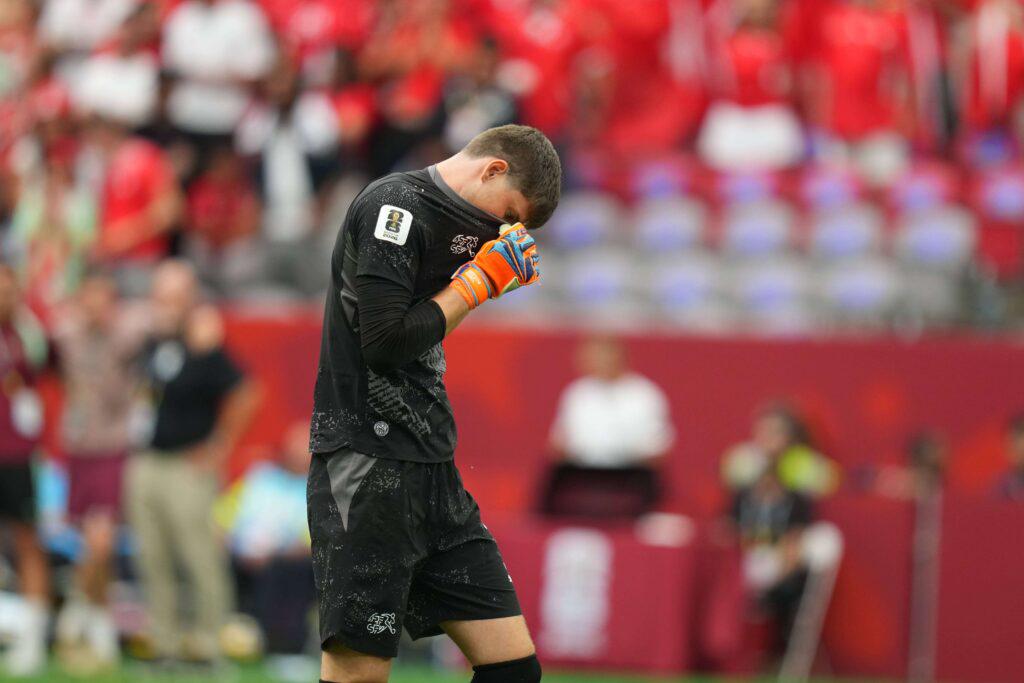
The lights at BC Place had barely cooled from a two-hour grind when Gregor Kobel walked toward the penalty spot line with the weight of a nation on his shoulders. Switzerland had spent 120 minutes locked in a tactical arm wrestle with Colombia, and the Round of 16 tie still refused to bend. What followed was the kind of goalkeeper performance that separates hopeful campaigns from credible deep runs at a World Cup — and it carried the Swiss into the quarterfinals.
A Knockout Tie That Demanded Patience
On paper, this was never going to be a free-flowing spectacle. Colombia arrived ranked 13th in the world, Switzerland sat one rung lower at 19th, and both sides had spent the group stage learning how to live without easy chances. The match data told the same story: Colombia finished with five attempts and 51 percent possession, Switzerland managed two shots on target from 49 percent of the ball. A 0-0 scoreline after regulation and extra time was less a surprise than a consequence of two disciplined structures meeting at the wrong moment for either attack.
That context matters when judging what Kobel did. In low-event knockout football, the goalkeeper is not a background figure waiting for chaos — he becomes the spine of the team’s emotional temperature. Every long spell without a breakthrough raises the premium on composure. Every Colombian half-chance carries amplified consequence. Kobel understood that rhythm from the opening whistle and never let Switzerland drift into panic.
Shot-Stopping That Outpaced Expectation
Across 120 minutes, Kobel recorded three saves, including two from inside the penalty area, and kept a clean sheet in open play. Those raw numbers only begin to describe the quality of his interventions. Advanced goalkeeper metrics from the match suggested he prevented roughly 0.43 goals relative to the average expectation on the shots he faced — a meaningful gap in a tie where a single conversion likely ends the tournament.
His positioning stayed tight throughout. Angles remained closed on cutbacks and central strikes alike, and when Colombia forced him into active work, his reactions carried the sharpness of a keeper who spends his club season under weekly Bundesliga scrutiny at Borussia Dortmund. He also showed command above his line, winning two aerial duels and claiming one high ball cleanly when bodies crowded the six-yard box. Three clearances and eight recoveries further illustrated a goalkeeper engaged in the full match, not merely reacting to isolated moments.
There is a useful historical lens here. World Cup knockout ties with fewer than three combined goals often turn on one goalkeeper outperforming the statistical baseline by a fraction — a fingertip here, a delayed step there. Kobel’s profile in Vancouver fit that archetype. He did not need a miracle every ten minutes. He needed repeated correctness, and that is considerably harder to sustain across two hours of mounting tension.
Distribution as a Pressure Valve
Modern knockout analysis frequently overlooks what a goalkeeper does with the ball, yet Switzerland’s ability to reset after Colombian pressing sequences owed much to Kobel’s choices in possession. He attempted 48 passes and completed 39, including 35 of 36 in his own half — near-flawless security when Colombia tried to pin the Swiss back. He also mixed in ambition when space appeared, connecting on nine of 18 long balls to relieve vertical pressure.
That balance echoes what elite tournament keepers have done in similar circumstances: not acting as a third center-back for its own sake, but using distribution to control tempo. With 60 touches and 12 carries totaling meaningful progression, Kobel helped Switzerland survive spells where the midfield could not cleanly escape. In a 0-0 environment, that steady outlet is often the difference between absorbing pressure and inviting it.
Where the Margins Finally Appeared
When the match moved to penalties, the narrative compressed into a single frame. Switzerland converted four spot kicks. Colombia matched that pace until the decisive moment, when Kobel read the run-up and produced the save that settled a 4-3 shootout. One stop in a seven-kick sequence is enough to rewrite a summer.
Consider the broader World Cup pattern: teams that advance via shootouts rarely credit luck alone. Someone usually earns the right to be called clutch through hours of prior discipline. Kobel had already done that work across two periods of extra time, absorbing contact, maintaining focus through stoppages, and refusing to let a single lapse define his evening. The penalty save was the visible headline. The 120-minute foundation was the actual story.
What This Means for Switzerland’s Quarterfinal Push
Switzerland’s recent competitive record has been defined by resilience rather than explosion — a run of drawn results in qualifying fixtures underscored a team comfortable grinding out results without always controlling them. Against Colombia, that identity found its ideal executor. FIFA’s 13th-ranked South American side created the slightly superior shot volume, yet could not translate territorial advantage into a breakthrough. Switzerland, meanwhile, trusted its structure and its No. 1.
Looking ahead, quarterfinal football will ask even more of the goalkeeper position. Opponents will arrive with sharper cutting edge and less tolerance for stalemates. If Kobel can reproduce even a portion of this performance — the angle discipline, the aerial authority, the calm distribution, the late-stage nerve — Switzerland will travel to the next round carrying genuine momentum rather than mere survival guilt.
For now, Vancouver belongs to a keeper who turned a tactical stalemate into a quarterfinal ticket. In a World Cup where fine margins decide everything, that is not a footnote. It is the entire plot.