
















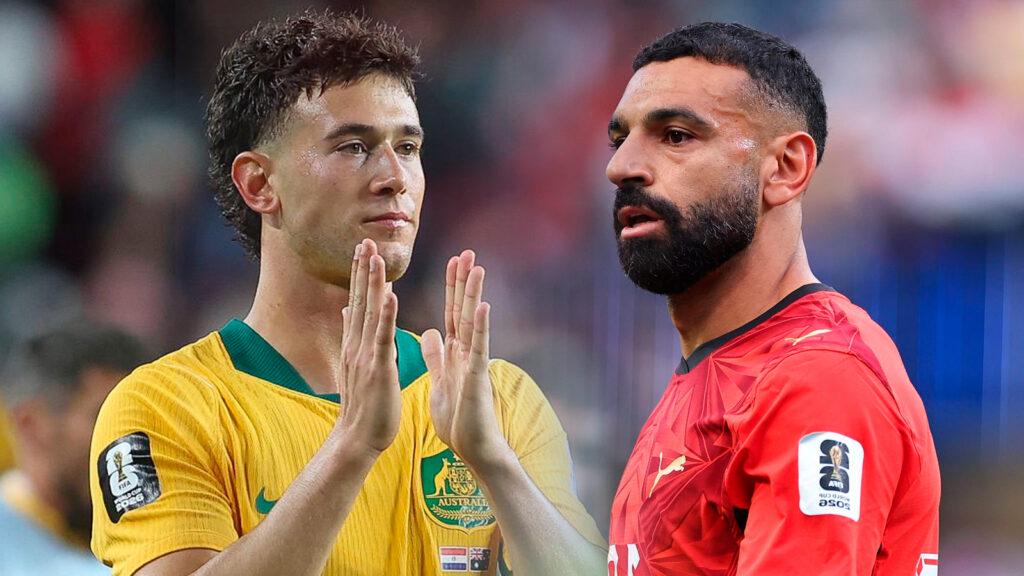
Knockout football at a World Cup rarely announces itself with fireworks. More often it arrives as a question of habit: what a team has learned to trust when the margin for error disappears. On the eve of the Round of 32 in Arlington, that question lands on Australia and Egypt, two sides separated by two places on the FIFA chart yet bound by the same pressure — one more win, or the road home.
AT&T Stadium will hold the moment. With capacity near 80,000 and a roof that keeps the Texas heat from rewriting the tempo, the venue has the scale of a late-tournament occasion without the anonymity of a neutral canvas. Supporters from both nations can reasonably reach Arlington, and that travel matters. Knockout ties are as much about who feels at home in the noise as who controls the ball.
Two World Cup Identities, One Door to the Last 16
Australia enter this tie carrying the profile of a team that has made restraint look like a plan. Across three group outings, they kept two clean sheets and conceded only twice while scoring just as modestly. Their average possession sat near 40.7 percent, which tells you something important: they have not needed the ball to feel secure. Twenty-six shots and eleven on target suggest a side willing to wait for the right entry rather than flood the box on principle.
The work without possession has been equally telling. Forty-eight tackles and twenty interceptions underline a collective trained to absorb pressure and respond with discipline. Tony Popovic’s 3-4-2-1 has given Australia width and running from the flanks, but the deeper story is structural — a back three that invites crosses and a midfield willing to turn duels into restarts.
Egypt arrive with a different rhythm. Unbeaten through three group matches, they have averaged 54.3 percent possession, taken forty-eight shots and found the net five times. Hossam Hassan’s 4-2-3-1 keeps a creator and finisher close, a shape that rewards repetition in the final third more than sudden structural shifts. Egypt have not yet recorded a clean sheet at this tournament, yet the unit has cleared danger ninety-two times and made twenty-nine interceptions — evidence of a team that pushes forward knowing the back line will be tested.
That contrast is the heart of the preview. Australia’s tournament numbers read like control through economy. Egypt’s read like conviction through volume. In a single-elimination setting, neither philosophy guarantees survival; each only asks a different kind of patience from its opponent.
Form Lines That Favor Fine Margins
Australia’s recent scoring pattern will look familiar to anyone who has followed pragmatic knockout football. Five consecutive matches have finished under 2.5 goals, a streak built on compact phases and set-piece opportunity rather than open exchanges. They have attempted forty-six crosses at roughly 26.1 percent accuracy — not a barrage, but a deliberate way of probing for one decisive moment against organized defenses.
In the air and on the ground, the Socceroos have held their own. Winning 51.5 percent of duels and 56.3 percent of aerial contests suits a matchup against a side that frequently delivers from wide areas. Against Paraguay in the group stage, Australia left with a 0-0 draw while controlling 56 percent of possession, producing twelve shots and five on target from a 3-4-2-1. The performance looked like the template Popovic wants: patient, vertical when the lane opens, unwilling to chase the game on Egypt’s terms.
Egypt’s group path tells a louder story in front of goal. A 3-1 win at New Zealand featured nineteen shots, seven on target and a 4-2-3-1 that produced three goals from sustained pressure. Against Iran, a 1-1 draw still carried fifteen attempts and 61 percent possession — numbers that reflect a team comfortable living in the opponent’s half even when the scoreboard stalls. Hassan’s side have been harder to beat than to shut out, which is exactly the tension knockout football exposes.
What the Rankings Suggest — and What They Cannot
Australia sit 27th in the FIFA rankings on 1580.67 points, unchanged from the previous window. Egypt are 29th at 1563.24 points, up two places from 31st. On paper the gap is narrow; on the pitch it may disappear entirely once the first challenge flies in.
The only previous meeting between these nations remains a reference point rather than a forecast. Egypt won 3-0 in a friendly back in 2010, a result from another era of personnel and expectation. This Arlington tie carries a different weight — not a rehearsal, but a place in the last sixteen.
Shapes, Space and the Tactical Test
Australia’s 3-4-2-1 is a statement about width and central cover. The two advanced midfielders are expected to stretch Egypt’s back four and create overloads before the box, while the wing-backs provide the running that keeps the shape from becoming passive. The risk is space between the wide center-backs if Egypt’s front four find rhythm between the lines — exactly the kind of detail that turns a tight knockout into a swing match early.
Egypt’s 4-2-3-1 is built for progression through the middle third and quick combination in the final third. With more of the ball across the group stage, Hassan has leaned on a defined structure rather than reactive tinkering. The trade-off is familiar: greater attacking volume can leave fewer bodies immediately behind the ball when transitions go the other way.
That is where Australia’s low-event profile could matter. If the Socceroos keep the game in the corridor between 0-0 and 1-0 for long stretches, Egypt’s need for a clean sheet at the back may start to influence choices further forward. Conversely, if Egypt establish their usual territorial foothold, Australia’s clean-sheet habit will face its sternest examination of the tournament.
The Officiating Frame and the Knockout Atmosphere
Uruguay’s Gustavo Tejera will take charge, a referee whose career numbers — 1,320 yellow cards and 37 red cards across 263 games — suggest a official who does not hesitate to punish repeated infringement. In a tie where both teams rely on physical duels, set pieces and transitional fouls to break rhythm, that tendency can shape the match as much as any tactical adjustment.
Cards do not only remove players. They change the calculus of the next challenge, the next cross, the next counter. For Australia, whose game is partly built on winning second balls and slowing Egypt’s forward momentum, a strict whistle could either protect their structure or fragment it. For Egypt, aggressive pressing and sustained final-third entries carry the same dual risk.
What Victory Would Mean Beyond the Scoreline
A place in the last sixteen is the immediate prize, but the broader meaning differs for each camp. For Australia, progression would validate a World Cup approach rooted in organization, aerial strength and the belief that knockout football rewards teams who know exactly what they are. For Egypt, it would confirm that a unbeaten group run built on possession and chance volume can survive the sharper edge of elimination — and finally pair their attacking output with the clean sheet that has eluded them so far.
Arlington will not decide which philosophy is superior in the abstract. It will only decide which one survives the night.
The numbers point to a tight affair: Egypt’s extra shots and goals against Australia’s defensive record and set-piece threat. The form guide points the same way — low-scoring tension for the Socceroos, progressive ambition for the Pharaohs. In a Round of 32 tie where both fanbases can fill the building and both managers trust clear shapes over improvisation, the preview reads less like a mismatch and more like a test of identity under pressure.
When the whistle blows at AT&T Stadium, the question will not be who deserves to win on paper. It will be who has learned, across three group games and years of preparation, to make their habits hold when the World Cup itself is on the line.