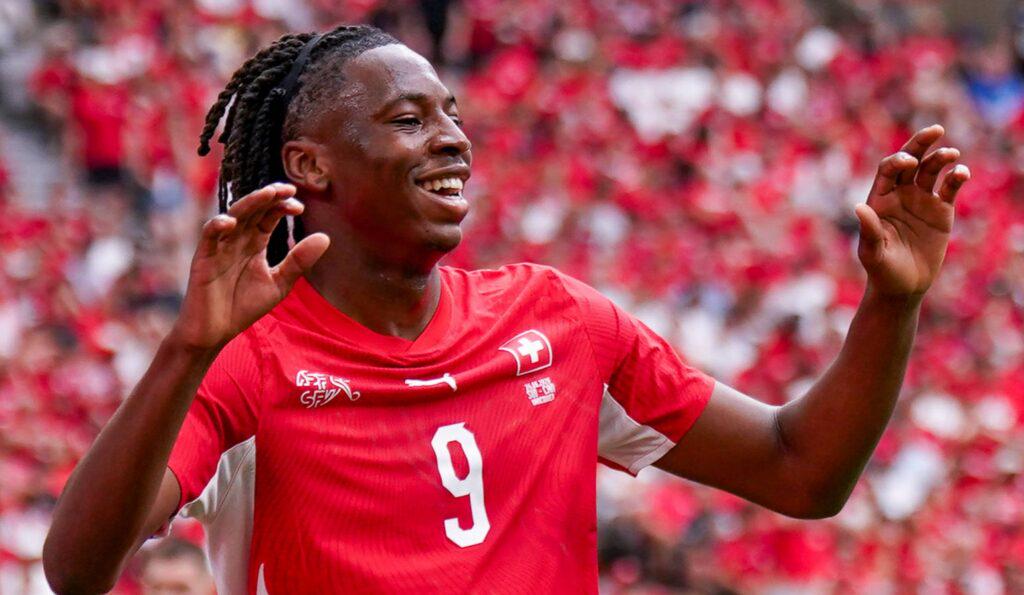


















There are World Cup stories that arrive as statistics, and others that feel like chapters in a national book. Johan Manzambi belongs to the second kind. At twenty years and two hundred sixty-one days, the SC Freiburg midfielder has turned a Swiss summer into something larger than a hot streak: five goal involvements in the group stage alone, three goals and two assists, and a place in the tournament’s historical ledger as the youngest player to reach that mark since nineteen sixty-six.
For Switzerland, the numbers matter because they sit beside a milestone the country has chased for generations. The Nati secured their first knockout-round victory at a World Cup since nineteen fifty-four, and Manzambi stood at the center of the run that made it possible. In a competition where identity is often debated in cafés from Zurich to Lugano—Are we pragmatic? Are we brave? Can we finish?—he has offered a fresh answer written in movement, timing, and composure.
The Weight of Swiss World Cup Memory
Swiss football carries a particular kind of patience. The nineteen fifty-four quarterfinal in Switzerland remains a reference point not because it ended in glory, but because it proved the nation could belong on the grandest stage. Since then, knockout football at the World Cup has been the line Switzerland struggled to cross: close enough to feel familiar, distant enough to become folklore.
That is why Manzambi’s emergence reads differently from a ordinary breakout. He is not merely producing; he is attaching himself to a national narrative that predates him by seventy years. When a player from SC Freiburg—a club rooted in the Black Forest borderlands where Swiss and German football cultures meet—starts deciding World Cup nights, the symbolism is difficult to ignore. Freiburg’s football is often described as disciplined, collective, and quietly efficient. Manzambi has imported that temperament into a Swiss shirt and added something rarer: a forward’s instinct in a midfielder’s role.
Ranked nineteenth in the latest FIFA standings, Switzerland entered this tournament with credibility but also with old questions about whether their technical security could become cutting edge when the margins tightened. Manzambi has helped shift that conversation from theory to evidence.
Record Pace Built on Simple Habits
Breakouts at major tournaments are sometimes described as lightning strikes. Manzambi’s work suggests otherwise. His influence is built on repeatable habits: running off the shoulder, attacking space before defenders settle, and keeping his first touch clean inside the penalty area. The end product has followed naturally—three goals and two assists arrived not as isolated flashes, but as the logical outcome of how he plays.
Decision-making has been the hidden layer. For a twenty-year-old listed as a midfielder, he has shown unusual maturity in choosing when to drop and connect build-up and when to remain high and pin center backs. That balance has opened passing lanes for Switzerland’s creators and created a kind of sustained pressure that accumulates across ninety minutes rather than appearing in isolated bursts.
To become the youngest player with five World Cup contributions since nineteen sixty-six is not a trivia note; it is a statement about consistency under global scrutiny. The tournament’s history is full of young talents who shimmer for an hour. Manzambi, by contrast, has returned again and again with match-shaping contributions.
Round Two: Changing the Tone Against Bosnia and Herzegovina
The clearest illustration came against Bosnia and Herzegovina in the second round of group play. Manzambi entered from the bench and altered the emotional temperature of the match within minutes. Over a nineteen-minute burst, he scored twice—first with a sharp near-post finish, then with a composed strike from the edge of the area that displayed two distinct sides of his finishing profile.
Bosnia arrived as a side climbing the rankings, recently improved to sixty-fifth in the world after moving up six places. They are organized, physically committed, and difficult to unlock once they settle into a low block. Manzambi did not beat that structure with complexity; he beat it with timing. By repeatedly stretching the back line, he forced a defense that had been comfortable to make repeated adjustments until it could not.
Switzerland closed the game in control, and the broader significance was unmistakable: a young substitute had not merely helped win three points, but had demonstrated that the team could change shape and rhythm through individual intervention without losing collective discipline.
Round Three: A Complete Forward’s Display Versus Canada
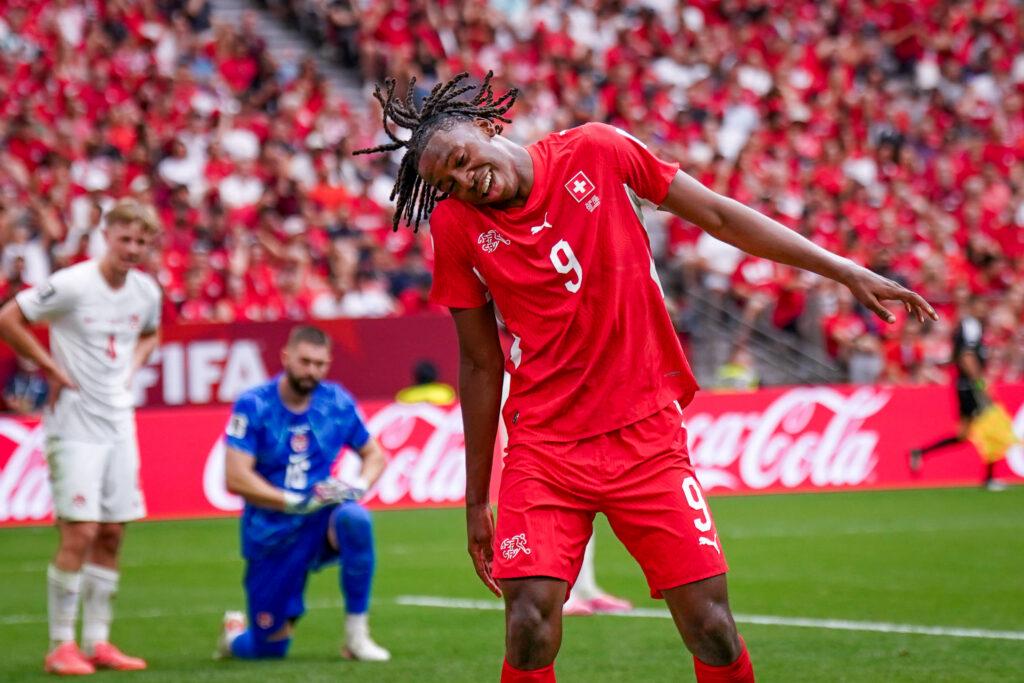
If Bosnia revealed his explosiveness, the meeting with Canada revealed his range. Manzambi produced one goal and one assist across eighty-five minutes in a performance that resembled a complete forward’s outing rather than a midfielder’s cameo. Canada, ranked thirtieth globally and among the most athletically dynamic sides in the CONCACAF region, presented a different test: more space in transition, more urgency in duels, more demand for sustained involvement.
The assist underscored his patience. Rather than forcing the moment, he held his ground in the box, waited for the defensive line to commit, and slid the final pass at the exact instant a teammate became free. The goal, a clean right-footed finish, followed a selfless decoy run moments earlier—a detail that matters because it shows Manzambi understands that World Cup production is often built on actions that never appear on a scoresheet.
Working for most of the match, he linked phases, pressed intelligently, and maintained the same calm in the final third that had defined his earlier appearances. Against a Canadian side that has spent years trying to convert athletic promise into tournament reliability, that level of maturity stood out.
Culture, Club Identity, and National Possibility
Manzambi’s path also illuminates how modern Switzerland draws strength from cross-border club development. Freiburg’s identity—structured, hard-working, tactically literate—maps neatly onto the Swiss football ethos that supporters recognize even when results fluctuate. Yet what Manzambi adds is vertical threat, the kind of quality that transforms secure possession into genuine fear.
In Swiss sporting culture, breakout figures often become more than athletes; they become shorthand for a generation’s ambitions. Xherdan Shaqiri’s era brought flair and directness. Granit Xhaka’s leadership brought edge and standards. Manzambi’s early World Cup footprint suggests a different emphasis: intelligent movement, efficient finishing, and a sense that the team can grow through him rather than only around him.
That matters because Switzerland’s best international periods have usually coincided with one player who makes the extraordinary feel routine. Manzambi is not yet at the end of that story; he is at the opening pages. Still, five involvements before the knockout threshold is the kind of beginning that forces historians to pay attention.
Knockout Football and a Line Crossed
The broader arc of Switzerland’s tournament cannot be separated from Manzambi’s influence. Securing a first knockout victory since nineteen fifty-four is, in sporting terms, the crossing of a psychological border. Knockout football compresses time: one lapse becomes a winter of regret, one inspired half-hour becomes legend.
Manzambi has already lived inside that compression. His contributions have arrived in clutch phases—off the bench when the rhythm needed changing, then as a starter when the team required a full ninety-minute presence. That versatility is precious in elimination football, where substitutions and game states shift quickly and youthful players often shrink.
Switzerland’s group-stage metrics reflected a team capable of winning without dominating possession entirely—an identity that suits knockout scenarios where pragmatism and precision often outweigh spectacle. Manzambi has become the player most likely to convert that identity into decisive moments.
What Comes Next
The tournament now enters a corridor where individual brilliance is tested against the deepest collective experience on the planet. Manzambi will face defenders who have spent careers studying exactly the spaces he attacks. He will face fatigue, tactical attention, and the quiet pressure of being the player an entire nation begins to expect things from.
None of that diminishes what has already happened. A twenty-year-old from Freiburg has tied himself to a Swiss World Cup record untouched for sixty years and helped end a knockout drought that stretched back seven decades. Whether this becomes a single luminous chapter or the start of a longer era will depend on the nights still to come.
For now, the story is clear enough to read without embellishment: Switzerland have found a young midfielder who plays with the timing of a veteran and the courage of someone who does not yet know what cannot be done. In a World Cup defined as much by memory as by matches, that may be the most dangerous quality of all.