
















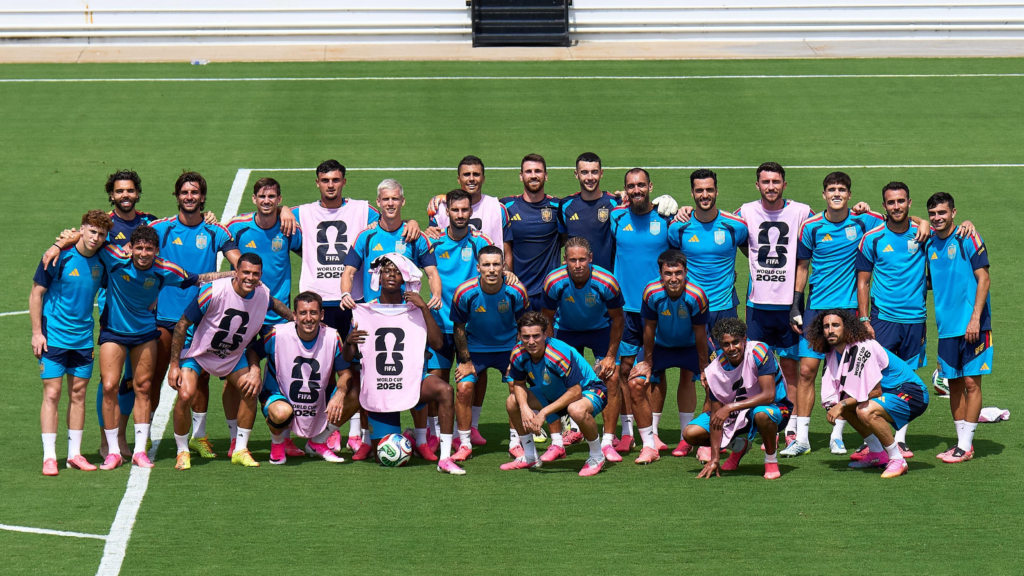
Spain will kick off their 2026 World Cup group-stage campaign at Mercedes-Benz Stadium in Atlanta, USA, with Cape Verde as their opening opponent. Our reporting from the ground suggests that on this Group H night, the indoor venue with a capacity of roughly 71,000 should help keep the tempo and passing quality at a high level — for Luis de la Fuente's side, which stresses the blend of possession and movement, the playing conditions themselves count as an advantage.
First meeting in the record books as two footballing traditions collide
This is the first official meeting between the two sides on the international stage. Spain have long sat at the heart of title talk, ranked second in the FIFA world rankings; despite a recent one-place dip, their 1876.40 points still reflect their depth. Cape Verde arrive as world No. 67, with around 1366 points and little movement in the rankings, yet they have consistently excelled at dragging stronger opponents into their own rhythm. With no previous meetings to draw on, every tactical assumption can only be built on recent form — which may not be a bad thing for Cape Verde; unfamiliarity is sometimes harder to break down than video analysis.
Recent form: possession habits and seizing the initiative in the first half
The trends clearly favour Spain. Unbeaten in their last 10, having scored first in nine of those — pulling the match into a possession groove before layering on pressure has become a steady output under de la Fuente; in five of their last seven, total goals topped 2.5, with midfield link-up and chance creation both firing. Cape Verde are no passive victims: riding a three-match winning streak, they took the lead before half-time in four of their last five, habitually protecting what they have before squeezing space. On discipline, Spain have seen fewer than 4.5 total yellow cards in eight of their last 10, and fewer than 10.5 corners in five of their last six — on neutral ground, the outcome is more likely to be shaped by quality of possession than a scrappy, open battle.
Formation and Personnel: The Pecking Order in a 4-2-3-1
Both sides are expected to line up in a 4-2-3-1. Spain's goal will be guarded by Unai Simón, with Marcos Llorente and Pau Cubarsí among those forming the centre-back pairing, balancing build-up play and recovery runs to provide a safety net for overlapping runs down the flanks. In recent years, De la Fuente has deliberately worked promising youngsters from club academies into the national team setup; defenders like Cubarsí, who can step forward and also drop back to cover, are exactly the extension of the "possession plus movement" approach on the back line. Cape Verde under Bubista likewise emphasise compact positioning out of possession; in their 4-2-3-1 variant, the width of coverage from the double pivot will directly determine whether they can cut off Spain's passing through the half-spaces.
The Tactical Chess Match Between De la Fuente and Bubista
De la Fuente's task is straightforward: use an opening win to seize the initiative in the race to qualify from Group H. If Spain continue their habit of "score first, then control the game," the window between the 15th and 30th minutes of the first half will be critical—and Cape Verde are particularly adept at making fast starts in that period. Bubista, meanwhile, needs to turn the confidence from three straight wins into 90 minutes of execution, rather than producing only one strong spell. Jordanian referee Adham Muhammad will take charge; both teams have picked up relatively few yellow cards recently, and if the officiating is lenient, the more technically adept side will find it easier to run their passing patterns smoothly.
Qualification Pressure and Key Points to Watch
The 2026 World Cup will be jointly hosted by the United States, Canada, and Mexico. Outside the host-nation framework, Spain remain the default favorites to pick up points in Group H; Cape Verde know their window — whether they can pose enough of a threat in the first 45 minutes will decide if they can keep the upset narrative alive into the closing stages. According to information we have, a Spanish win would give them both a psychological and points edge heading into the rest of the group stage; if Cape Verde can hold them to a draw or even pull off an upset, the entire Group H picture would be reshaped immediately.
From a squad depth and tactical perspective, this opening match is also a litmus test for De la Fuente to assess how well his blend of established core players and new faces works: Simón's distribution, Llorente's vertical coverage, and Cubarsí's positioning choices will all come under sharper scrutiny under pressure. For Cape Verde, whether they can replicate their recent habit of leading at half-time on the World Cup stage is the key metric for judging whether they can repeat their history of punching above their weight. Before kickoff, all the pre-match talk will come down to 90 minutes — a neutral venue, the highest stakes, and whoever executes their game plan to the end will be closer to seizing the initiative in Group H.