








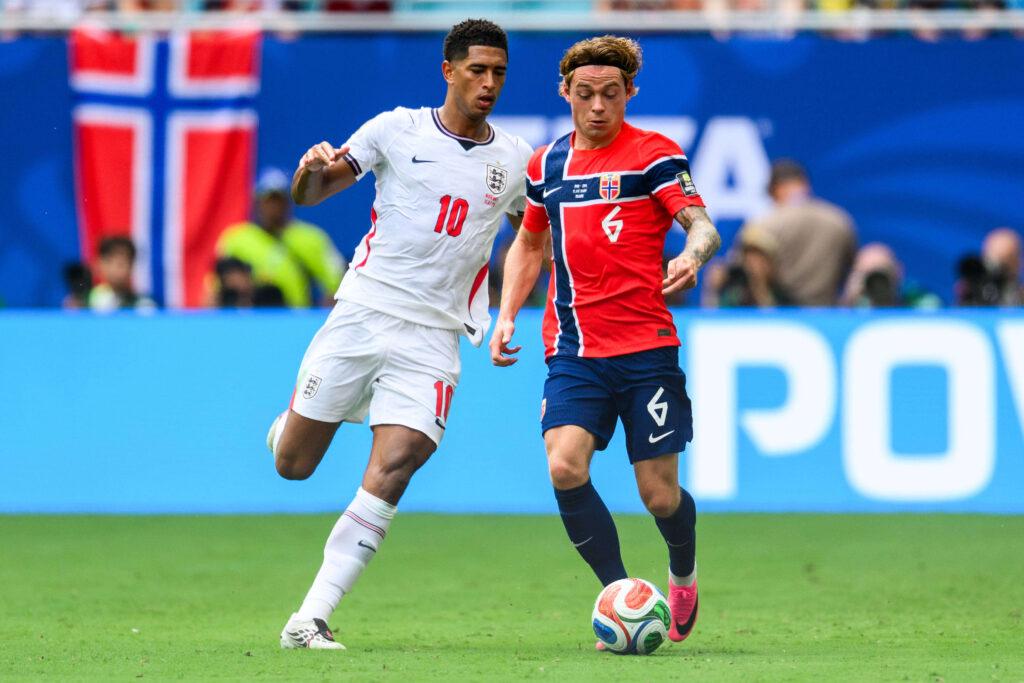
The lights over Hard Rock Stadium in Miami Gardens did more than illuminate a World Cup quarterfinal at the break. They turned a 1-1 scoreline into a visual duel between two national football identities, each carrying its own apparel story onto one of the tournament's loudest stages.
Norway moved ahead through Andreas Schjelderup in the 36th minute, a reminder that sharp movement and calm finishing can outshine possession charts. England answered in the second minute of added time through Jude Bellingham, converting the half's only officially logged big chance and shifting the emotional temperature of the room just before the teams headed for the tunnel. At halftime the numbers sat at 1-1, but the look of the match told a wider story: compact Scandinavian transitions against England's structured control, with two distinct kit languages sharing the same humid Florida night.
England, operating in the streamlined Nike ecosystem that has long defined the national side's sideline and retail presence, lined up in a 4-2-3-1 under Thomas Tuchel. John Stones and Marc Guéhi built calmly from the back, Declan Rice connected the lines, and the high stepping of Ezri Konsa and Nico O'Reilly stretched the shirt's graphic lines into moving geometry across the final third. With 68% possession, 355 passes and 337 accurate deliveries, England owned territory and logged 40 final-third entries. Yet the visual authority did not fully translate into box threat. Three crosses came off nine attempts, only two shots found the target, and the half finished with a sense of control waiting for a sharper editorial finish.
Norway arrived with a contrast-heavy national kit identity and a game plan built to make every burst count. Ståle Solbakken's 4-3-3 lived in a compact mid-block, then punched forward when Alexander Sørloth, Erling Haaland and Schjelderup could play early into feet. They held only 32% of the ball, but produced four shots inside the box to England's two and led expected goals 0.34 to 0.22. Sander Berge and Patrick Berg screened with discipline, helping a back four combine for 11 tackles and 10 clearances. Norway also won the invisible precision contest of the half, catching England offside three times with line timing that felt as deliberate as any tailored silhouette.
The opening goal carried its own subplot. Norway's strike blended craft with English error, with Martin Ødegaard supplying the assist and Schjelderup finishing with composure for his on-target attempt. At 20, he wore the moment lightly, which is its own kind of quarterfinal statement. Bellingham's late reply carried the opposite brand energy sponsors chase at this level: deadline drama, clear narrative, and a celebration that reads cleanly on stadium screens and social feeds alike.
Set pieces added another layer to the texture. England won two corners to Norway's none, yet Norway read most second balls with the poise of a side trained to absorb pressure without looking frayed. That contrast, rhythm against directness, is the split World Cup campaigns are built around. One team sells continuity and star presence. The other sells surprise, youth, and the thrill of winning the cleaner chance on fewer touches.
Halftime in Miami therefore felt less like a conclusion than a wardrobe change between acts. The global crowd, the Hard Rock lighting rig, and kits engineered for broadcast close-ups all amplified a game still finely poised. Norway can point to the sharper looks in the box. England can point to the territorial canvas and the late equalizer that reframed the half. In a tournament where image and intent travel together, this was a draw that left both sides looking as if they still had something memorable to unveil after the break.