
















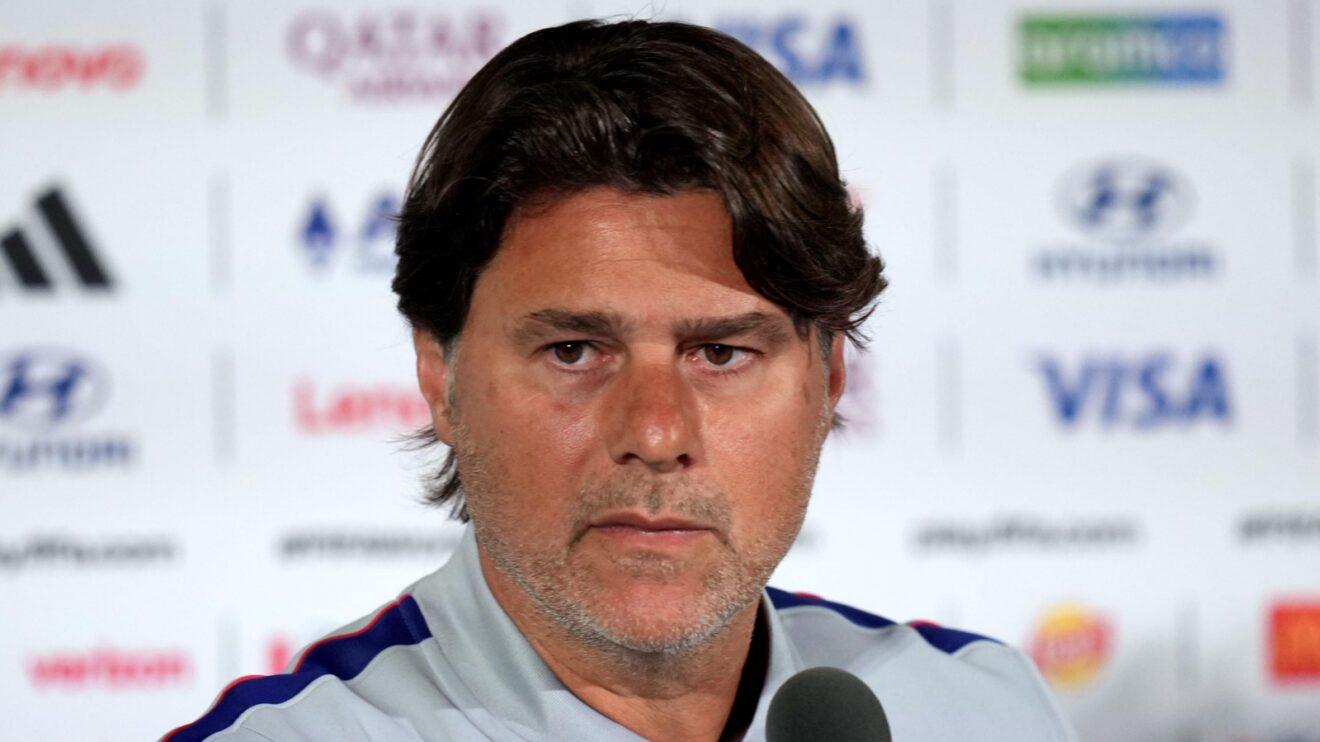
In the closing stage of the World Cup group stage, emotions inside and outside the stadium often fall out of sync. For U.S. men's national team head coach Mauricio Pochettino, the gap on this night was especially concrete: with his team having already secured top spot in their World Cup group, they were beaten at the death by already-eliminated old rivals Turkey thanks to a late winner from Kaancan Ayhan; yet at the post-match press conference, what truly left him unable to sit still was that reporters did not immediately offer congratulations for finishing first in the group.
Pochettino, usually known for his composure, clearly lost patience during the Q&A after the Turkey match. Based on the pre-match situation, the United States had already guaranteed top spot with a 4-1 win over Paraguay and a 2-0 victory over Australia; though Turkey had no chance of advancing, they fought until the final minute and took all three points. The sporting outcome was clear, and the qualification task had been completed well before this game — yet in Pochettino's view, the reaction in the media section did not match that fact.
"Turkey are celebrating three points, Australia and Paraguay are celebrating qualification, and you don't congratulate us for winning the group — that's really disappointing," he said into the microphone. "I have to remind myself: we won the group. Sorry, everyone."
Looking out from the bench, these remarks both affirm a stage-by-stage objective and reveal a long-overlooked demand: when a team crosses the line first in a tough group, the head coach wants the outside world to see and acknowledge that achievement—not focus only on the loss in the final match. As one of the hosts, the United States already faces more scrutiny; Pochettino’s emphasis on “we achieved our first goal” at this moment sounds more like a bid for the group stage as a whole to get the credit it deserves.
The dispute escalated in the follow-up Q&A. When a reporter asked about the team’s “fightback” after falling behind, Pochettino turned to the U.S. media officer, his tone puzzled and sharp: “They fought for 97 minutes, didn’t they? We competed for 97 minutes—not just the second half.”
That response reflects his insistence on the integrity of the match. What he drills in training day after day is usually sustained commitment over 90 minutes and stoppage time—not defining the whole team’s attitude from one stretch of play. Singling out a “second-half fightback,” to his ears, both oversimplifies the issue and undervalues the players’ overall effort on the pitch.
What made the press conference feel even “strange” was a question about “momentum”—with the knockout rounds approaching, would a stoppage-time defeat cost the United States its forward drive? Pochettino almost immediately shot back: “I don’t understand… what is momentum? Is it not getting yellow cards, or not taking risks with players who have issues? Did Germany”—which had lost to Ecuador earlier that day—“also lose momentum?”
He then listed what he saw as positives: the aim was to fight for first place, and the result was first place; everything could be viewed in a positive light. “Maybe I didn’t show it because your question was a bit strange.” He even said half-jokingly, “The atmosphere and feeling here confuse me… maybe tonight we go home and Turkey stays.”
Near the end, he returned on his own to that core grievance: “Nobody congratulated us on finishing first in a very difficult group!”
From the coach's perspective, such emotions are not entirely incomprehensible. The group stage is a short, high-intensity test: the big win over Paraguay (FIFA ranked 40th), the clean sheet against Australia (FIFA ranked 27th)—both delivered real points and confidence; losing the final match with the job already done, with tactical rotation, player protection and mental adjustment all part of the coaching staff's plan. Ayhan's last-gasp winner may have humiliated the hosts, but it did not change the name at the top of the group standings.
But the roles of the media and the coach are ultimately different. Reporters need to press on the details of the defeat, knockout-round risks and in-game decisions—not play cheerleader; Pochettino's plea for "congratulations," colliding with the reality of having just lost a match, was the entire tension of this press conference—one side affirming the journey, the other scrutinizing the final piece.
For the United States, the true test begins in the knockout stage. With first place in the group already secured, Pochettino may say they are not short on "momentum," but clearly he still wants the narrative to separate results from process: accept that they won the group, while staying alert to the stoppage-time lapses against Turkey. As for the friction at the press conference, perhaps in the pressure cooker of a World Cup, on qualification night, it was simply a coach, in his least composed way, demanding for his team that overdue but warranted recognition.