







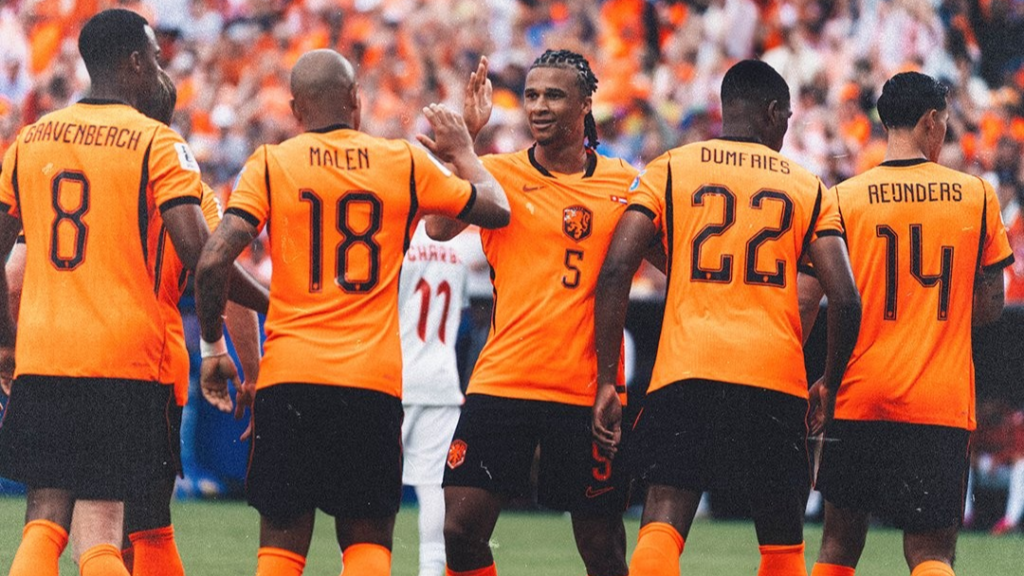
The Round of 32 at the 2026 World Cup moves to Monterrey, Mexico, where more than 53,000 seats at Estadio BBVA will witness a head-to-head clash between the Netherlands, ranked seventh in the FIFA rankings, and Morocco, ranked eighth. For Ronald Koeman, what truly needs to be settled before the whistle is not the starting lineup itself, but whether the Netherlands can deliver on their attacking promise and defensive discipline at the tournament’s do-or-die stage—the glow of ten goals in three group games shines bright, but the four conceded reveal gaps just as real.
Attacking blueprint proven; Koeman’s next chapter is defense
The Oranje stick with 4-3-3, totalling 40 shots and 20 on target in the group stage, with only one of five high-quality chances missed and 80% of goals coming inside the box. The 5-1 rout of Sweden and 3-1 win over Tunisia align with the numbers from the Tunisia match—71% possession, 20 shots, and an aerial duel win rate above 60%: Koeman has woven width, half-space penetration and high pressing into a single attacking grammar. Sixty-four crosses may not be elite in accuracy, but they land squarely on Morocco’s structural weakness—an aerial duel success rate below 50%. The problem is that behind the impressive passing success rate, the risk of being punished in transition always hangs overhead—with four goals conceded in the source data, Koeman cannot treat “score one more and we win” as the default knockout-round logic.
Morocco are not an opponent who only sit deep
The North African side opened in a 4-2-3-1 and often settled into a 4-4-2 without the ball. They controlled close to 60% of possession in the group stage, and in the 4-2 win over Haiti they produced 22 shots with 11 on target and 69% possession—matching their opponents in both aggression and efficiency. With pass completion rates approaching 90%, they were just as capable of squeezing the game into fine margins, which means Koeman cannot simply count on steering the rhythm back onto the Dutch possession template—breaking out of a compact block at pace is the weapon Morocco has proven time and again on the big stage. Separated by one place in the rankings yet united as possession disciples, the Monterrey fixture looks like a mirror: whoever finds the breakthrough in this reflected contest is more likely to pull the match into a rhythm they know.
Three Hard Choices Facing Koeman
First, the balance between attack and defense. European odds slightly favor the Netherlands at 2.25, with the draw at 3.00 and Morocco at 3.60; the Asian handicap has the Netherlands giving half a goal at equal odds with the underdog—the lines sit extremely tight. Koeman must draw a line between sustaining goal-scoring momentum and controlling risk on the counter, and not underestimate North African counterattacks because of group-stage firepower. Second, transitions and set pieces. The pitch plays fast; neither side racked up many corners in the group stage, but knockout tension turns every buildup from the back into a test of leadership—set pieces and second balls may be the low-cost route to break the stalemate. Third, discipline. Referee Pareira Sampaio’s career yellow-card rate runs high; Koeman needs on-field leaders to lock emotions into tactical discipline and avoid an ill-timed booking rewriting the entire tournament path.
More Than Just One Match
For Koeman, this is not merely a round-of-16 hurdle but a proof test at the World Cup knockout edge for managing the Netherlands: the attack already speaks Dutch, but the defense must learn Morocco’s resilience. The Netherlands’ recent twin 0-0 probes against Germany tested different attack-defense mixes; tonight against Morocco, what he must do is not write another attacking report but prove the Oranje can show grit at the line between life and death. Leadership is never written on the team sheet, yet always reveals itself after the first goal conceded—Monterrey tonight is about selection, but even more about composure.