
















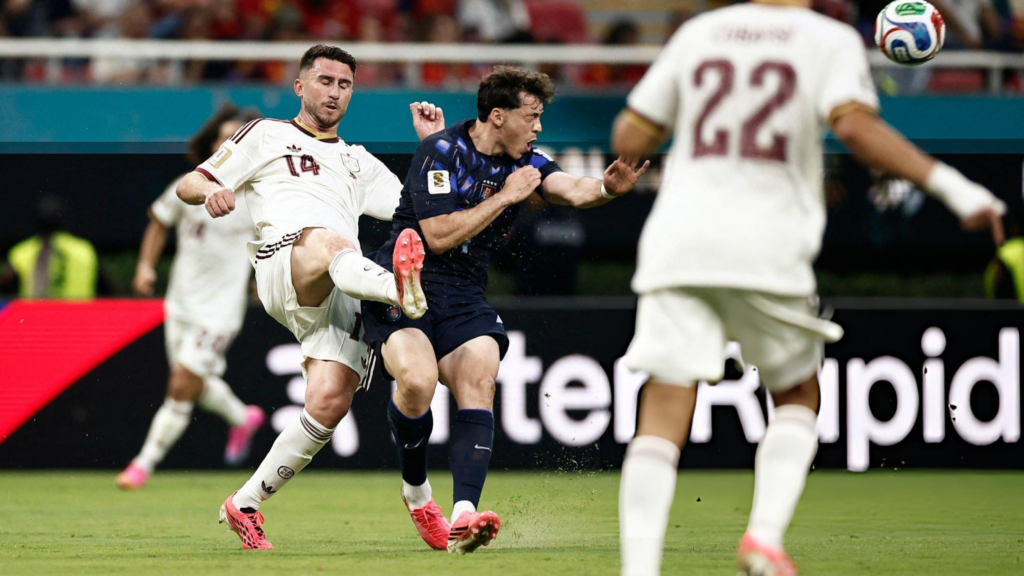
On this night in Guadalajara, the scoreboard finally read 0-1—Uruguay fell at home, and Spain left with all three points. For La Roja, ranked second by FIFA, this was not just another win in the 2026 World Cup group stage, but a practical answer to the question of how to keep control of a match when ahead. And the name at the center of that answer is Aymeric Laporte.
Why Laporte?
When a match reaches the stage where someone needs to “hold the tempo,” the head coach’s choice often matters more than a single shot. Spain lined up in a 4-2-3-1 here, with Laporte playing the full 90 minutes at center back and earning a ScoreZ rating of 7.8—in a tight 1-0 affair, that number reflects not just solid defending, but his near-constant involvement in the team’s decisions in transition.
By the numbers, Spain had 67% possession, 623 passes and an 89% completion rate; Uruguay had just 33% possession and 301 passes. Laporte personally completed 94 of 102 passes, including 58/62 in his own half and 36/40 in the opposition half, plus one key pass. His 117 touches made him the metronome of build-up from the back—this was not the style of a risk-taking center back, but the clear choice after going ahead: trading possession for safety.
Passing: risk control with a lead
At a critical point in the World Cup group stage, every pass out from the back is a decision. Laporte’s distribution was clear: short passes as the main route, long balls used sparingly (2 of 8 completed), with an xA of just 0.02, showing he was not blindly sending in threatening balls, but keeping Spain’s circulation going. That matched the state of the game perfectly—leading 1-0 called for stability, not recklessness.
41 carry advances totaling 386.66 meters, including 4 effective progressive carries. For a center-back, this was not showboating. When Uruguay dropped deeper and tried to create chaos through direct runs, Laporte used small, controlled carries forward to take pressure off the back line. Spain’s 6 shots and 1 goal were built on the back line holding firm first, which gave the front line room to breathe.
Defense: Maintaining Shape Against a Man-Down Opponent
Uruguay managed 5 shots with only 1 on target and ended up chasing an equalizer with 10 men after a red card. Laporte’s defensive contribution showed in the details: 5 of 6 duels won, 5 aerial wins, 8 clearances, 3 interceptions, and 2 ball recoveries. The 8 clearances were the most eye-catching number of the match—each time an opponent tried to exploit the second ball, he cleared with positioning and anticipation rather than a last-ditch tackle.
Discipline mattered just as much: only 1 foul and no yellow card. In the closing stages, when the opponent is a man down and emotions run high, center-backs are most likely to give away cheap set pieces through unnecessary fouls. Laporte’s approach was to read the play, hold his ground, and clear—Spain’s back line kept its shape, and the clean sheet followed naturally.
Decision-Making Sealed: Anchor Value Over Flash Moments
The fight in World Cup Group H will not end because of one 1-0. Spain had previously drawn 0-0 with England, the Czech Republic, and others; this time they finally took victory at minimal cost. Uruguay, after drawing 2-2 with Cape Verde in their first two group games, suffered defeat here. For Laporte personally, there was no thunderous goal or assist, but across 90 minutes every pass choice, every clearance timing, and every tempo control while leading together formed the full definition of an “anchor center-back.”
On the World Cup stage, teams often have no shortage of goal-scorers but lack someone who can steady the whole side in the crucial minutes. Laporte’s 7.8-rated performance proved that sometimes the right decision is simply not letting the match spiral out of control—and that is exactly the leadership Spain needs right now.