



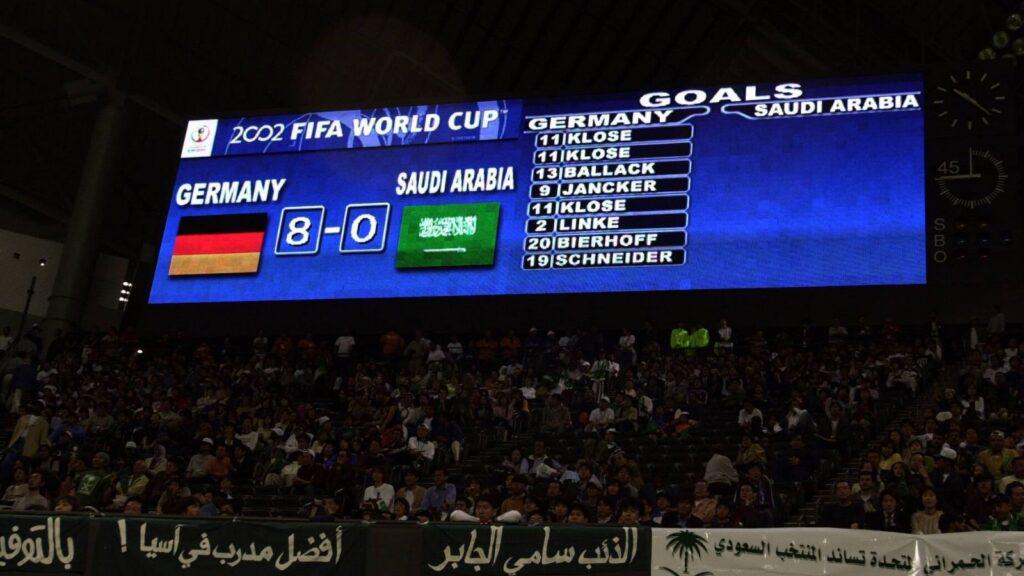
When fans talk about World Cup “massacres,” many still think first of that 7-1 in Brazil in 2014—Germany caught hosts Brazil cold in the semifinals. Yet by goal difference and the sheer lopsidedness of the scoreline, that iconic rout does not rank among the most brutal blowouts in World Cup history. Across twenty-two editions, group-stage matches and earlier formats have produced even more one-sided scorelines, each threading a story about fitness, schedules, and how teams developed in different eras.
1982: Hungary 10-1 El Salvador
The biggest single-game scoreline in World Cup history came in the 1982 Spain group stage—Hungary beat El Salvador 10-1. That Hungary side was long past the peak of the 1950s “Golden Team,” yet unleashed all their attacking firepower in one group match. Substitute Laszlo Kiss scored three goals in seven minutes, setting the record for the fastest World Cup hat-trick; ten goals in the match also etched his name into tournament history.
From a “schedule and recovery” perspective, such heavy scorelines often come in late group-stage games or matchups with huge gaps in quality: weaker teams playing on consecutive days, worn down by travel, while stronger sides turn a fitness edge into sustained pressure. Hungary won that match but then drew Argentina and lost to Belgium, and were eliminated in the group—proof that padding goal difference and actually picking up points to advance are never the same thing at a World Cup.
1954: Hungary 9-0 South Korea
At the 1954 FIFA World Cup in Switzerland, the Mighty Magyars led by Ferenc Puskás and Sándor Kocsis routed South Korea 9-0. South Korea endured a long journey to reach the tournament and arrived far from peak condition; Hungary, meanwhile, used the rout to showcase the depth of what was then the strongest national team in world football. They marched all the way to the final that year, only to be overturned by West Germany in the decider—emphasis on the scoreline underscored their quality, but it could not shield them from the twists of fate and nerves on the final day.
Put that record alongside the present day: South Korea currently sit 25th in the FIFA rankings with 1,588.66 points, drawing 0-0 in back-to-back matches against the UAE and Vietnam recently, with rotation and recovery emphasized amid a congested schedule; Hungary are ranked 42nd with 1,500.58 points, long removed from the side that ruled Europe in the 1950s, though the World Cup archives still hold their sharpest attacking chapter.
1974 and 1938: The Divide Between Nine Goals and Eight
In the group stage at the 1974 World Cup in West Germany, Yugoslavia beat Zaire 9-0 in one of the most lopsided performances in tournament history. Off the pitch, there was further drama: after the defeat, Zaire's leadership reportedly warned players in harsh terms that another heavy loss to Brazil would carry serious consequences. Yugoslavia used that goal-difference edge to finish top of the group ahead of Brazil on goal difference—a rout can reshape the standings directly, and that is not uncommon in World Cup group play.
Going further back, at the 1938 FIFA World Cup in France—the last edition before World War II—Sweden beat Cuba 8-0, likewise ranking among the biggest scorelines in history. The format, travel demands and single-elimination pressures differed from today, but the logic of weaker sides running on empty while stronger teams keep finding the net has stayed the same.
Editor's view: Why a rout rarely equals a title
Looking at these blowouts, the pattern is clear: most came in the group stage or early rounds, with opponents badly mismatched in quality or preparation; what really shapes the title race remains stability in the knockout rounds and execution in the matches that matter. Germany's 7-1 win over Brazil in 2014 keeps being cited because the stage, the opponent and the emotional shock were all at their peak—yet on the numbers alone, it still does not crack the front rank of the biggest margins in history.
For modern fans, these records are more like a mirror: Germany are currently ranked 10th by FIFA on 1730.37 points; Brazil 6th on 1761.16; Argentina 3rd on 1874.81; Belgium 9th on 1734.71—the identity of the elite shifts, yet the World Cup every four years still reminds the world that a 10-1 can make history without necessarily winning the trophy; development, fitness and fixture management are the long-term work that runs through training camps and a full tournament cycle.