

















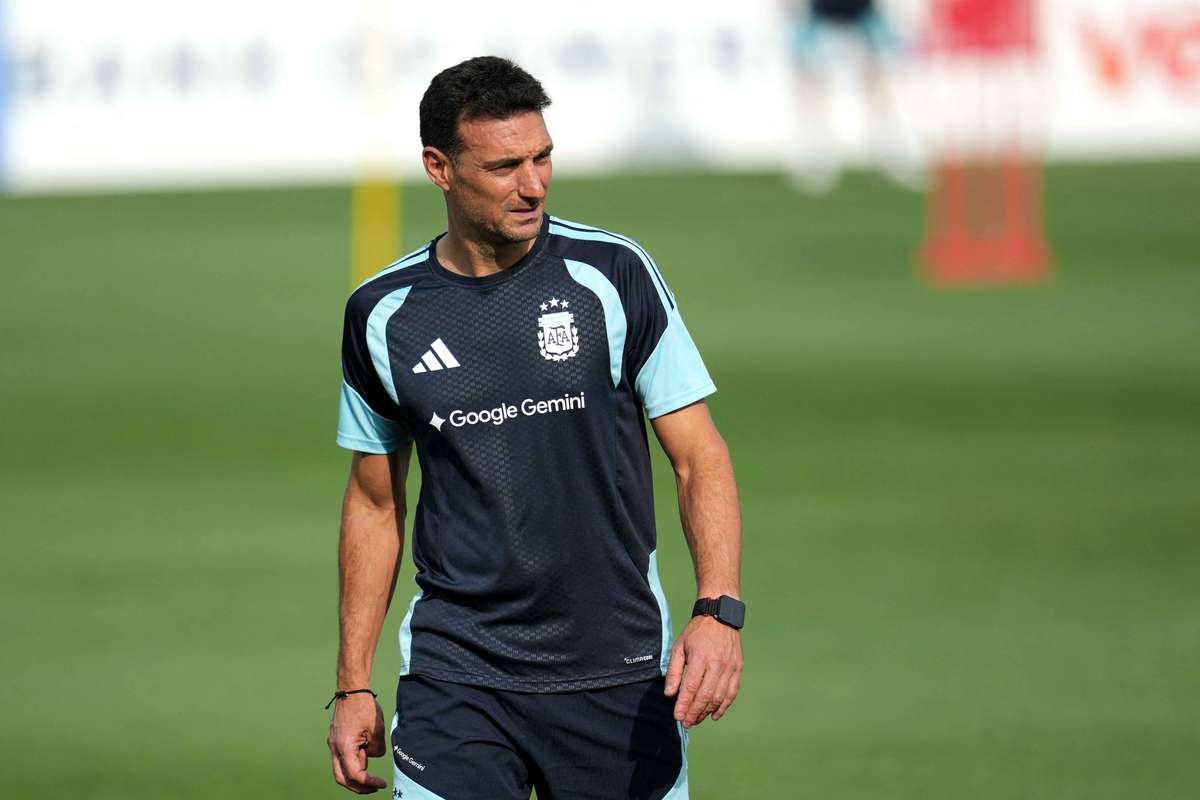
The entire Argentina squad returned to training on Monday ahead of Tuesday’s clash with Austria. On Wednesday, the team limited work to recovery in the gym, with all starters back in the fold. The choice up front remains the thorniest puzzle in Scaloni’s hands—against Algeria in the opener, Lautaro Martínez led the line as the center forward, with Julián Álvarez coming off the bench in the 55th minute; for the second game against Austria, who will spearhead the attack is still undecided.
Will the Qatar script repeat itself?
Before the tournament, Álvarez was widely seen as the more likely regular starter. Scaloni, however, put his faith in Lautaro for the curtain-raiser—a call that immediately recalled the 2022 World Cup in Qatar: back then, the Inter striker got the nod first as well, with Álvarez only gradually taking over as the main man up front from the third match onward, before going on to lift the trophy with the squad.
Scaloni confirmed before kickoff that the Atlético Madrid forward’s ankle issue had cleared and that he was fully fit to face Algeria. After the match, he did not dodge questions about rotation, instead highlighting Lautaro’s “incredible physical commitment” in the opener. In his view, a coach makes choices every day—who starts, who sits, who comes on, who gets hooked—it is part of building an 11-man unit that works as a whole, not simply indulging individual players’ desire for minutes.
A technical comparison of two striker templates
Reporting from our correspondent on the ground, the local press widely assessed after Thursday’s training session that Scaloni is more likely to turn to Álvarez than stick with Lautaro as the starting No. 9 against Austria.
In terms of movement efficiency and role distribution, the two are not a simple either-or—they represent two different attacking solutions. Lautaro is the archetypal penalty-area finisher: his touches come closer to goal, and his most reliable output is poaching and the final strike after holding the ball up with his back to goal. Álvarez has sharp instincts in front of goal too, but his range of movement is noticeably wider—he can drop into the half-spaces to link play and add extra pressing intensity in the high press.
A former Argentina international who once played for Boca Juniors described the situation as a “happy problem” and “healthy competition”—when forward depth forces choices, that itself is proof of squad depth. To put it in scouting-report terms: Lautaro’s strengths lie in finishing purity and box instincts; his limitation is a relatively fixed radius of movement. Alvarez’s strengths are running coverage, pressing contribution and system compatibility; his weakness is that he can sometimes be overly aggressive in choosing chances in front of goal, requiring more precise service from midfield.
Scaloni's Rotation Logic
For Scaloni, this is not a black-and-white case of “dropping” a player, but rather deploying resources according to the opponent, form and tactical needs. Starting Lautaro heavily in the opener reflected valuing his high-intensity off-the-ball runs and front-line pinning; bringing on Alvarez after half-time tilted the rhythm toward more flexible high pressing. If Alvarez starts again against Austria, the logic is equally clear: against an opponent likely to emphasise physical duels and vertical progression, the front line needs someone who can drop deep, drift wide and create chaos at the first line of defence.
From a fitness-management angle, splitting a roughly 60-minute “impact burst” from a late-game “tactical twist” under a run of games also fits common thinking across a major tournament. Neither Lautaro nor Alvarez lacks big-tournament experience; the real test is whether Scaloni can, as in the Qatar cycle, quickly lock in the combination best suited to the current phase through trial and error.
Back-Line Variables Also Shape the Starting XI
Beyond the forward debate, Argentina’s right flank also holds uncertainty. Against Algeria in the opener, Gonzalo Montiel started while regular first choice Nahuel Molina came on at half-time. On the left, Nicolás Tagliafico’s fitness is in doubt due to a calf injury; Facundo Medina deputised at left-back in the opener—the Argentine FA said on Wednesday that Tagliafico has returned to training and his recovery is trending positively.
Small adjustments at the back will in turn shape the front-line selection. If the left flank continues to be manned by understudies, and the right requires Nahuel Molina to provide extra attacking width, the front line will need more of a striker in the Julián Álvarez mold—one who can drop deep to help midfield and relieve pressure down the flanks; conversely, if Nicolás Tagliafico returns in time and the wide play regains stability, a more pure penalty-area focal point like Lautaro Martínez stands a better chance of receiving quality service inside the box.
Key observations ahead of the Austria clash
Monday's meeting with Austria will be Argentina's second outing in Group J. Lionel Scaloni must both build winning momentum and use the limited minutes available to road-test the effectiveness of his two front-line and wide-play setups.
This site assesses that Álvarez's chances of starting are rising, but Lautaro Martínez will not be pushed to the margins—his relentless work rate and finishing remain Scaloni's most reliable trump card. What truly merits continued tracking is whether Scaloni will again replicate the Qatar-cycle's incremental approach: letting Lautaro open the contest before handing the tempo to Álvarez, or whether he will flip that sequence in the second group game. Behind the enviable front-line dilemma lies a tactical question Argentina must answer correctly on its path to defending the title.