







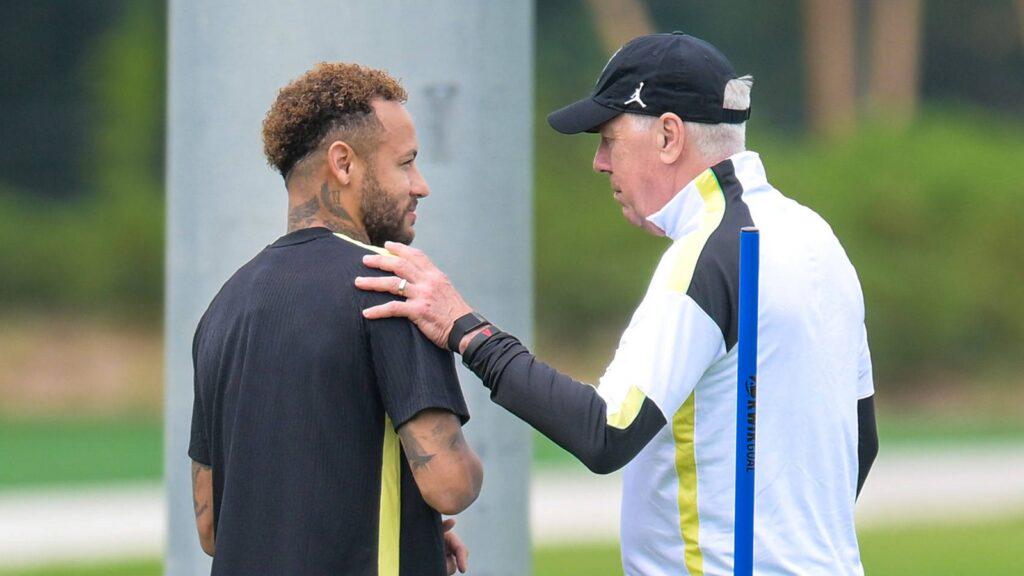
Before Brazil's final group-stage match at the 2026 World Cup, the team received mixed news: No. 10 Neymar's recovery from a right calf injury is accelerating, with head coach Carlo Ancelotti setting a return timeline; meanwhile, winger Raphinha left early during the match against Haiti due to discomfort in his right hamstring, and his availability for the clash against Scotland remains uncertain.
Final-Round Must-Win: Brazil Face Scotland in Miami
At Beijing time on June 25 (local time Wednesday, June 24), Brazil will face Scotland in Miami in the final group-stage match. After one win and one draw in their first two games, the Selecao still need points in the last round to secure qualification and build momentum heading into the knockout stage. Their 3-0 victory over Haiti showed a smoother attacking rhythm, but injury concerns are thinning out their forward depth.
The 2026 World Cup is co-hosted by the United States, Canada, and Mexico. As a non-host nation, Brazil already face a heavier schedule and travel burden. Moving to Miami for the final group game raises the bar for players' physical recovery given the heat and humidity—a key factor in assessing whether Neymar and Raphinha can truly be match-ready upon return.
Neymar: Back with the Squad After Individual Training
Since arriving in the United States with the squad, Neymar has been sidelined with a right calf injury. While the team traveled to Philadelphia to face Haiti, he remained in New Jersey to continue his rehabilitation, training at the Brazil team hotel and the New York Red Bulls facility along a phased, load-monitored recovery plan.
After the win over Haiti, Ancelotti updated Neymar's status: he will complete an individual training session on Saturday, rejoin full team training on Monday, and target a return against Scotland. If the plan holds, it would mark Neymar's first appearance of the tournament—a direct boost to Brazil's attacking organization, ball progression in the final third, and set-piece threat.
From a tactical standpoint, Neymar's return means Brazil can once again establish the "hold-and-attract plus weak-side switch" connection through the middle and in the half-spaces. His first-step burst, ball protection and turning, and final pass remain among the most dependable technical weapons Brazil have for unlocking compact defenses. Equally important, though: the calf muscle group carries a significant risk of recurrence after sustained high-intensity action. His first game back is more likely to involve managed minutes and a gradual return to match rhythm rather than an immediate full 90 minutes.
Raphinha: Fourth Hamstring Scare
Against the more positive news around Neymar, Raphinha's situation looks significantly more worrisome. In the first half against Haiti, he felt discomfort in his right hamstring during a run that helped produce the team's second goal, and was later replaced by Reinan. Post-match, the medical staff arranged imaging to assess the severity of the injury.
The extra caution inside the squad is no accident: over the past 12 months, this is already Raphinha's fourth recorded hamstring-related problem. Repeated issues in the same area often point to a structural tension between load management, sprint frequency, and recovery cycles—for a winger whose game is built on repeated off-the-ball sprints and cut-inside finishes, that almost directly determines whether his tactical value can be delivered consistently.
Reinan came off the bench against Haiti and offered pace on the flank as an alternative. If Raphinha misses the Scotland match, Brazil's right-sided attack will probably redistribute roles between the "fixed starter" and the "impact substitute," with corresponding tweaks to fullback overlap depth, second-ball battles in the half-spaces, and conversion speed.
Qualification Picture and Squad Chess
The final group-stage fixture is never just about the arithmetic of qualification; it is also a lineup trial window before the knockout rounds. If Brazil can beat Scotland in Miami, they can not only resolve the qualification picture as early as possible but also give returning stars like Neymar a genuine match environment rather than leaving every fitness test until the Round of 16.
Up front, Vinícius Júnior chipped in with a goal and an assist against Haiti and remains Brazil’s most reliable attacking outlet at the moment; if Neymar returns, ball distribution among the front three (or the dual-core-plus-striker setup) and pressing-and-tracking distances will be the focus of Ancelotti’s next two or three training sessions. If Raphinha is unavailable, depth on the right may rely more on overlapping full-backs and midfield runs from deep, with the attack tilting toward central overloads and strong-side combinations down the left.
From a fitness and medical standpoint, Brazil’s medical staff need to complete imaging and return-to-play risk assessments on Raphinha within 48 to 72 hours, while continuing to monitor Neymar’s muscular response after individual training. The two timelines run in parallel—Monday’s full-team session is the shared checkpoint: on one side, whether he can make the squad; on the other, how many minutes he can manage.
Our Take: Return Window and the Injury Ledger
If Neymar features against Scotland, his value goes beyond goals and assists—he would pull Brazil’s front line back onto a system built around a central ball-carrying hub; yet his comeback appearance should be judged on efficiency rather than numbers, with 20 to 30 minutes of quality touches a better long-term bet than forcing a full 90.
Raphinha’s situation looks more like a running injury ledger: a fourth hamstring alert suggests that even if he makes this round, Brazil must plan rotation and workload ahead for the high-intensity knockout schedule. For Ancelotti, the final group game against Scotland is not just a qualification match—it is a chance to test medical decisions and squad flexibility at genuine World Cup pace. Whoever arrives in Miami with a body that is actually ready to play is more likely to lock down a starting spot in the knockouts.