

















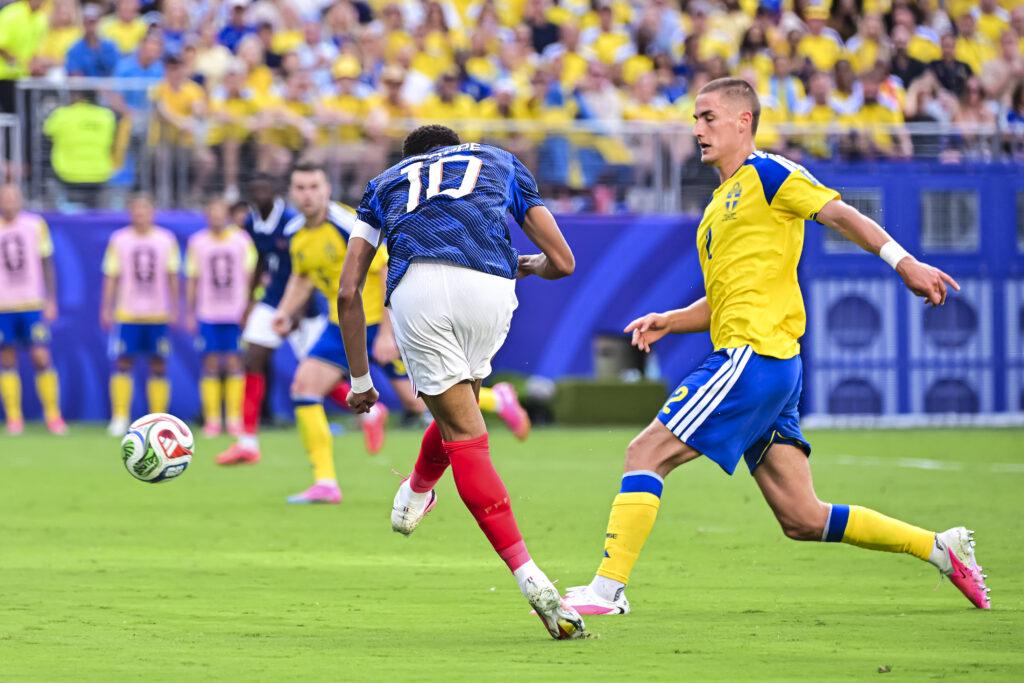
The difference between a team that survives the group stage and one that pushes deep into a World Cup often shows up long before the final scoreboard settles. It appears in the rhythm of a match: how often a side forces the goalkeeper into a save, how quickly danger arrives after a turnover, and whether the best attackers are testing the target with intent rather than hope.
At this tournament, five names have separated themselves on that front. Using current World Cup averages for shots on target per match, Kylian Mbappé, Lionel Messi, Erling Haaland, Harry Kane, and Vinicius Junior form the clearest shooting tier in the competition. They do not share the same role, body type, or route to the box. What they share is a habit of making keepers work early and often — and that habit is one of the most reliable predictors of knockout-round staying power.
Why shot quality and volume matter more than raw possession
Possession can flatter a side that never breaks the last line. Shots on target rarely do. A high on-target rate signals discipline in chance selection; high volume signals a player who repeatedly earns repeatable looks. The five attackers on this list combine both traits in different proportions, which is why they deserve attention as a group rather than as isolated headline acts.
France sit atop the FIFA rankings at No. 1, Argentina at No. 3, England at No. 4, Brazil at No. 6, and Norway at No. 31. That spread matters. Three of these shooters operate inside nations built to control phases of play and funnel service toward elite finishers. Two — Haaland and, in a different way, Vinicius — carry the burden of turning limited touches into decisive moments. Reading their shot maps is therefore reading two different tournament philosophies: sustained pressure versus explosive conversion.
Kylian Mbappé: speed, volume, and placement under pressure
Mbappé’s profile is built on speed into space and ruthless placement. He is averaging 3.3 shots on target per match at this World Cup, with 68% of his attempts testing the goalkeeper. That pairing of volume and accuracy is rare for a wide forward operating in transition-heavy minutes.
The pattern is familiar but difficult to stop. He starts wide left, attacks the half-space at pace, and cuts inside onto his right foot to shoot across the keeper. When defenders overplay the far post, he adjusts to the near side. Expect roughly five total attempts per game, many arriving from left half-space breaks or quick one-twos at the edge of the box.
For France, that output is not a bonus — it is the structural release valve for a team that can dominate territory without always piercing compact blocks. Mbappé also contributes from dead-ball situations, taking penalties and stepping in on free kicks when the angle suits him. The conclusion is straightforward: when France need a moment to tilt a tight knockout tie, his shot volume is the most reliable lever they have.
Lionel Messi: precision, timing, and the cost of marking him
Messi’s numbers are powered by precision rather than repeated sprints. He averages 3.0 shots on target per match with a 72% on-target rate — the highest accuracy in this group. That reflects a player who selects moments rather than lanes, then strikes with minimal backlift through traffic.
Most of his looks originate from the right half-space, where he shapes left-footed curlers or drives low through bodies. Because he draws multiple markers, his personal shot volume arrives alongside secondary chance creation: defenders shift, space opens elsewhere, and Argentina’s supporting runners benefit even when Messi does not score.
Argentina enter the tournament ranked third globally, and their attack still orbits his decision-making in the final third. Roughly four to five total attempts per game is a realistic expectation, many from clean sights just inside or outside the box. The deeper judgment is that Messi’s shooting efficiency lowers Argentina’s requirement for territorial dominance. They do not need 65% possession to feel dangerous; they need Messi to receive in the half-space with time to pick the gap.
Erling Haaland: penalty-box gravity and first-touch finishing
Haaland lives in the penalty area and treats every touch as a potential finish. His World Cup average stands at 3.0 shots on target per match with a 65% on-target rate — numbers that underline how little he needs to create major danger.
His shooting is built on movement off the last defender’s shoulder and first-time finishes from crosses, cutbacks, and loose-ball scrambles. He does not require elaborate build-up. One diagonal run, one service, one contact — and the chance is real. That profile fits a Norway side ranked 31st in the world, where phases of control are less guaranteed and the No. 9 must convert sparse service into sustained threat.
The tactical read is clear: Haaland’s shot volume is Norway’s clearest path to staying competitive against higher-ranked opponents. If service arrives, he will test the keeper. If it does not, Norway’s ceiling drops sharply — which is why opposing coaches prioritize cutting lanes to him even when they concede space elsewhere.
Harry Kane: link play that still ends in shots
Kane belongs on this list because his role at the World Cup blends traditional center-forward finishing with deep involvement in England’s rest defense and build-up. He is not merely a poacher waiting on the six-yard line; he drops, connects, and then arrives in the box when the final action is required.
England, ranked fourth in the world, structure much of their attack around Kane’s ability to hold play facing goal or peel into channels before turning toward the target. That dual function makes his shooting profile different from Haaland’s. Kane’s attempts often follow sustained possession sequences rather than single transition bursts. He shoots from deeper when the pass is on, and he finishes when service reaches the penalty area from wide overloads.
Without attaching fabricated per-match figures to his tournament line, the observable trend is consistent: Kane remains among the forwards most likely to combine chance creation with personal end product. For England, that versatility is essential in matches where wide players are marked tightly and the central lane becomes the only reliable route to a high-quality attempt.
Vinicius Junior: dribble volume turned into box entries
Vinicius represents the other end of the wide-forward spectrum from Mbappé — equally dangerous, but more often arriving at shots after beating a defender on the dribble rather than exploiting pure pace in straight lines. For Brazil, ranked sixth globally, his ability to turn isolation situations into attempts inside the box is a primary source of xG when central channels are congested.
His value in this shooting conversation is not only finishing but the frequency with which he forces defensive rotations. When Vinicius commits a fullback one-on-one, the entire back line adjusts. That movement creates secondary shooting lanes for Brazil’s interior players and rebound opportunities when keepers parry rather than hold.
Brazil’s tournament identity often depends on whether Vinicius can translate dribble success into repeated tests of the goalkeeper. When he does, Brazil look like a side capable of winning matches without needing 90 minutes of midfield control. When he is isolated and doubled, their attack narrows noticeably.
What separates this group in knockout football
The five profiles converge on one competitive truth: World Cup knockout rounds punish teams that create without finishing. Mbappé and Vinicius supply wide gravity and transition threat. Messi supplies elite efficiency in half-space pockets. Haaland supplies penalty-box concentration under limited touches. Kane supplies a bridge between build-up and final action for a possession-capable England side.
The practical takeaway for the next round
Track three indicators when these players are on the pitch: time from regain to first shot, percentage of attempts hitting the target, and whether chances originate from designed patterns or individual creation. Mbappé and Haaland should lead on quick-shot generation. Messi should lead on shot efficiency. Kane should show the highest share of attempts following multi-pass sequences. Vinicius should lead on box entries created after successful dribbles.
Final judgment
This is not a list of the only dangerous attackers at the World Cup. It is a list of the five whose shooting habits most consistently align with what knockout football demands: repeated tests of the goalkeeper, credible threat from multiple angles, and the ability to produce attempts even when the match tilts against their team.
France, Argentina, England, Brazil, and Norway arrive with different resources and different expectations. What these five share is the capacity to change a scoreline without waiting for perfect conditions. In a tournament where margins are thin and keepers decide evenings, that capacity is worth more than any single highlight reel. Watch them not only for goals — watch them for how often they make saving the next shot the opposition’s primary job.