














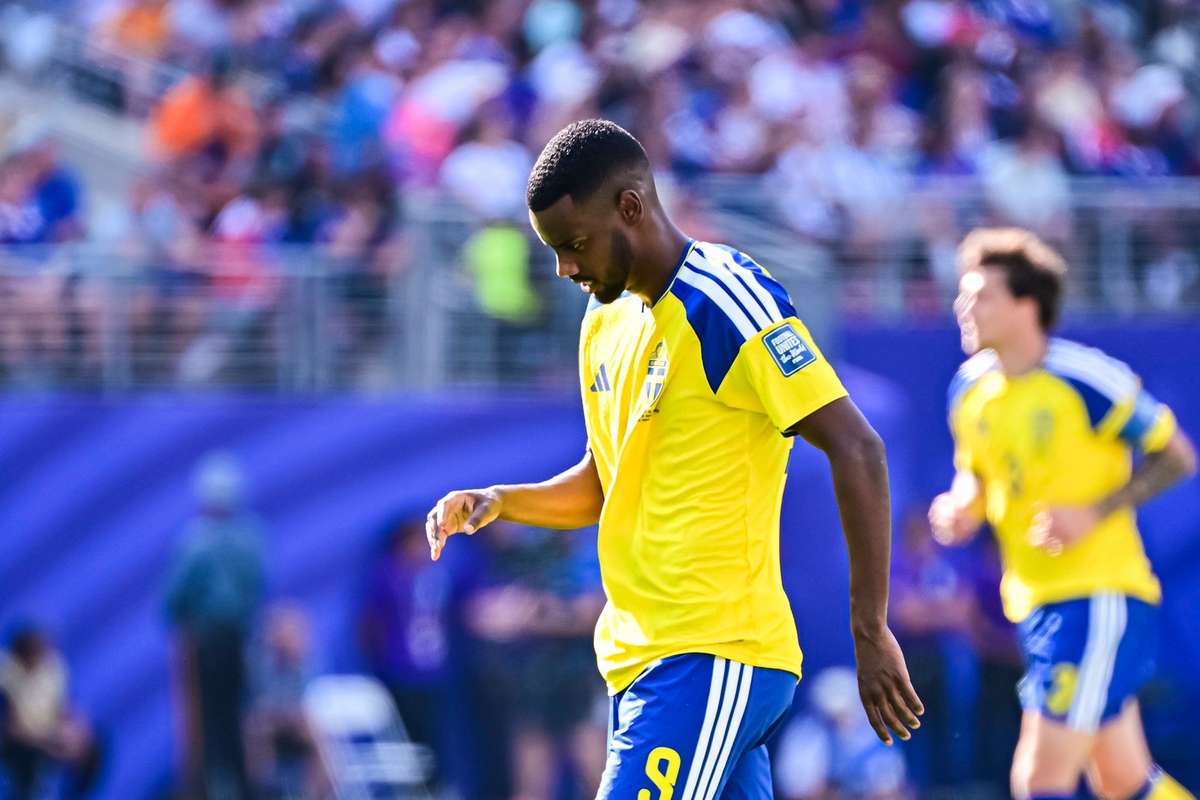
Before kickoff against France, Viktor Gyokeres framed the task in stark terms: Sweden would need to be almost perfect to beat the world's top-ranked side. After the final whistle, Graham Potter went further still, suggesting that even perfection from his players might not have been enough. The scoreline — a 3-0 defeat — and the underlying numbers tell a story that extends well beyond one bad night in North America.
France controlled 61 percent of possession, fired 25 shots with 12 on target, and walked away with three goals. Sweden managed eight attempts, three on target, and none found the net. For a nation that entered the World Cup with an attack envied by rivals, the gap between ambition and execution has become impossible to ignore.
The pattern that keeps repeating
The problems on display against France were not new. They were familiar echoes from Sweden's opening group phase, where a 1-1 draw with Japan already exposed structural weaknesses in Graham Potter's back line.
Against Japan, Sweden tried to limit the threat from wide areas — a response shaped in part by how the Netherlands had stretched them in earlier preparation. That adjustment left gaps through the centre of defence, and Japan punished exactly those spaces for their goal. Against France, the same central vulnerability returned, only this time Didier Deschamps' side moved through the heart of the Blagult back line with alarming ease.
A team arriving at the World Cup on a run of 14 matches without a clean sheet was never likely to shut out Les Bleus. Yet Sweden seldom made their back five look remotely compact. France's only shutout in their previous eight outings had come against Iraq; Sweden had genuine reason to believe they could trouble a defence that had been porous for months. Instead, the contest followed a different script entirely.
When the attack stops carrying the team
For much of the buildup to the tournament, Sweden's forward line looked like the one part of the squad that could compensate for everything else. Viktor Gyokeres and Alexander Isak both contributed when deployed together, and the partnership promised a release valve for a team still learning to defend as a unit. As the World Cup progressed, however, that threat diminished.
Expected goals ticked up only marginally — from 0.64 against Japan to 0.70 against France — while actual shot volume and accuracy both declined. Sweden again finished with fewer efforts and fewer on target than they managed against Japan. The attack that had carried playoff hopes through March was no longer masking the cracks beneath it.
Anthony Elanga earned his place in the starting lineup against France on merit, yet the broader question is whether his pace might have been more useful as a second-half weapon when Sweden needed to chase the game. With Isak Hien injured, the experiment of Victor Lindelof in midfield was cut short — another tactical thread Potter could not fully pull through the tournament.
Damage limitation instead of ambition
The second half offered the clearest illustration of Sweden's psychological and tactical retreat. Rather than pressing France in an open game, Potter's side appeared to settle into damage-limitation mode. Bodies stayed deep, the midfield evaporated, and the attack grew isolated.
Two of Sweden's three shots on goal came in the 89th minute or beyond — moments when the contest was already decided. That is not the profile of a team that believed it could still change the outcome. It is the profile of a team that had accepted the shape of the evening long before the clock ran down.
France at the summit, Sweden searching for identity
The contrast with France could hardly be starker. FIFA's newly crowned No. 1 side, climbing two places on 1877.32 ranking points, played with the conviction of a team that knows exactly what it is. Didier Deschamps had no need to compromise; his 4-2-3-1 functioned as designed, and superior quality did the rest.
Sweden, ranked 38th despite a four-place climb in the latest FIFA update, arrived with a different narrative — a nation rediscovering itself under a manager whose contract extension to 2030 looked like a gamble before the March playoffs and a stroke of genius immediately afterward. The jury on Potter's tactical and selection decisions, however, remains very much in session.
Where the Blagult go from here
The World Cup has a way of stripping away pretense. Sweden's group-stage draw with Japan offered warnings; the loss to France confirmed them. Defensive organisation, midfield connectivity, and the willingness to commit bodies forward when trailing are not abstract coaching concepts — they are the difference between surviving a group and going home with regrets.
Potter inherited a project still being built. Gyokeres spoke honestly about the standard required; Potter spoke honestly about its limits. What comes next depends on whether the Swedish federation sees this tournament as the end of a successful cycle or the beginning of a harder conversation about how a talented attack can coexist with a defence that has not kept a clean sheet in 15 consecutive matches.
Sweden's World Cup story was supposed to be about renewal — a new manager, a new contract, a new generation led from the front. Instead, it became a case study in how quickly the world stage exposes what domestic form can hide. The path forward does not require reinvention from scratch. It requires answering one question Potter himself has already posed in different words: can this team ever be perfect enough, and if not, what must change so that imperfection no longer looks like surrender?