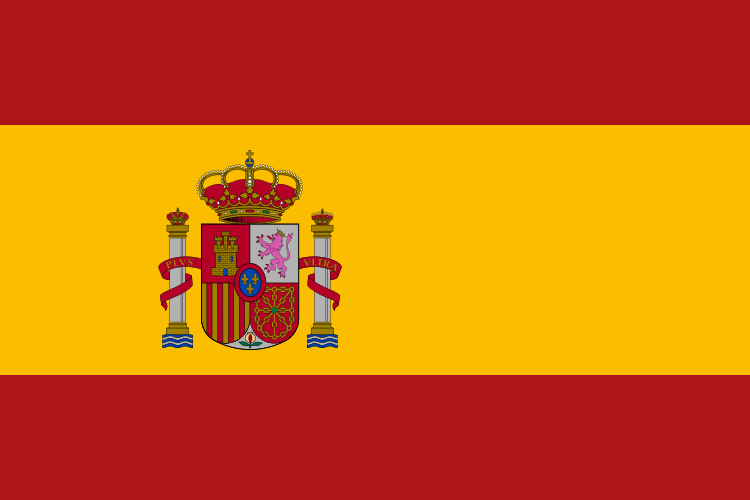















The 2026 FIFA World Cup reaches its defining night as Spain and Argentina face off for the trophy at MetLife Stadium in East Rutherford, New Jersey. Kickoff is scheduled for 21:00 CET, and the matchup carries weight far beyond a single 90-minute contest. Both nations arrive with clear historical targets, and the final shapes up as a collision between a reigning champion seeking continuity and a European side riding one of the longest unbeaten stretches in modern international football.
Why This Final Matters More Than Most
A World Cup final is always treated as the sport's summit, but this edition adds layers that make the stakes unusually sharp. Argentina enter as defending champions, a status that changes how opponents prepare and how pressure builds inside the squad. Spain, meanwhile, have not merely reached the last game of the tournament—they have done so while extending a run that has already stretched across three years of competitive action.
For casual viewers, the headline is simple: two elite national teams, one trophy. For anyone tracking the broader arc of international football, the final is also a referendum on whether a dynasty can repeat and whether a patient rebuild can finish with the game's biggest prize.
Argentina's Repeat Bid and What It Would Mean
Under Lionel Scaloni, Argentina are attempting something that almost never happens at this level. Only one nation has ever won consecutive FIFA World Cups in the men's game: Brazil in 1958 and 1962. That alone explains why Argentina's path to this final has been framed in historic terms rather than as a routine title defense.
Repeating is difficult for reasons that go beyond talent. The emotional drain of a World Cup win, the shifting age profile of a squad, and the way every rival targets the champion all combine to make a second title far harder than the first. Scaloni's side have still navigated the knockout phase and arrived in New Jersey with their identity intact: compact defending when needed, sharp transitions, and a collective belief forged through years of shared tournament experience.
Argentina currently sit third in the FIFA rankings with 1874.81 points, one place below their pre-tournament position. That slight shift does not diminish their pedigree in a final, but it does underline how tightly packed the top of the global order has become. In a one-off match, ranking lines blur quickly once the first whistle blows.
The Rulebook Side of a Title Defense
From a competition-structure standpoint, Argentina's task tonight is straightforward on paper and brutal in practice: win one more match under World Cup conditions—extra time and penalties included if required. There is no second chance, no aggregate scoreline, and no margin for a slow start. That format favors teams who manage emotion without losing edge, a balance Scaloni has repeatedly emphasized throughout the knockout rounds.
Spain's Unbeaten Run and the European Record in Reach
On the other side, Luis de la Fuente leads a Spain team that has not lost in regulation time across 37 consecutive matches, a sequence built on 27 wins and 10 draws. Extending that run through a World Cup final would mark the longest unbeaten stretch by a European nation in recorded international history, a statistic that captures both consistency and the difficulty of sustaining performance across qualifiers, Nations League fixtures, and tournament knockouts.
Spain's rise under De la Fuente has been defined by control. They rank second in the world with 1876.40 FIFA ranking points, reflecting a profile built on structured possession, coordinated pressing, and a clear tactical language from back to front. In tournament football, that kind of clarity matters because it reduces the chaos that often decides late knockout games.
It is worth separating two ideas that sometimes get mixed together. An unbeaten run speaks to resilience and game management; a World Cup final demands peak execution in the highest-pressure environment. Spain have proven the former repeatedly. Tonight determines whether that foundation converts into a fourth star on the shirt.
The Stage: MetLife Stadium on Football's Biggest Night
MetLife Stadium provides a fitting backdrop for a final of this scale. The venue has hosted major American sporting events for more than a decade, but a World Cup decider carries a different rhythm—global travel, multilingual supporter sections, and a broadcast audience measured in hundreds of millions. For players who grew up watching World Cup finals on television, walking into this stadium for the last match of the 2026 tournament is the practical realization of a childhood ambition.
Weather, travel, and recovery cycles all factor into performance at this stage, especially for teams that have played deep into July. Neither side can treat preparation as abstract. Rest, tactical review, and mental readiness are part of the competitive equation even before the first pass is completed.
How the Match May Unfold Tactically
Argentina's recent World Cup profile under Scaloni has often featured disciplined defensive blocks and rapid attacking bursts, a model that can frustrate possession-heavy opponents. Spain's typical approach under De la Fuente asks opponents to chase the ball, then punishes gaps when structure breaks. The central question is whether Argentina can absorb pressure without conceding early territory, and whether Spain can translate control into clear chances against a defense organized for moments like this.
Set pieces, discipline, and substitutions will likely carry extra importance. In a final, margins are rarely wide. A single transition, a dead-ball routine, or one disciplinary lapse can tilt the balance. Both coaches have tournament experience and squads deep enough to change the game's texture after halftime.
What to Watch as Kickoff Approaches
As the World Cup prepares for its closing act, several storylines converge. Can Argentina become only the second nation to retain the trophy? Can Spain turn an extraordinary unbeaten sequence into a global title? And which team handles the emotional weight of the occasion more effectively when the spotlight is at its brightest?
The answers will arrive over 90 minutes—or more—at MetLife Stadium. Until then, the final remains open, loaded with history on both benches and a generation of players positioned to define how this tournament is remembered.