



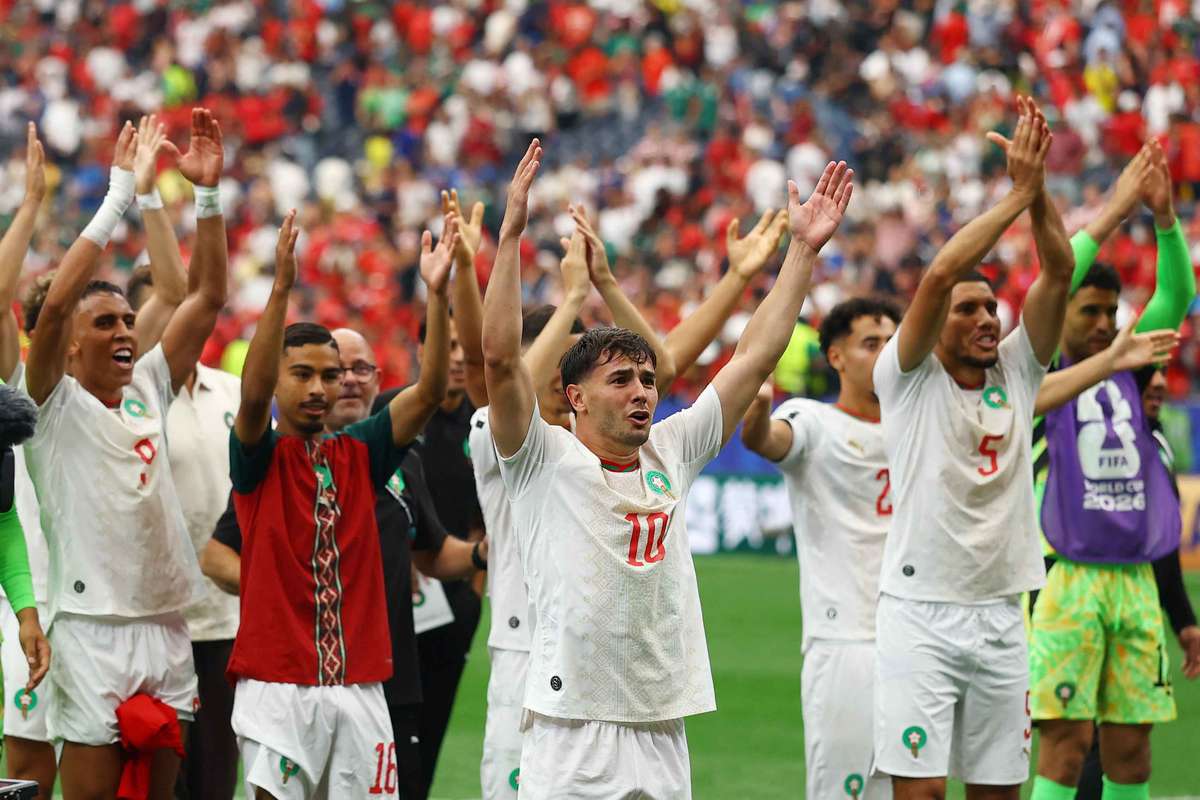
The first day of the Round of 16 delivered two contrasting knockout stories — and an immediate scheduling problem for both survivors.
World Cup knockout football rarely offers the luxury of a long reset. With the opening quarter-final between France and Morocco scheduled for Thursday, both teams now face a compressed window to recover, rotate, and rebuild match sharpness after Saturday's last-16 ties.
Two Round-of-16 Paths, Two Recovery Profiles
In Houston, Morocco advanced with a 3-0 victory over Canada, reaching a second consecutive World Cup quarter-final. The Atlas Lions were not at their sharpest in the opening 45 minutes, but the second half told a different story.
Azzedine Ounahi broke the deadlock shortly after the restart, converting a rehearsed free-kick routine finished with a low first-time strike. Achraf Hakimi delivered the set-piece service that left Ounahi unmarked at the top of the box — a detail that underlined how quickly Morocco can punish lapses once the tempo rises.
Ounahi added a second goal after Brahim Diaz's cutback, and Soufiane Rahimi — introduced early for Ismael Saibari — sealed the win with a stoppage-time third. For Canada, a third finals appearance ended in Houston as the first co-host eliminated from the tournament.
In Philadelphia, France's path looked very different on paper and on the stat sheet. Les Bleus controlled 76% of possession, produced 15 shots and five on target, and completed 90% of their 568 passes. Yet Paraguay held firm until Kylian Mbappe converted a penalty with roughly 20 minutes remaining for a 1-0 win.
What the Numbers Say About Fatigue Risk
France's dominance in possession and passing volume suggests a demanding 90 minutes, even when the scoreline stayed narrow for most of the match. Extended periods in the final third, repeated attempts to break down a deep block, and the mental strain of a one-goal knockout tie all add cumulative load — especially for players carrying heavy minutes through the group stage.
Paraguay's defensive effort told its own story: 24% possession, five shots, and a 5-4-1 shape designed to absorb pressure. France eventually found the breakthrough, but not before burning energy against organized resistance.
Morocco's workload looked lighter in comparison. After a sluggish first half, the Atlas Lions scored three times in the second period and never allowed Canada back into the tie. That pattern matters for recovery planning: Morocco finished the night with less prolonged stress than France, even if the opening half raised questions about early-game rhythm.
Ranking Context Before the Quarter-Final
The quarter-final pairing carries clear pedigree on both sides. France enter as FIFA's No. 1 side, having climbed two places with 1877.32 ranking points. Morocco remain eighth at 1755.87 points, stable from their previous position but carrying the momentum of another deep tournament run.
Canada depart ranked 30th, while Paraguay hold 40th — reminders of how narrow the margins become once knockout football begins. France were expected to control territory against Paraguay; Morocco needed a second-half correction to avoid a nervy evening against a co-host side playing on home soil.
Four Days Between Knockout Games
Thursday's quarter-final will not allow either team much time to fully reset. In tournament conditions — travel, media obligations, recovery sessions, and tactical preparation — a four-day gap between Saturday's Round of 16 and the opening quarter-final is short enough to make squad management decisive.
For Morocco, the priority is likely twofold: restore first-half intensity without losing the second-half clarity that unlocked Canada, and decide whether Rahimi's early entry changes the preferred front-line rotation.
For France, Didier Deschamps faces a more complicated balance. Les Bleus proved they can monopolize the ball and create volume, but they also showed how costly protracted control can be when a deep block refuses to break. Mbappe's penalty solved the immediate problem, yet the broader question — whether France can win faster and preserve legs — becomes urgent with Morocco waiting.
Players Who Shaped the Recovery Equation
Ounahi emerged as Morocco's clearest difference-maker, scoring twice and giving his side a knockout win that should require less late-game desperation than France endured. Hakimi's role on the set piece that opened the scoring also reinforced his value as more than a wide outlet — he is a direct creator in dead-ball moments that decide tight tournaments.
On the French side, Mbappe's captaincy carried tangible weight when the tie needed a single moment of composure from the spot. But the broader performance profile — heavy possession, limited payoff until the penalty — suggests France may need sharper final-third efficiency before facing a Morocco side that has already shown it can accelerate after halftime.
Quarter-Final Outlook
France versus Morocco is the first quarter-final on the schedule, and it arrives with both teams carrying different physical and psychological receipts from Saturday.
Morocco arrive with confidence from another statement second half and a proven ability to reach the last eight in consecutive World Cups. France arrive as the top-ranked side in the world, tested by a Paraguay team that made them work for 70 minutes before the decisive spot kick.
The tactical matchup is compelling: France's possession engine against Morocco's capacity to grow into games and strike on rehearsed moments. The scheduling subplot is equally important. In a tournament where recovery windows shrink every round, the team that manages legs, minutes, and emotional energy best over the next four days may hold an edge before a single ball is kicked on Thursday.