











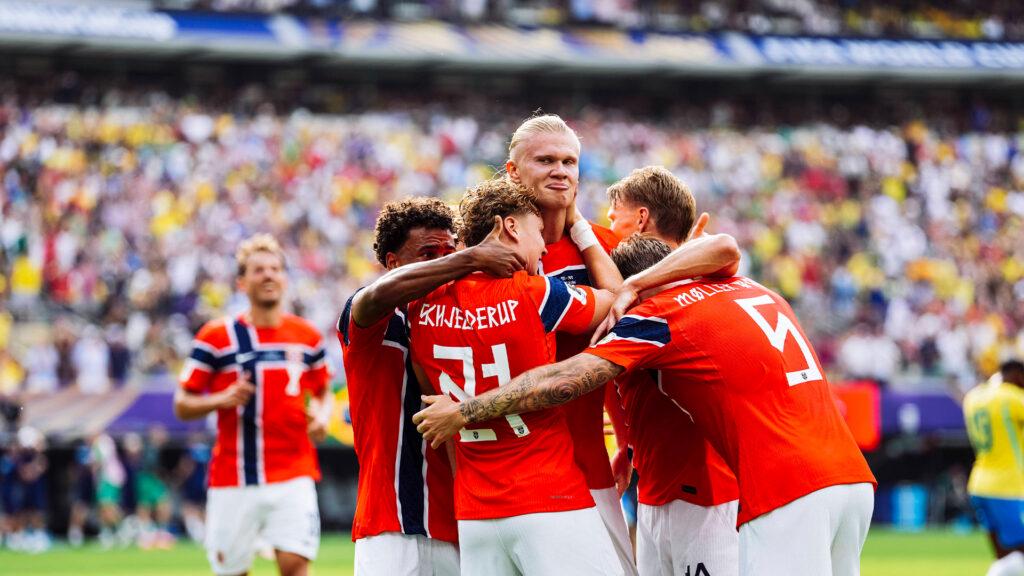
Seven goals in four matches is not a hot streak. At the 2026 FIFA World Cup, it is a dataset that already separates Erling Haaland from almost every debutant in tournament history.
The Norway striker has turned his first World Cup into a scoring engine with measurable impact: four match-winning goals, a knockout run that was unimaginable for this nation a month ago, and a rate of 1.75 goals per game that reads like a simulation output rather than real international football. The noise around the numbers is loud. The context behind them is louder.
A Debut That Belongs With the All-Time Names
Before 2026, the last player to reach at least seven goals on a first World Cup appearance was Poland’s Grzegorz Lato in 1974. That campaign ended with Lato on seven and Poland taking bronze. Haaland has matched that total and given Norway a genuine path toward its first World Cup medal.
Zoom out to the historical leaderboard and the scale of what he is doing becomes clearer. Just Fontaine’s 13 goals in 1958 still leads the way, ahead of Sándor Kocsis on 11 in 1954 and Gerd Müller on 10 in 1970. Guillermo Stábile scored eight back in 1930. Ademir de Menezes also struck nine in 1950 on his first World Cup. Eusébio hit nine in 1966. Haaland is already inside that conversation and still climbing.
Match-Winning Output as a Performance Metric
Raw goal totals tell one story. Match-winning goals tell another.
Haaland owns four at this World Cup. Only Lato in 1974 and Italy’s Salvatore Schillaci in 1990 ever recorded more in a single edition, with five apiece. That is elite company, and it reflects how often his finishing actually shifts results rather than padding a scoreline in games already decided.
Norway are not simply scoring. They are advancing because Haaland scores at the right moments in knockout football.
Norway’s Record Book Is Being Reset in Real Time
This is uncharted territory for Norwegian football on the global stage. Until 2026, the nation had appeared at only three World Cups and scored a combined seven goals across all of them. Haaland has matched that entire historical tally in one campaign.
No previous Norway player had ever scored more than one goal at a single World Cup. He has cleared that barrier by a wide margin.
Knockout Bracket Production
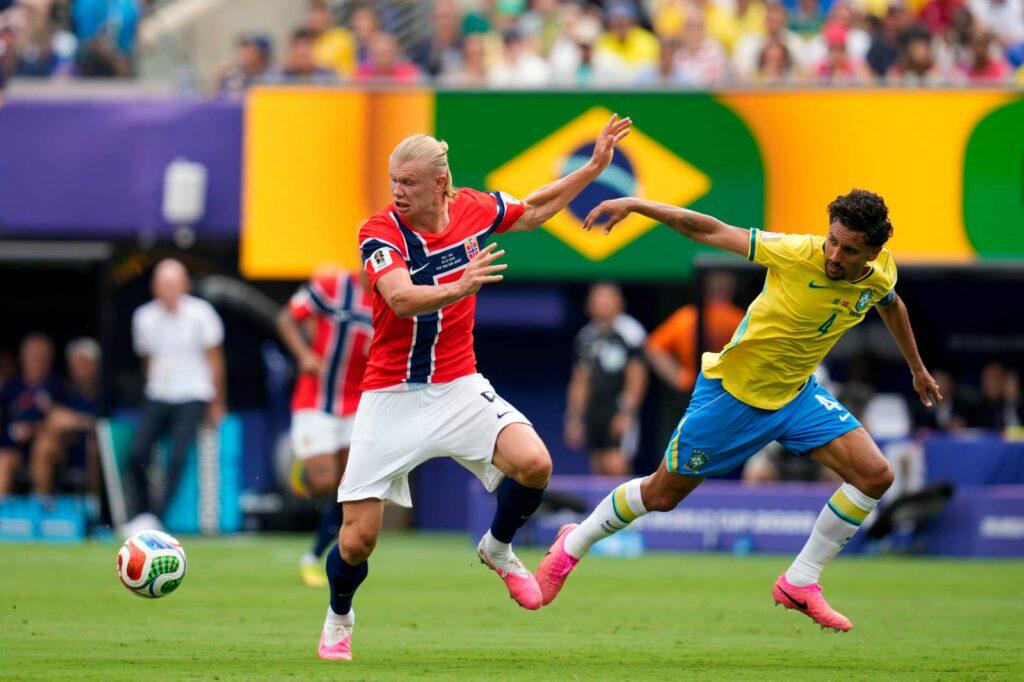
He is the first Norway player to score twice in a knockout match at any major international tournament. All three cases of a Norway player scoring two or more in a single game at a major tournament belong to him at this World Cup — against Brazil, Senegal and Iraq.
Those three fixtures also underline how his output has scaled when stakes rise. Brazil sit sixth in the current FIFA rankings. Senegal are 14th. Iraq are 57th and climbing. Norway entered the tournament 31st in the world. Haaland’s production has carried a mid-ranked side through meetings with established and rising opponents alike.
Career Numbers That Frame the World Cup Run
He is already Norway’s all-time leading scorer with 62 goals in 54 caps at just 25 years old. That is 1.15 goals per game across his full international career — video-game efficiency applied to real international minutes.
The World Cup sample is smaller but even more extreme. Four games, seven goals, four winners. If the knockout trend holds, the debate will shift from whether he belongs among great debutants to where he lands on the all-time single-tournament chart.
What the Historical Comparison Actually Means
Modern football is not 1958 or 1974. Defensive structures, squad rotation, travel loads and tactical preparation all differ. Comparing Haaland directly to Fontaine or Müller requires caution.
Still, the debut-tournament filter matters. First World Cups strip away reputation and force players to produce on a blank slate. Haaland arrived with global club stardom but zero World Cup minutes. The gap between expectation and proof has closed faster than almost anyone anticipated.
Lato’s 1974 run ended in bronze. Schillaci’s 1990 surge carried Italy to the final. Those are the benchmarks for what elite debut scoring can unlock. Norway’s path now depends on whether Haaland can sustain conversion efficiency against deeper, better-organized opponents.
England Looms With a Personal Layer
The next chapter adds narrative weight to the data story. Norway now face England, ranked fourth in the world and among the tournament favorites.
Haaland was born in Leeds while his father Alf-Inge Haaland played in English football. He could have been eligible for the Three Lions. Instead he chose Norway, and that choice is now the spine of the most important World Cup run in Norwegian history.
England’s defensive planning will center on limiting his touches in the final third, disrupting service into the box and forcing Norway to win through secondary channels. Norway’s game model will do the opposite: compress space, feed their No. 9 early and often, and let the best finisher in the tournament decide another knockout tie.
What to Watch in the Quarterfinal
Set-piece volume will matter. Haaland’s physical profile makes him a target on dead balls, and Norway’s ability to win aerial duels could decide whether England’s back line stays compact or gets stretched.
Transition speed is the other lever. Four match-winning goals suggest he does not need 20 chances to change a game. One clear look may be enough.
The Bigger Picture for 2026
Whether Norway reach a first World Cup medal or fall short against England, Haaland has already changed how this tournament will be remembered. A nation that scored seven World Cup goals across three previous appearances now has a single player matching that total in four matches.
The record book is not just being updated. It is being rewritten in real time by a 25-year-old whose debut numbers already sit beside legends from six different decades.
The quarterfinal against England is the next data point. Everything before it suggests Haaland treats knockout football like a laboratory — and the results keep confirming the hypothesis.