



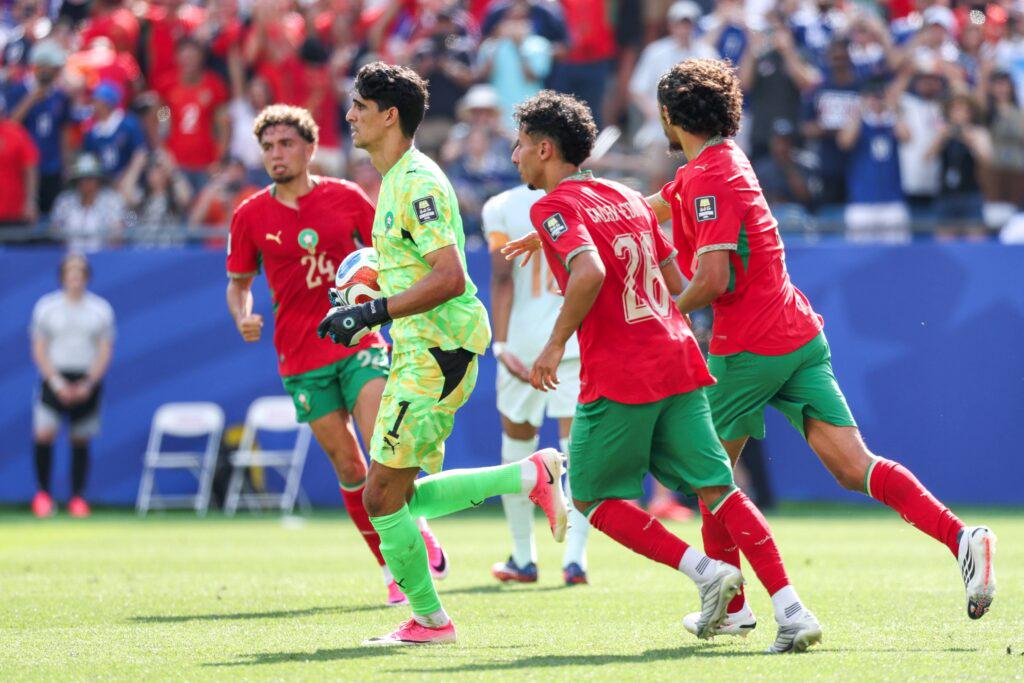
Knockout football has always asked a blunt question: does control deserve a reward, or does survival count as its own kind of mastery? At Gillette Stadium, with the FIFA World Cup 2026 quarterfinal between France and Morocco locked at 0-0 at the interval, that question hangs over the pitch like stadium lights that refuse to dim. One side has spent forty-five minutes bending the match toward the opponent’s goal. The other has spent forty-five minutes proving that structure, nerve, and a goalkeeper in full command can keep a tie alive when the numbers say otherwise.
This is not a stalemate born from caution on both flanks. It is a contest shaped by pressure and resistance — the kind of half that future analysts will study not because it was chaotic, but because it was lopsided in every metric except the one that matters most on the night.
A Quarterfinal Framed by Rankings and Expectation
Entering the match, the broader football landscape already framed the stakes in stark terms. France arrive as the world’s top-ranked national side, climbing to No. 1 in the latest FIFA standings after rising two places with 1877.32 rating points. Morocco, steady at No. 8 with 1755.87 points, carry the memory of a World Cup run that changed how many observers think about African football at the highest level — not as a surprise, but as a repeatable model built on discipline, collective intelligence, and players who understand tournament tempo.
That context matters because quarterfinals rarely forgive vagueness. Didier Deschamps has built his France tenure on the belief that tournament football is a separate language from club football — one where game states, risk management, and the ability to absorb pressure without surrendering shape can decide a summer. Morocco, lining up in a 4-2-3-1, came to Gillette Stadium prepared to speak that language fluently.
France’s First Half: Territory, Volume, and a Missing Goal
If the halftime scoreboard were the only evidence available, a neutral observer might assume balance. The underlying ledger tells a different story entirely.
France finished the opening period with 13 shots to Morocco’s 1. They placed three efforts on target, generated six attempts from inside the box, and created three big chances. Their expected goals total stood at 1.87 against Morocco’s 0.04 — a gap wide enough to suggest that chance quality, not mere ambition, separated the sides. They struck the woodwork once, completed four of six crosses, and were sharper on long balls with seven of fifteen accurate compared to Morocco’s eight of twenty-six.
Territorial control reinforced the attacking profile. France recorded 42 final-third entries to Morocco’s 11 and made 16 touches inside the Morocco penalty area. Even where passing totals looked nearly level — 236 accurate passes for France against 235 for Morocco — the distribution revealed intent. France completed 83 of 103 actions in the final-third phase; Morocco managed 36 of 45. The ball may have moved across the pitch with similar frequency, but it moved toward danger far more often in blue.
For Deschamps, this is both encouragement and warning. His side has done the hard work of establishing authority in a knockout environment. Yet the recent international record offers a sobering echo: France have drawn 0-0 in multiple high-level fixtures across this cycle, including meetings with Italy, Belgium, and Turkey. Dominance without conversion is not a new anxiety for this group. It is a recurring exam question — one that quarterfinal football grades harshly.
The Set-Piece and Transition Toolbox
France’s pressure was not one-note. It arrived through set plays, quick switches of play, and driven cutbacks that forced Morocco’s back line to defend multiple angles at speed. That variety matters in knockout football because deep blocks can survive repetition; they struggle against teams that change the geometry of attack every few minutes.
Morocco, by contrast, accepted a narrower footprint. They defended deep, scrapped in midfield, and leaned on aerial organization to blunt France’s physical advantage in the air. With only one shot across the half, their attacking contribution was minimal — yet their game plan never promised open-field equality. The Atlas Lions came to survive the first forty-five minutes without being pulled apart, and on the scoreboard, they succeeded.
Bounou’s Penalty Save and the Culture of Goalkeeping under Pressure
There is a reason goalkeeping lore travels so well across languages and eras. A penalty save in a World Cup quarterfinal is never only technique. It is timing, psychology, and the ability to remain narrow in decision-making while the stadium expands around you. Bounou’s stop did more than preserve a 0-0 scoreline. It gave Morocco a emotional anchor — proof that one individual act can neutralize an entire half of territorial disadvantage.
Mbappé, Upamecano, and the Gap Between Creation and Completion
For France, the frustration is specific rather than vague. Mbappé did not disappear. He generated the half’s most valuable individual chance and remained central to the team’s attacking gravity. Yet knockout football rarely awards process alone. It demands that creators become finishers at the exact moment the opponent’s structure begins to creak.
Behind him, France’s defensive platform held firm. Dayot Upamecano was involved in the half’s defensive workload as Morocco sought rare outlets, and structural collapse. It was precision in the final action — the last pass, the last shot, the last decision in a crowded penalty area.
That distinction is where elite tournaments are often decided. Teams that rank first in the world are expected to control. Teams ranked eighth are expected to bend. But when bending produces a clean sheet at the break, the psychological scoreline shifts. Morocco walk to the tunnel knowing they have absorbed France’s best period. France walk knowing they must either keep producing at the same rate or find a new gear before doubt creeps into the stadium air.
What the Second Half Must Answer
Halftime in a World Cup quarterfinal is less a rest than a referendum. Morocco will likely remain compact, trusting that one moment — a transition, a set piece, a goalkeeper’s continued command — can rewrite a match France have largely authored. Deschamps must decide whether to persist with volume, introduce fresher attacking profiles, or alter the point of pressure to avoid predictability against a back line that has already survived forty-five minutes of stress.
The numbers say France should lead. The scoreline says the tie remains alive. That tension is exactly what knockout football sells: a contest where knowledge, preparation, and execution do not always arrive in the same minute.
A Half That Belongs to the Trend Line, Not the Scoreboard
At 0-0, this quarterfinal is unfinished in the only sense that matters to supporters — the result. Yet the first half has already drawn its outline. France have been the team asking questions, Morocco the team withholding answers, and Bounou the player who turned statistical dominance into a still-even game.
The second half will determine whether this night becomes a lesson in conversion for the world’s top-ranked side, or a deeper chapter in Morocco’s tournament resilience. For now, the break belongs to goalkeeping, structure, and the enduring truth that in World Cup football, the ledger and the scoreboard are related but never identical.