





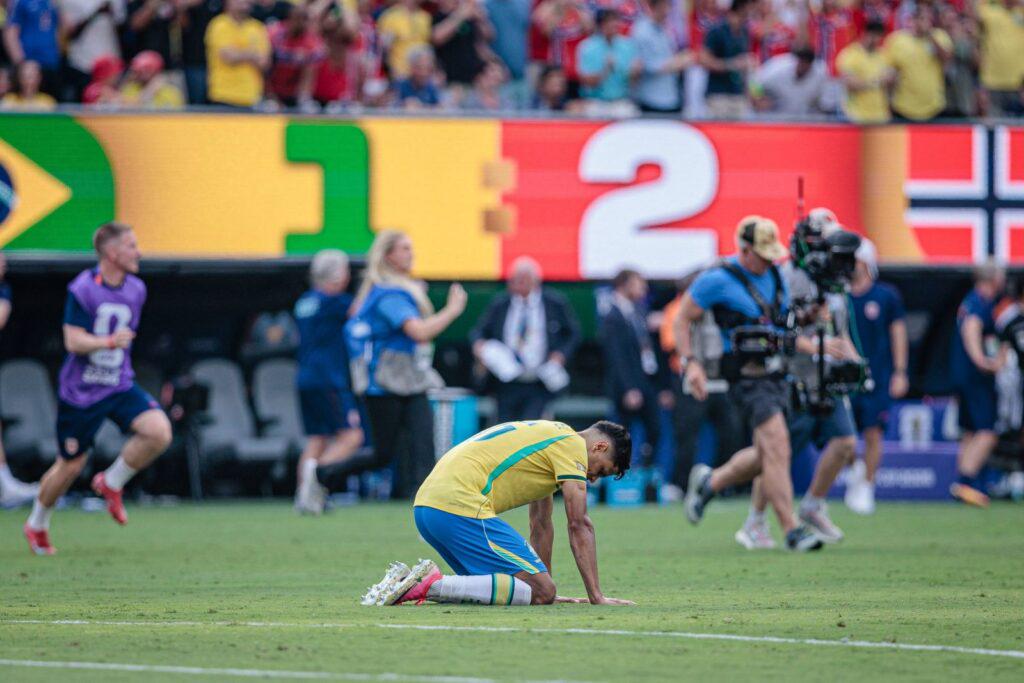
The New York New Jersey Stadium became the stage for one of the most painful nights in recent Brazilian football history. Brazil fell 2-1 to Norway in the World Cup 2026 Round of 16, ending the Selecao's pursuit of a sixth world title and leaving Carlo Ancelotti's squad to confront a rare and deeply uncomfortable chapter in the nation's tournament record.
For a team ranked sixth in the latest FIFA standings, the outcome carried extra weight. Norway arrived from 31st in the global table, yet controlled the emotional and tactical direction of a knockout tie that turned on a handful of decisive moments rather than sustained dominance from either side.
Early Penalty Failure as the First Risk Layer
The match's defining fracture appeared early. In the 13th minute, Bruno Guimarães stepped up from the spot and saw his effort saved by Norwegian goalkeeper Ørjan Nyland. That single sequence did more than deny Brazil an opening lead. It shifted the psychological balance of the entire contest.
From that point, Brazil's rhythm became visibly strained. Passes in the final third grew hurried, build-up play carried more risk, and the Selecao began inviting the kind of transitional openings that Norway had prepared to exploit. In knockout football, the first major failure often sets the template for everything that follows. Here, the missed penalty functioned exactly that way.
Why Vinícius Júnior Was Not on the Ball
The choice of taker immediately became one of the night's most debated organizational decisions. Vinícius Júnior is Brazil's primary attacking reference, yet he was not the player entrusted with the kick.
The reasoning, viewed from a preparation standpoint, was grounded in recent national-team history. Vinícius had missed penalties against Venezuela and Chile while wearing the yellow shirt. Bruno, by contrast, had converted every spot-kick he had taken for his European clubs. Ancelotti's staff leaned on that split in data, treating club reliability as a proxy for World Cup pressure.
The problem is that a World Cup knockout round is not a league fixture. The weight of the moment, the crowd, and the immediate consequence of failure create a different decision environment entirely. Brazil learned that distinction the hard way within the opening quarter-hour.
Structural Collapse Under Knockout Pressure
Once confidence dropped, Brazil's technical profile changed. The Selecao still created openings, but the composure required to convert them never fully returned. Errors in possession increased, defensive spacing widened at the wrong moments, and Norway were allowed to settle into the match on their own terms.
The numbers from the tie underline how uneven the flow became. Norway finished with 66% possession and nine attempts, five on target, while Brazil managed 14 shots with only four on target despite generating more volume in attack. Efficiency, not activity, decided the tie. Brazil had moments to restore order; they lacked the calm to make those moments count.
Norway's Execution and Haaland's Closing Statement
While Brazil wrestled with their own instability, Norway executed a disciplined plan. Defensively organized and direct in transition, Ståle Solbakken's side absorbed pressure without surrendering control of the game's direction.
Their decisive weapon was Erling Haaland. The striker's movement in the final third repeatedly found the space Brazil's back line could not close quickly enough. He opened the scoring in the 79th minute, then sealed the result in the 89th with a clinical finish after receiving the ball in midfield and advancing with minimal resistance.
Two goals in the closing stages turned a tense knockout tie into a historic Norwegian victory and a Brazilian elimination. Haaland did not need a large number of touches to define the night. He needed only the two clearest chances Norway created when Brazil were most vulnerable.
A Rare Historical Exit for the Selecao
This defeat places Brazil in an uncomfortable historical bracket. Including 2026, the Selecao have now been eliminated in the World Cup Round of 16 only three times, previously in 1934 and 1990. No other exit at this stage of the tournament has occurred across Brazil's long World Cup history.
Only the 1930 group-stage elimination, in the tournament's first edition before the modern Round of 16 format existed, represents an earlier or more abrupt departure from the competition. For a nation that measures success by deep runs and titles, a last-16 exit against a lower-ranked European opponent lands as more than a single bad result. It raises questions about penalty protocols, in-game leadership, and how a squad ranked among the world's elite can lose control so quickly after one early failure.
What the Night Means Going Forward
Brazil leave World Cup 2026 with unfinished business at the organizational level. The penalty decision, the immediate psychological response, and the inability to recover across 90 minutes will be dissected long after the final whistle. Norway, meanwhile, advance with proof that structure and efficiency can overturn ranking gaps on the sport's biggest stage.
For Ancelotti, the defeat ends a short but high-stakes national-team chapter defined by one knockout tie that unraveled in layers: first the spot-kick, then the mood, then the late goals. Brazil's sixth title will wait. The more immediate task is understanding how a team of this quality allowed a single early miss to become a full-scale elimination.