

















Argentina's 3-2 comeback against Egypt was not simply a story of emotion. It was a stress test of how a defending champion manages load, spacing, and collective nerve when a knockout tie starts going the wrong way.
Trailing 2-0 with roughly 11 minutes left in regulation, Argentina looked headed for one of the great World Cup shocks. Instead, goals from Cristian Romero, Lionel Messi, and Enzo Fernandez in stoppage time kept the holders alive and turned a potential elimination into a lesson in late-game execution.
Early Egypt Push Exposed Argentina's Defensive Spacing
Egypt arrived with a sharper attacking posture than many expected, choosing to press forward rather than sit deep and wait for counters. That early intent paid off after 15 minutes when Emam Ashour worked the right flank, recycled possession to Marwan Attia, and watched Attia's floated cross find Yasser Ibrahim for a clean headed opener.
The sequence mattered tactically because it showed Egypt could stretch Argentina vertically without overcommitting numbers. Argentina's back line was drawn toward the ball side, and the second-wave cross arrived with too much room at the back post. For a team built around controlled progression, that kind of defensive spacing error is exactly what knockout football punishes.
Egypt doubled the lead through
Argentina should have responded almost immediately. Haissem Hassan caught Nicolas Tagliafico with a late challenge on an overlapping run, and the referee pointed to the spot. But goalkeeper Mostafa Shoubir read Messi's left-footed strike cleanly, diving to his left to keep Egypt in front.
That save was more than a momentum swing. It became the central psychological checkpoint of the night. Messi had already missed from the spot against Austria in the group stage, making him the first player to fail on two World Cup penalties. For a squad that leans heavily on its captain's rhythm, that miss raised a practical question: could Argentina keep creating without forcing play through one man?
The answer, in hindsight, was yes — but only after the staff and senior players stabilized the tempo. Rather than panic pressing, Argentina gradually increased volume through the middle and wide channels. That patience would define the second half.
Why the Numbers Favored a Comeback Even at 2-0
tournament conditions, that kind of control often matters most when the scoreboard turns hostile. Egypt's lower shot volume suggested they were absorbing pressure rather than consistently threatening a third goal, which left the door open for one decisive attacking spell.
Romero's Header Started the Structural Shift
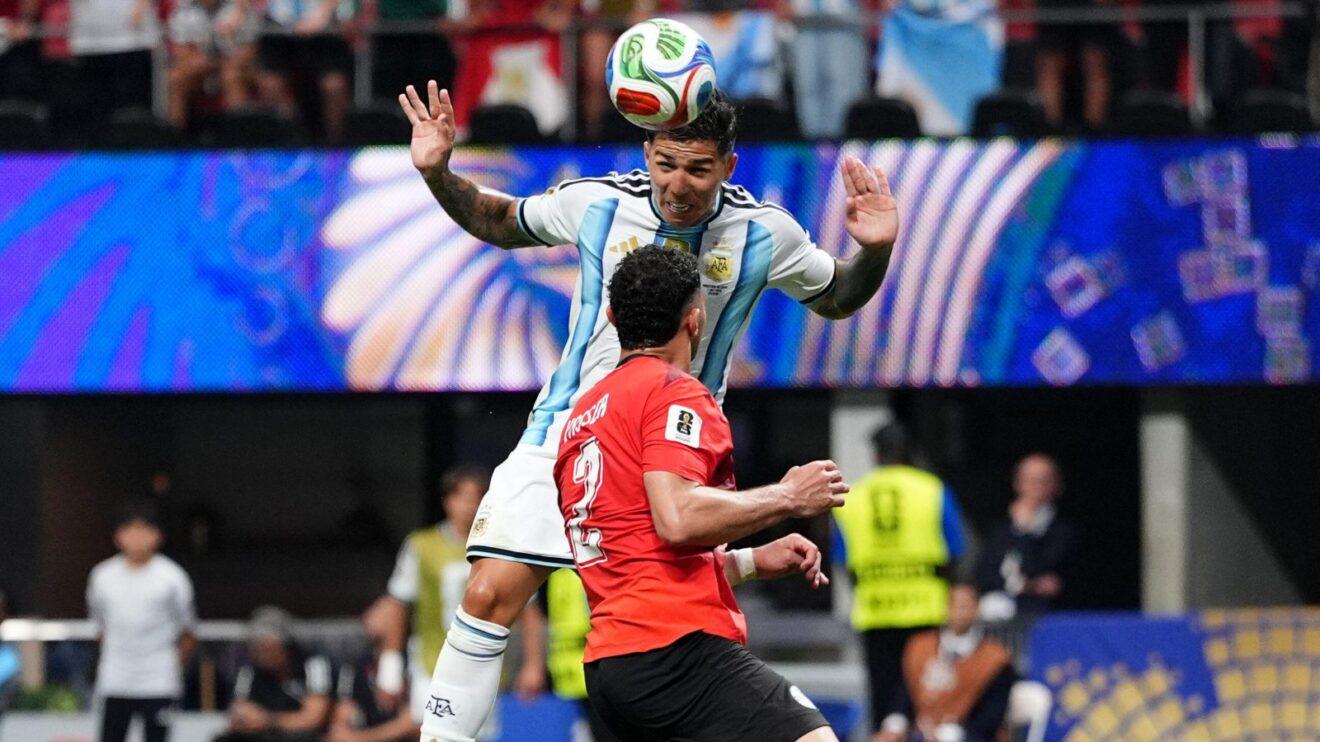
The comeback began when Messi delivered the cross and Romero attacked it with proper timing and upper-body tension to head Argentina back into contention. It was a classic recovery moment: not a hopeful punt, but a rehearsed pattern where the captain's delivery met a defender arriving with forward momentum.
Four minutes later, Messi finished the equalizer after Lautaro Martinez and Gonzalo with quick combination touches that prevented Egyptian defenders from resetting their line. That sequence illustrated the value of fresh legs and rehearsed link play in tight spaces. Substitutes were not brought on merely to run. They were inserted to increase combination speed and deny the opponent time to organize.
Once level, Argentina's challenge shifted again: avoid extra time on fatigued legs and find one clean transition before Egypt could rebuild their defensive shell.
Fernandez's Winner Rewarded Counter-Attack Discipline
The deciding goal arrived from exactly the kind of transition Argentina had been preparing for all evening. Lautaro Martinez drove down the right, delivered a back-post cross, and Fernandez cushioned a header past Shoubir, who had otherwise kept Egypt competitive with repeated interventions earlier in the match.
It was a textbook late knockout goal: one pass from danger, one runner arriving with separation, and a finish that required calm rather than power. For a squad that had endured penalty trauma and an 11-minute survival window, that composure was the real victory.
Egypt argued they should have had a penalty before the breakaway and protested loudly, but the officials were unmoved. From a performance standpoint, the North Africans still leave with proof that their aggressive game plan can trouble elite opposition. The difference was sustainability. Argentina's depth, passing base, and ability to keep probing without collapsing structurally allowed themlast a brave Egyptian side.
What the Result Means for Argentina's Knockout Path
FIFA's latest rankings place Argentina third in stretches, which is precisely why this tie will be studied inside the Argentina camp as a recovery case study rather than a routine win.
Messi, visibly emotional at the final whistle, now has 21 World Cup goals to his name and another night that tested his leadership under maximum stress. The holders move on, but not before revealing both vulnerability and the systems that still make them dangerous: controlled possession, late tactical substitutions, and the refusal to let one missed penalty define the entire evening.
In a World Cup built on thin margins, Argentina showed that championship teams are not the ones who never wobble. They are the ones who, the patterns, and the belief to turn a two-goal deficit into survival.