







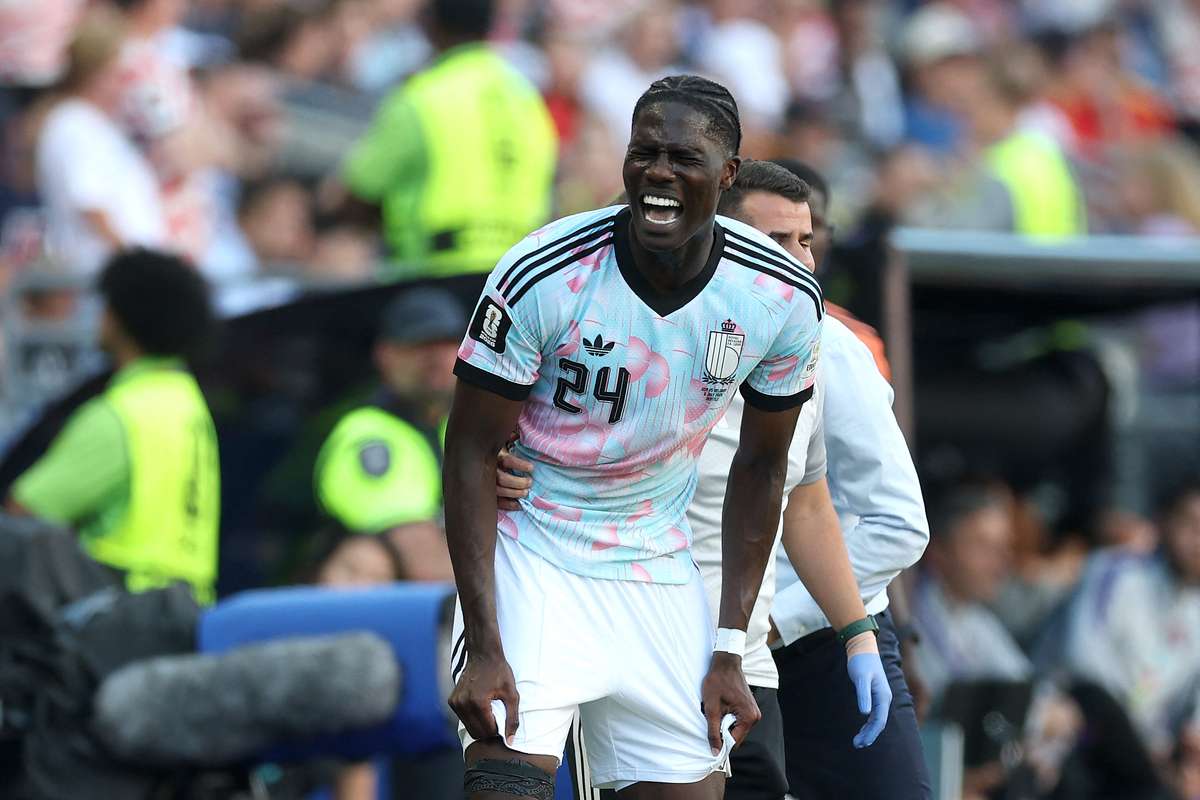
The image that will linger from Belgium's Round of 16 victory is not the four goals, nor the roar of a team that looked, for a night, like it could still belong to the sport's elite. It is Amadou Onana on crutches at full time, smiling through pain, surrounded by teammates who understood what the photograph already implied: a tournament that had demanded everything from him was over in the twenty-first minute.
Team doctor Brahim Hacene confirmed what medical staff feared after Onana landed awkwardly and left the pitch. The examinations, Hacene said in an official statement, showed a rupture of the anterior cruciate ligament. "This is devastating news, both for him personally and for the team," he added. In a sentence, Belgium lost a player and a reference point at once.
The Moment Everything Changed
Onana had been central to how Belgium wanted to play in this World Cup. At Aston Villa he had grown into a midfielder trusted to shield the back line, carry the ball under pressure, and win duels without turning matches into chaos. In Qatar's successor tournament on North American soil, that profile mattered. Belgium's group-stage data already hinted at a team comfortable in a 4-2-3-1: wins built on organized rest defense, bursts of vertical passing, and enough control to survive nights when the scoreboard stayed tight.
Against the United States, the pattern held until it did not. Belgium won 4-1, a result that flatters the narrative of dominance while hiding the fracture at its center. Onana's substitution was not tactical. He did not jog off with a grimace and a hopeful wave. He was gone, and the midfield suddenly looked like a puzzle missing its corner piece.
What an ACL Rupture Actually Means
Football culture has spent decades learning to speak about knee injuries with a mixture of dread and familiarity. The anterior cruciate ligament is a small structure with an outsized role: it stabilizes the knee when a player plants, cuts, decelerates, or absorbs contact. When it ruptures, the joint does not simply "hurt." It loses the internal logic that makes elite movement trustworthy.
Modern sports medicine has turned ACL rehabilitation into a curriculum rather than a guessing game. Load management, neuromuscular retraining, and return-to-play protocols now treat the injury as a long negotiation between tissue healing and psychological readiness. Players who once feared career endings now routinely return within nine to twelve months, sometimes sooner, depending on graft choice, associated damage, and the athlete's history. That knowledge has changed how clubs plan seasons and how national teams build squads deep enough to absorb a single catastrophic twist of the knee.
None of that softens the immediate blow. A ruptured ACL at a World Cup is not a scheduling inconvenience. It is the erasure of a role a coach has rehearsed for months. Onana will not "fight through it." He will not be rushed back for a semi-final fairy tale. The tournament timeline and the biology of the ligament refuse that storyline.
The Athletic Profile Belgium Loses
Onana's value was never reducible to highlight reels. He is a midfielder whose game reads like a study in spacing: close enough to intercept, far enough to spring transitions; strong enough to hold off a press, disciplined enough not to chase shadows. Belgium's recent World Cup numbers underline a team that can win while sharing possession or without it—four goals in one knockout win, three in another, five in a group-stage statement, yet also a scoreless draw in which they controlled seventy percent of the ball. That versatility requires players who can anchor different emotional temperatures within the same system.
Without Onana, Belgium must redistribute those responsibilities. Another No. 6 may inherit the defensive shield. A more adventurous partner may be asked to risk positioning Belgium previously protected. The quarter-final against Spain on Friday will be the first high-stakes examination of that revised balance.
Belgium's World Cup Path Without Its Midfield Anchor
Ranked ninth in the world and unchanged from the previous cycle, Belgium arrived at this tournament carrying the familiar tension between golden-generation memory and present-tense reality. The Round of 16 win over the United States suggested the squad still possessed enough collective quality to survive knockout football. Losing Onana introduces a different question: not whether Belgium can score, but whether they can control the middle against opponents who treat possession as territory.
Spain represents that test in its purest form. La Roja's football is built on rhythm, positional discipline, and the belief that the center of the pitch is where tournaments are decided. Belgium without Onana may need to accept periods of chasing the ball while trusting compactness, set-piece threat, and the individual brilliance that has kept this generation relevant long after its first obituaries were written.
The database arc of Belgium's World Cup campaign already shows a team capable of explosive attacking nights—thirty-five shots and five goals in one fixture, nineteen shots and three goals in another—alongside a drawn match in which they dominated the ball but not the scoreline. That inconsistency is common in knockout tournaments. What changes now is the identity of the player most likely to calm those swings.
Why Onana Will Stay With the Squad
Hacene's statement added a detail easy to overlook in the rush of bad news: after consulting with Aston Villa, Onana will remain with Belgium until at least after the quarter-final against Spain. That decision reflects a shift in how national teams and clubs collaborate during major tournaments. The injury is Villa's concern for the long term; the immediate days belong to Belgium's collective psychology.
There is practical logic. Medical staff who witnessed the mechanism of injury are best placed to manage early recovery steps. There is emotional logic too. Onana celebrated with his teammates on the pitch while on crutches after the United States win—a gesture that reads less like performance and more like belonging. Squads that advance deep into World Cups often carry injured players as reminders of shared sacrifice, and as voices in meetings where tactical adjustments are debated without the filter of match-day adrenaline.
For Onana, presence may also be part of the rehabilitation story modern sport increasingly acknowledges. Isolation after a severe injury can slow recovery as surely as poor physiotherapy. Remaining embedded in the group keeps competitive habits alive even when competitive minutes are impossible.
A Tournament Lesson Written in Ligament Fiber
Every World Cup produces injuries that feel cruel because they arrive at the apex of a career calendar. Onana's case will join a long archive of players whose names become footnotes to someone else's trophy lift. Yet the broader lesson is structural. Depth in the pivot zone is no longer a luxury for nations with Belgium's ambitions. It is infrastructure.
Hacene called the news devastating twice in spirit—once for the player, once for the team. Both truths coexist. Onana's personal road will extend far beyond Friday in Spain. Belgium's road must continue without him, carrying the image of a midfielder who still found a way to stand with his teammates when the final whistle confirmed both victory and loss.
The quarter-final will decide whether this World Cup remains a living project or collapses into another what-if. For Amadou Onana, the tournament is already a memory being written in crutches and statements. For Belgium, it is now a test of whether a team's knowledge of itself can survive the absence of the man who helped define its center.