

















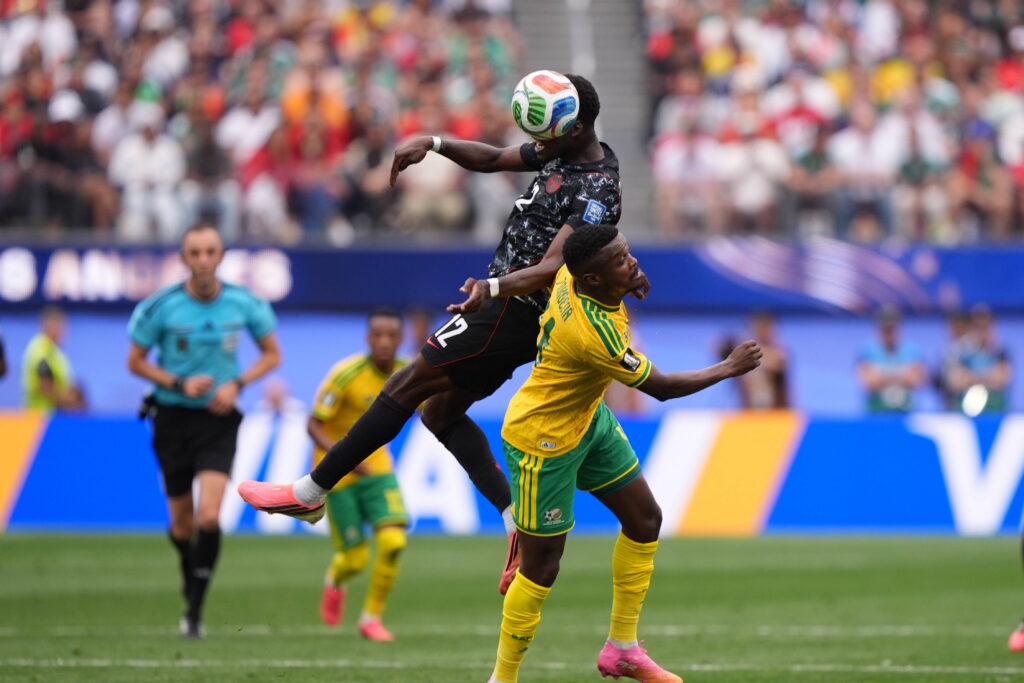
When the World Cup knockout stage reaches the phase where “the data speaks but the score stays silent,” a 0-0 at half-time often tests a team’s realistic path more than the surface result suggests. In the early hours of June 29, Beijing time, the FIFA World Cup Round of 32 clash between South Africa and Canada at SoFi Stadium was exactly that kind of sample—one where chances and outcomes were temporarily out of sync.
Half-time data: Canada more dangerous, South Africa more solid
From a structural standpoint, South Africa held around 55% possession and completed more passes, trying to control the tempo and slow the game down; Canada concentrated their threat on the edge of the box. Shots 8-3, shots on target 4-1, expected goals 1.05 to 0.06—those gaps say more about who was closer to scoring than the 0-0 scoreline. Canada took 7 shots inside the box, missed all 3 big chances, led 3-1 on corners, and completed 17 touches in the opposition area—a classic “attacking quality over possession share” approach.
South Africa’s response showed up in the defensive and duel columns: 13 tackles to 6, 10 interceptions to 6, 14 clearances to 2, a 65% ground duel win rate, and 62% overall duels won. Most of their shots came from outside the box, with only 1 attempt inside; a low xG of 0.06 was no surprise. With suspended core player Themba Zwane absent, the team relied more on the system, first-ball wins, and steady goalkeeper play, repelling Canada’s attacks again and again in front of goal.
Case study: Eustáquio’s orchestration vs the structural cost of Zwane’s absence
On the Canadian side, Stephen Eustáquio served as the creative hub in the first half: 4 key passes, 4 of 6 crosses completed, and 0.56 expected assists. The team entered the attacking third 34 times, completed 10 of 16 long passes (63%), and kept applying pressure in the final-pass phase. For readers tracking young players’ career choices, this looks very much like the standard template for a modern midfielder at a major international tournament—not necessarily the flashiest on the stat sheet, but the player who determines whether chances get created.
South Africa, by contrast, offers a different path: ranked 60th by FIFA (Canada 30th), using defensive discipline in a World Cup knockout to offset a shortfall in creativity. With Zwane unavailable, their front-line link-up and ability to break down opponents in tight spaces are weakened; three first-half shots with one on target shows they are still waiting for counter windows rather than going toe to toe.
Trend call: In the second half, watch who converts the value already created first
The key in these matches is not possession but big-chance conversion. Canada has pushed the threat to the doorstep yet missed the net three times; if South Africa keeps winning duels and second balls, they still have the psychological and tactical room to drag the game level or even into extra time. For two sides both searching for a breakthrough on the World Cup stage, 0-0 at half-time is both suspense and the most common reality in professional football—leading on the data does not mean leading on the scoreboard, and structural stability does not mean you can rest easy.