














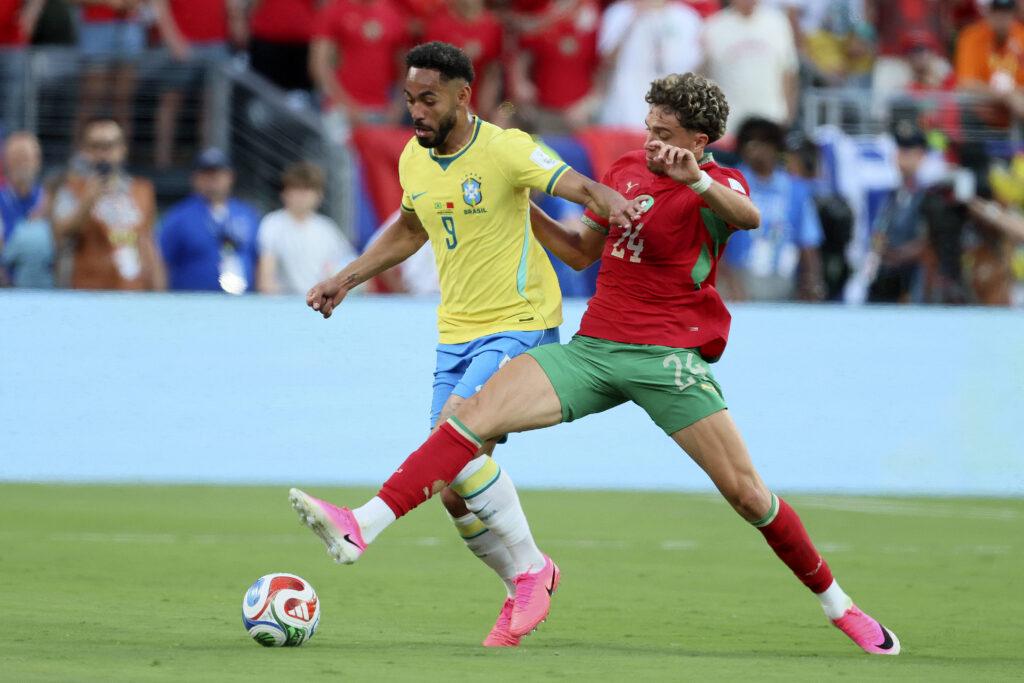
Brazil and Morocco played to a 1-1 draw in their opening Group C match at the 2026 World Cup. Ismail Saibari opened the scoring in the 21st minute, and Vinicius Jr. pulled level with a long-range strike in the 32nd; after the break neither side found the net again, and both teams left New Jersey with a point apiece.
First Half: Morocco Fly Out of the Blocks, Brazil Level Through Individual Brilliance
The curtain-raiser was played at a brisk tempo. Morocco pressed higher from the start, stringing together successive threats in the final third—Brazil's back line was forced to survive on blocks at one stage, with Gabriel Magalhães making a crucial intervention to deny Nayef El Aynawi's follow-up from the edge of the box.
In the 21st minute, Morocco's counter-attack paid off: Brahim Díaz slipped a through ball to Saibari, who, with Vinicius Jr.'s international teammate Alisson advancing, calmly chipped over the goalkeeper to make it 1-0. The goal fit the first-half pattern—by the numbers, Morocco had 12 shots to Brazil's six at the break, with expected goals of 1.28 to 0.86, the Atlas Lions proving sharper in transition.
Brazil took around 15 minutes to find their rhythm. In the 32nd minute, Bruno Guimarães played a through ball, and Vinícius Jr. cut inside before drilling a right-footed shot into the far corner—their only shot on target of the match proved decisive. In stoppage time, Lucas Paquetá saw an overhead kick in the box saved by Bono, and the half ended 1-1.
Second Half: Rotation Changes and Fitness Toll
Carlo Ancelotti made a double substitution at the break, taking off Casemiro and Roger Ibañez—both had been booked in the first half, and keeping them on carried too much risk. Danilo and Fabinho came on, and Brazil settled into a steadier rhythm, finishing with 54% possession to 46%, 501 passes at an 88% success rate, clearly edging their opponents.
The intensity dropped in the second half, but the rate of substitutions picked up. In the 61st minute, Ancelotti sent on Matheus Cunha and Luis Enrique for Paquetá and Igor Thiago, hoping their running would stretch the pitch wide; Morocco withdrew Díaz and Ounahi in the 64th minute, bringing on Talbi and El Moulaabet to shore up midfield. Brazil finished with 12 shots and 4 on target along with 5 corners, while Morocco had 12 shots, 2 on target and 0 corners—despite dominating possession and volume of attempts, the scoreline remained unchanged.
From a scheduling and recovery standpoint, being forced into rotation after two yellow cards in the opener sends a significant signal for Brazil's next two fixtures: midfield anchor Casemiro was withdrawn early and the back line was reshuffled in midfield. Morocco head coach Walid Regragui, taking charge of his first competitive match, kept a conservative but effective substitution tempo; a late long-range strike from El Aynaoui was still kept out by Alisson, and the point was well earned.
By the numbers: evenly matched, with fine margins deciding the ceiling
Both teams set up in a 4-2-3-1, with the statistics almost a mirror image: 12 shots apiece, Brazil with more on target and more corners, Morocco committing slightly fewer fouls and picking up no yellow cards. In the FIFA rankings, Brazil sit sixth and Morocco eighth—the gap on paper is not large, and the match confirmed as much.
Vinícius Júnior registered 53 touches and completed 26 of 31 passes, with his one key shot carrying enormous value; Brahim Díaz completed all 16 of his first-half passes and set up the assist, making him Morocco's most active player in the opening period. Raphinha, Achraf Hakimi and others threatened too, but neither goalkeeper conceded again—Alisson saved the decisive long-range effort late on, while Bounou had already denied Lucas Paquetá in the first half.
Group C outlook: a draw is acceptable, but fixture pressure arrives immediately
For both teams, a draw on Matchday 1 is no disaster, but hardly a comfortable outcome either. Brazil, as five-time world champions and pre-tournament favorites, will face heightened scrutiny for failing to take all three points; Morocco, meanwhile, showed they have the steel to go toe-to-toe with elite opposition, giving Walid Regragui genuine reason to feel more optimistic about their path out of the group.
The real test arrives on June 20, when Brazil face a group rival and Morocco meet Scotland. With only a few days separating the opener from the next round of fixtures, yellow-card accumulation, squad depth and the quality of recovery in training will directly shape whether either side can pick up points in Matchday 2. Group C sits perfectly balanced on one point apiece—the other results already on record are Scotland 0-0 Haiti, Brazil 0-0 Haiti and Morocco 0-0 Scotland—and any draw could redraw the qualification picture entirely.
Our View
This 1-1 felt less like a stalemate and more like each side hitting the ceiling of what it needed: Morocco on the strength of their early efficiency and counter-attacking discipline, Brazil through individual moments of quality and second-half control. If Carlo Ancelotti wants to crank up the tempo in the next round, two issues need fixing—cutting out needless fouls that carry suspension risk, and getting Vinícius Júnior on the end of Bruno Guimarães's through balls earlier and more reliably. For supporters, Group C has already set a template of high-intensity, high-transition football from the opening round; the next two games will be well worth tracking for rotation calls and fatigue curves.