















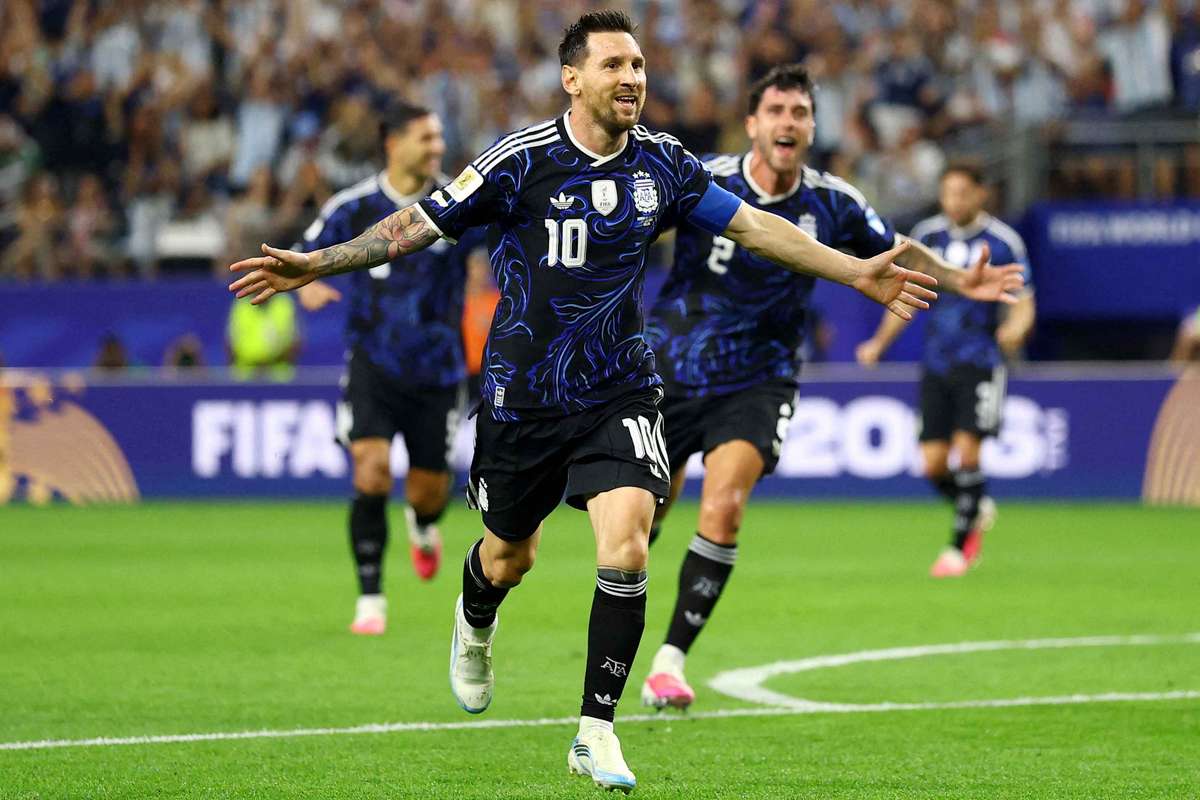
When the match reached the 80th minute with the score still deadlocked, Argentina turned to substitute Messi to change the course of the game. From about 25 meters out, he struck a free kick that curled into the net, and Argentina went on to win 3-1. This goal meant more than the result on the day—it made Messi the first player in World Cup history to score in seven consecutive matches, and extended his personal World Cup tally to 19 goals, continuing to rewrite the record books.
Where the Record Began: The Starting Point of Continuity in 2022
To explain the "seven consecutive matches," we have to go back to Qatar 2022. In that tournament, Messi's scoring run began with a 2-1 win over Australia, and in the knockout rounds he went on to find the net against Netherlands and Croatia. In the final against France, he scored twice in what was an epic showdown and lifted the trophy with his team. Viewed in sequence, this record was not the product of a single explosive performance, but the result of sustained delivery across the knockout stage in different roles and at different tempos: the pressure to take points from the opening whistle, and the patience to restart amid a big-score swing.
The 2026 Continuation: Opponent Gradient and the Density of the Second Match
Entering the 2026 final tournament, Messi continued to extend this scoring streak. In the opening match against Algeria, he completed a hat-trick; in Argentina's second match, he answered with two goals against Austria. His strike against Jordan pushed the consecutive-run to seven matches and lifted his personal World Cup goal tally to 19. Viewed through squad rotation and the rhythm of the schedule, still being able to land a decisive blow as a substitute in later matches after two consecutive high-intensity outings shows that his deployment was not a "use him up and discard him" approach, but rather bringing in the core finisher when the team needed to change the structure of the match.
Comparison with 1958 and 1970: From "Six in a Row" to "Seven in a Row"
Before Messi, the benchmark for consecutive World Cup goals had long remained at six matches. In 1958, French striker Fontaine scored in six straight games at that tournament; in 1970, Brazil's Jairzinho did the same. The two embodied the stability of forwards from different eras in their off-the-ball movement and finishing chains, but neither crossed the threshold of a seventh match. Messi this time set the record with a set-piece as a substitute, moving the discussion from "can you score in consecutive games" to "can you maintain finishing efficiency under different physical load management and tactical roles."
Tactical Perspective: Substitutes, Set Pieces, and Structural Changes Late in Matches
What most deserves breaking down in this match is not just the goal itself, but also how and when it came. A 25-yard free kick in the 80th minute means the game had entered a phase of fading fitness and shrinking space; at that point, teams often need a way to change the scoreline without relying on elaborate build-up play. Messi completed that task after coming on as a substitute, which also reflects Argentina's familiar resource-allocation approach across a World Cup cycle: placing a core player's peak output in the windows that shape the match, rather than spreading it evenly from the opening whistle. For opponents, even when preparing substitutions early while leading or locked in a stalemate, they still have to maintain full defensive coverage against free kicks on the edge of the box—and that is itself part of managing "opportunity sequencing" at the highest level.
Nineteen World Cup goals have further strengthened Messi's place on the all-time scoring charts. More importantly, those 19 goals are spread across a continuous cycle spanning 2022 and 2026, covering group stages, knockout rounds, and opponents of varying strength—showing that the record is not a short-term burst from a single tournament. For those tracking Argentina's youth development and tactical evolution, this run of goals also offers a useful case study: how a core player maintains scoring rhythm across a national-team cycle, and how a side, at key moments, puts its most reliable finishing weapon in the hands of the player most at home on that stage.
The record is now part of history, but the World Cup goes on. Whether Messi can extend his run of consecutive appearances will depend on how upcoming opponents press, Argentina's rotation plans, and whether similar high-quality set-piece chances will still be available in the closing stages of matches.