


















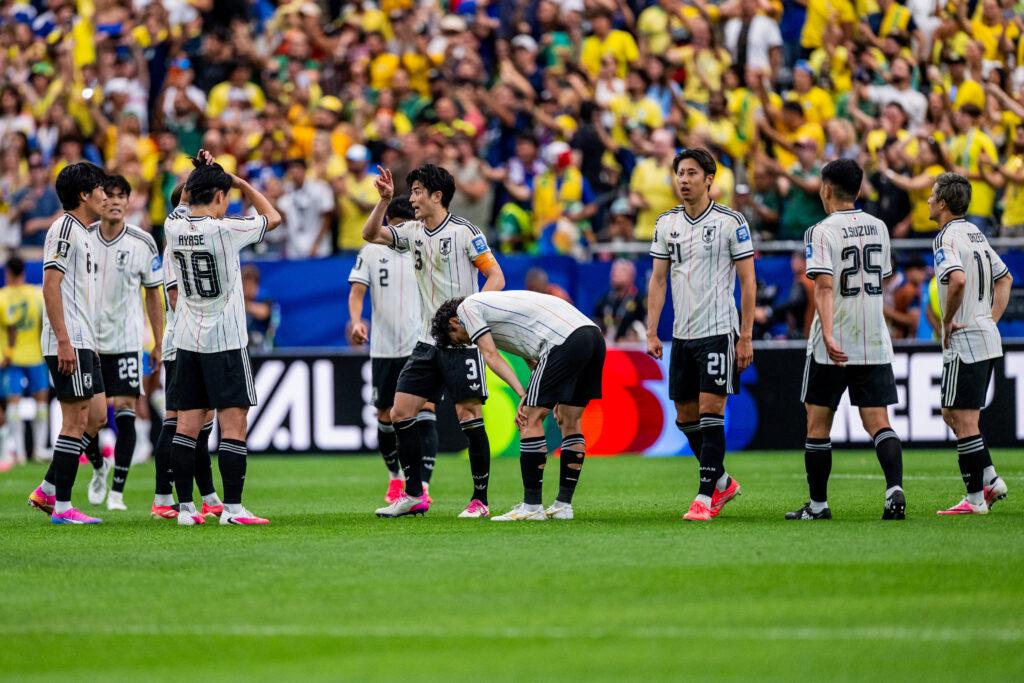
If you think of the World Cup as a long corridor, the Japan team often navigates the first stretch with remarkable discipline—passing lanes are clear, pressing timing is precise, and the play frequently looks like a textbook example of modern football. Yet each time they reach that Round of 16 door, they come up just half a step short at the end of the corridor: four knockout runs, four times their journey ended by a single goal or a penalty shootout. This highly repetitive script tests fans’ patience and forces you back into the technical details for answers.
A Knockout Path Almost Carved into Their DNA
Since making their World Cup debut in 1998, Japan have reached the knockout stage in four editions—2002, 2010, 2018, and 2022. The record itself shows the team has stable competitiveness, but the manner of elimination is strikingly consistent: all stopped at the Round of 16, without exception falling to a one-goal defeat or a penalty shootout. This is not random fluctuation, but the repeated emergence of a structural problem.
From the content of the matches, Japan more often win the “process”—possession, circulation, and local combinations often dominate, yet what truly decides the outcome is another set of variables: set pieces, aerial duels, and the opponent’s direct transitions. In knockout games, game management after taking the lead, rest defense, and in-game substitutions have also repeatedly shown cracks under pressure. For a team known for discipline and system, this is cruel: what they get right over ninety minutes may be undone by a single lapse on a dead ball, or a broken rhythm on the counter.
2002: Home-Turf Momentum Meets Turkey’s Efficiency
2002年作为联合东道主,给日本队注入了罕见的集体能量。小组赛头名出线后,球队依靠精密的传切与有组织的前场压迫,把“快、稳、准”的战术标签贴在了日本足球身上。十六强战移师宫城,对手是身体对抗强硬、定位球威胁明确的土耳其。
决定性画面出现得很早:角球开出,Ümit Davala 在禁区内头球破门,0比1的比分从此像一道细线,横亘在整场比赛上方。此后日本队并未崩盘——他们仍能调动宽度、完成转移,控球与推进节奏并不凌乱,却在禁区前沿反复缺少那种干净、直接的中路终结。土耳其收缩肋部、保护门前,日本在外围绕行,时间一点点流逝。这不是溃败,更像一次被精确计算的损耗:势头还在,关键瞬间却已交给对手。
从战术地图回溯,日本队长时间掌控节奏与场区,射门与传球成功率并不难看,但高质量机会更多来自对手的空袭与二次进攻。那一记角球,恰好戳中了日本在淘汰赛里反复遭遇的痛点——不是踢法不够现代,而是在“最后一触”与“最后一防”的博弈中,差了一拍。
Technical Profile: Winning the Picture, Losing the Moment
The Scissors Gap Between Possession and Transition
日本队的风格底座是速度、结构与脚下技术。小组赛阶段,这种组合往往能把对手拖入自己的节拍:三中卫或变体阵型下的边翼卫推进、中场短传撕扯、前场小范围配合,都能打出流畅观感。可一到淘汰赛,对手级别陡升,比赛状态变得敏感——领先时如何压缩空间、落后时如何避免被反击打穿,这些细节在日本身上多次成为分水岭。
Set Pieces: An Amplified Weakness
Compared with the technical displays in open play, set pieces and defending crosses have always been the more lethal test. Opponents’ aerial superiority, corner kicks, and free-kick routines often, against a backdrop of Japan controlling possession for longer stretches, seize the one touch that decides the outcome. The early goal conceded against Turkey in 2002 is a classic case: it was not open play being overrun, but a marking lapse in dead-ball situations being magnified into the end of an entire tournament run.
Knockout Psychology and Marginal Costs
Four Round of 16 appearances, four similar endings—the same logic runs through them all: marginal costs in the knockout stage are extremely high. One foul in the wrong place, one full-back beaten down the flank, one second ball not cleared—these can carry more weight than an entire stretch of fluid passing and possession. Japan is not lacking in competitiveness; rather, it has yet to stabilize its conversion rate of turning advantages into advancement in a knockout context.
From Data to Reality: The Blue Samurai Are Still on the Journey
The latest in-house reference points show this same sense of “almost there” continuing: FIFA ranking has risen to 18th, with 1660.43 points, up from the previous cycle; during the 2026 World Cup cycle, the team still often deploys a 3-4-2-1 system, with possession and pass completion rates reaching highs of 62% and 90% respectively in some matches, while also showing the resilience to fight for goals with as little as 31% possession. The label of attractive football has not been lost, but that knockout threshold still looms ahead.
For Japanese football, the World Cup story has never been about “not knowing how to play,” but about “how to turn the ability to play into the ability to win in the shortest possible exchanges.” When the Round of 16 door closes for the fourth and fifth time behind them, the question is no longer merely talent or passion, but the full engineering of set-piece defending, managing leads, and converting on-pitch advantages into a place in the next round. The Blue Samurai’s style of play remains worth appreciating; for a team hungry to break through, however, appreciation alone is not enough—they need a summer that truly rewrites the script.