
















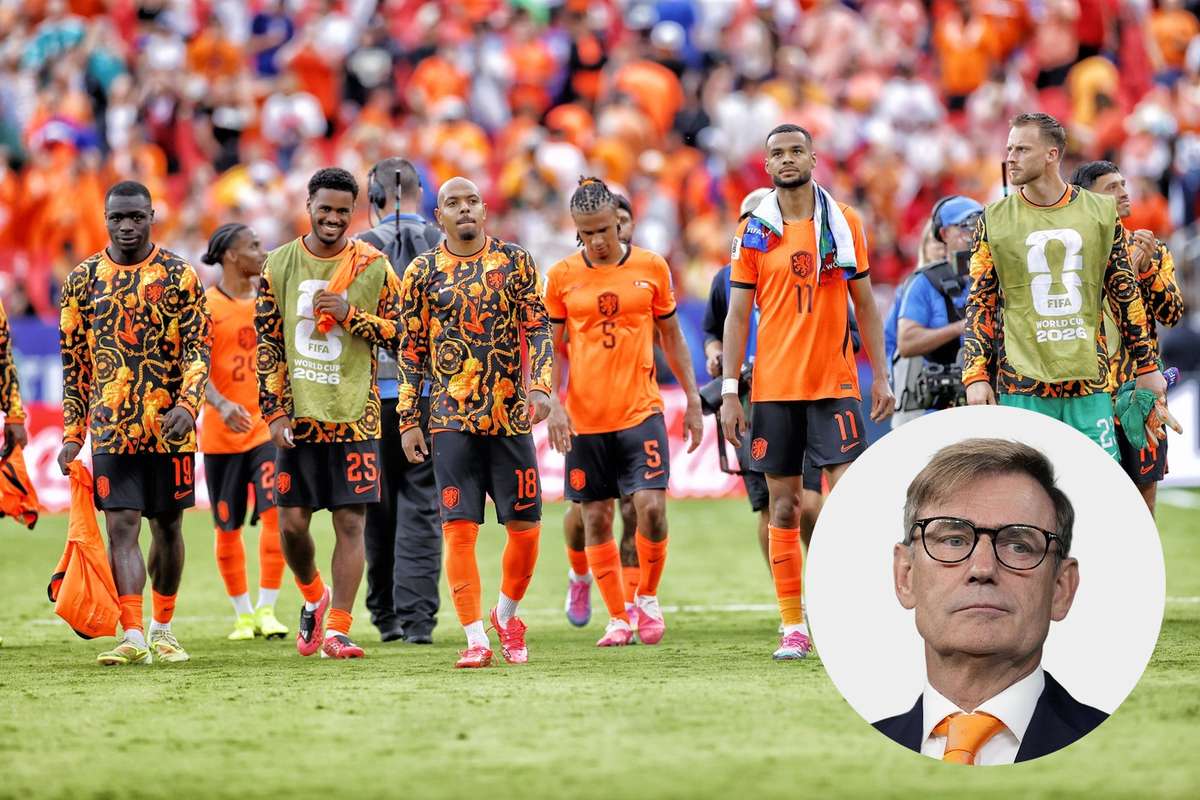
Standing on the sidelines of the World Cup, you can always hear two very different voices: one from the stands, where expectations have been ignited by a big win, and another from the dressing room, where doubts still linger. In a recent column, Netherlands goalkeeping coach Frans Hoek captured both moods in writing—and he was blunt about it. This was not a report that only celebrates the good news, but rather the unfiltered view of someone who has spent years on the training ground.
Before the match had even kicked off, the story was already written in the opening rounds of the group stage. Hoek noted that Tunisia had a miserable start: after losing 0-5 to Sweden in the first round, the team changed coaches and brought in the experienced Hervé Renard, only to lose 0-4 to Japan next. Questions about the quality of the players were everywhere, and Hoek also noticed that the African side’s biggest concern at that moment was no longer whether they could play attractive football, but simply avoiding another humiliation at the hands of their opponents. On the other side, the Netherlands had just beaten Sweden 5-1, and the mood across the country and in the dressing room was fully ignited. Although concerns remained, there was more light on everyone’s face. According to the site’s FIFA ranking reference, the Netherlands are currently 7th, Tunisia 44th, Sweden 38th, and Japan 18th—the gap on paper is real, but the World Cup has never been a place where numbers tell the whole story.
What really set Hawk off in his column was whether to rotate after already qualifying. He cited the USA vs Turkey example: to preserve their starters, the USA fielded a reserve lineup, lost, and sparked fierce post-match controversy. Hawk admitted he was opposed to that approach at the time, and was relieved Ronald Koeman did not take the same path. The Netherlands had already secured qualification, and speculation was rife about whether they would give substitutes a run-out to find rhythm, but Koeman still picked his strongest lineup—with one exception: he did not risk playing Micky van de Ven and Chistianio Sumerville, because one more yellow card for either would trigger a suspension for the next match. Beyond that, it was essentially a full-strength side. Hawk said this kind of judgment—"steady when you need to be steady, bold when you need to be bold"—matters especially as the knockout rounds approach.
Against Tunisia, Hawk narrated the match like a fast-paced little story. Tunisia had the first clear chance of the game—in a World Cup, that first opening can often change the course of a match, but they failed to take it. A few minutes later, Denzel Dumfries delivered a superb cross, and a Tunisian player turned it into his own net, 1-0. Before long, Brian Brobbey added another, 2-0. Hawk described the Netherlands in those minutes as "remarkably efficient"—the mark of a top side; at the same time he acknowledged luck mattered too—after the second goal, Tunisia got an unmarked header from a corner, yet the ball flew straight to Bart Verbruggen, who barely had to move to collect it. You need luck, and this time the Netherlands had it.
Even trailing 0-2, Tunisia did not push out to chase the game but continued to lock themselves into a low block on the edge of the box. Hawk wrote that they knew full well that once their shape opened up, the Netherlands would cut them apart. When this kind of compact low block is executed properly, it makes life very difficult for the team in possession—the Dutch had all seen how troublesome this approach can be when Japan faced Tunisia earlier. The Netherlands did create chances after that, yet still struggled to truly break through that wall of bodies. Hawk did not shy away from the issue: after taking the lead, the team lacked enough cutting edge in front of goal, once again exposing their difficulty breaking down packed defenses. This was not one person's fault, but a challenge that needed continuous refinement throughout the tournament.
If you read Hawk's piece through to the end, you will find he is really talking about something closer to "growth on the pitch": the World Cup does not automatically become easier just because you have already qualified, nor does it automatically become a rout just because the opponent collapsed early. Tempo, selection, the risk of the first yellow card, whether the first chance is taken or missed, whether that moment in front of the goalkeeper truly "falls into your lap"—these details stacked together make up a genuine 90 minutes. For the Netherlands, a 2-0 win and three points was enough, but Hawk's reminder was equally clear: do not get too clever with rotations, and do not treat efficiency as a given; in the knockout stages, every shot, every block, every moment that demands the goalkeeper to hold his position will push the team right up against the mirror.