
















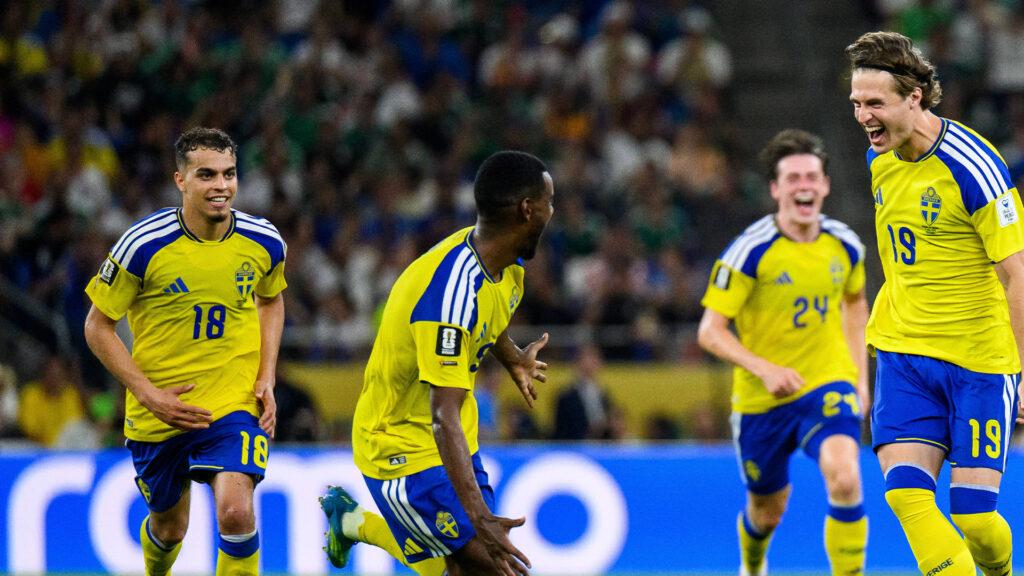
On June 14, Sweden striker Alexander Isak was named the 2026 World Cup Player of the Day after a complete centre-forward display of one goal and two assists, topping the Team of the Day with an 8.8 rating; on the same day, Ecuador fell 1-0 to Ivory Coast, with Amad Diallo scoring the only goal of the match and also making the lineup.
Isak: A textbook day at centre-forward
Isak posted typical modern No. 9 numbers in this match: 3 shots, 2 on target, 0.36 expected goals and 0.44 expected goals on target, 17 passes with 14 completed for an 82% success rate, including 12 of 14 in the opposition half. More crucially, he delivered at both ends of finishing and link-up play — 1 goal, 2 assists, 2 big chances created and 2 key passes — running through the drop-deep-to-receive, create-space, final-pass routine.
Off the ball, he did not slack either: 14 carries, 4 of them progressive, for 155.8 metres of total progressive distance, with his longest run covering 21.3 metres; he also completed 1 tackle and 1 ball recovery. Three offsides and one big chance missed show how tightly the defence marked him, yet he kept testing the back line, dragging opposition centre-backs out of their comfort zone with his movement. Both of his 2 dribbles were unsuccessful, but he focused on intelligent off-the-ball runs and link-up play — every one of his 35 touches served the team's rhythm rather than individual showboating.
For Sweden, this was more than individual brilliance. Their FIFA ranking has risen to 38th, up four places from the previous update; despite recent 0-0 draws in some matches, the technical numbers from this 5-0 rout — 13 shots, 7 on target, 49% possession, 353 passes at 79% accuracy — aligned closely with Isak's output, showing the team can convert front-third combinations from training into effective finishing in key matches.
Diallo: How the Winger Delivered the Decisive Blow
In Ivory Coast's clash with Ecuador, Diallo took Man of the Match honors with an 8.5 rating. Both of his two shots were on target, with expected goals of 0.19 and expected goals on target of 0.88—the gap between those figures showed he seized higher-quality chances and converted them. The match's only goal came from his boot, directly deciding the outcome.
Behind the numbers was his reading of the game: 30 touches, 15 of 17 passes completed for an 88% success rate, 10 of 12 passes in the final third, and both long balls finding their mark. He completed 6 of 7 dribbles and won 7 of 9 ground duels, threatening consistently in possession while drawing defensive pressure to his flank. Defensively, he added 3 ball recoveries and 1 attempted tackle, plus 1 key pass and 0.15 expected assists—a textbook all-action winger display.
Ecuador held 52% possession, completed 492 passes at an 85% success rate, yet managed only 1 shot on target from 12 attempts—their attacking efficiency bore little resemblance to their control of the ball. Ranked 23rd by FIFA with 1594.78 points, they were hardly short on paper, but Diallo's individual brilliance and Ivory Coast's collective discipline magnified their failure in the final third. For Ecuador, raising decision-making quality inside the box while preserving their possession-based structure will be essential in the group stage matches ahead.
Team of the Day: Control, Directness and Late-Game Impact
The June 14 Team of the Day was not simply a list of goal scorers, but a balanced selection weighing finishing, progression and overall match influence. Beyond Isak and Diallo, the lineup featured a German spine through the middle, highly rated wingers on both flanks, and a goalkeeper who produced several crucial saves early on—collectively embodying a hybrid style of midfield control, direct wide play and late-game game-changing impact.
The contrast between Isak and Diallo is worth reading closely: the former handled hold-up play, finishing, and assists from the centre-forward role, while the latter operated as a winger, using dribbling and physical duels to break open space. Their ratings differ by just 0.3 points, yet their tactical roles could hardly be more different—a clear illustration of how the day's best XI is chosen: not just by goals scored, but by whether players in the right positions turn team tactics into meaningful data.
What to Watch Next: Club and International Double Duty
Isak plays his club football for Newcastle United. St James' Park holds 52,758, and with the club season overlapping the World Cup schedule, demands on players' workload allocation and recovery management are higher. He has already shown for his country that he can carry the full centre-forward load; whether he can maintain the same running volume and passing accuracy back at Newcastle will directly shape the Magpies' attacking ceiling in the league.
Sweden must keep refining the front-three interplay in their 3-1-4-2 system through the World Cup cycle. Ecuador, meanwhile, need to quickly adjust the attacking conversion rate of their 4-4-2 after defeat. If Diallo can sustain his dribble success and duel-win rates from this match in upcoming group-stage fixtures, Ivory Coast's flanks will become a focal point for every opponent's defensive plan.
Our Take
Isak's selection as player of the match was barely disputed: beyond one goal and two assists, pass completion in the opposition half, progressive carrying distance, and chances created together form the evidence chain of a complete centre-forward. Diallo's inclusion was equally justified—against opponents who dominated possession, he produced higher-quality threat with fewer touches, exactly the skill that matters most in World Cup knockout football. For fans, the signal from the 14 June best XI is clear: with the 2026 World Cup being jointly hosted by the United States, Canada, and Mexico, the fit between individual quality and team structure is replacing raw possession as the new yardstick for judging a match's value.