


















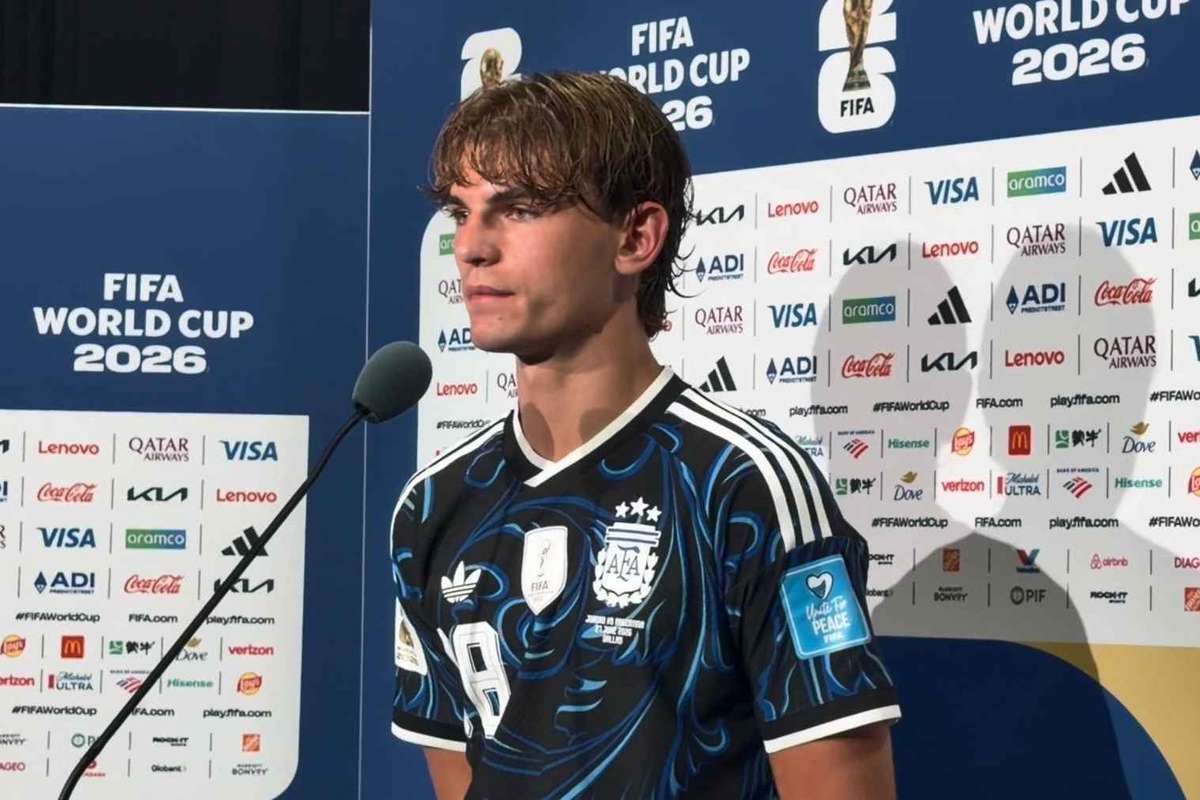
When a young player in their early twenties earns their first World Cup start, emotions are often harder to quantify than tactics. Nico Paz finds himself at precisely such a moment, overlapping with Argentina's 50th World Cup victory in history—a 3-1 win over Jordan. The score itself was no surprise: Argentina dominated with 73% possession, 799 passes completed at a 92% success rate, 12 shots with 4 on target; Jordan managed only 5 shots with 1 on target and 27% possession. More noteworthy is that in post-match interviews, Paz repeatedly pointed to one variable: the locker room atmosphere is turning "talent expectations" into "on-field expression."
Atmosphere Is Not a Slogan, but a Permission Mechanism for Young Players
Paz has spent less time with the national team than most of his teammates, but his judgment on collective dynamics is quite clear: "When we get along well off the pitch, it definitely shows on the pitch." This is not vague solidarity rhetoric. For rising stars, atmosphere is essentially a "permission to perform"—allowing you to play your familiar style under high pressure, without having to carry the narrative of "replacing someone" or "surpassing someone" with every touch.
Before the World Cup, outsiders had already placed him on Argentina's potential breakout list. Paz handled this with equal composure: thanking supporters and emphasizing how closeness brings stability to his game. "I can show myself more calmly"—behind that statement lies a new member who has been fully embraced, not an over-hyped media spectacle.
Veteran Mentorship: Messi and Otamendi's "Permission to Be Yourself"
Paz specifically mentioned Messi and Nicolas Otamendi. His description was very specific: they would proactively communicate before and after matches and offer advice, with the core message always being “be yourself, play calmly, and don’t be afraid to show your qualities.”
From a team-structure standpoint, this precisely fills the most sensitive gap in Argentina’s title-defense cycle—how to manage the generational transition while Messi remains the central axis. The new generation represented by Paz does not need to be pushed to copy the old template; what it needs is to find a replicable match language within the championship framework. Otamendi provides the defensive experience benchmark, while Messi provides the offensive decision-making model; the two men’s work in helping young players overcome fear is closer to the real source of competitiveness than any tactics board.
Beyond the 3-1: What the opening-match data reveals about a knockout template
Against Jordan, Argentina delivered a typical possession-based victory: in a 4-4-2 setup, they suppressed the opponent with high possession and a high pass-completion rate—6 corners, only 7 fouls, zero yellows and zero reds, discipline and efficiency in equal measure. Jordan, in a 3-4-2-1 counter-attacking shape, still showed threat by scoring once, but with 27% possession and 5 shots, they struggled to sustain systematic pressure.
For Paz personally, starting his debut at a team-history milestone was a signal that he had been “formally brought into the core rotation.” The outside world expected him to be a surprise weapon, but he placed more emphasis on fitting in—an approach that actually reduced the friction between him and the team.
Round of 32 approaching: fitness recovery and new challenges against Cape Verde
Paz has clearly felt the psychological gap between the knockout stage and the group stage: "Completely different stage, completely different mentality." He also stressed the immediate priority—recovery. After a match that took a heavy physical toll, the entire squad needs to recharge before shifting focus to the next opponent starting tomorrow.
Argentina's Round of 16 opponent is confirmed as Cape Verde. Ranked 69th by FIFA, the latter has leaned heavily on 0-0 draws across recent fronts, projecting a steady, organized style of play—distinct from Jordan's deep-block counter-attacking. For the defending champions, the real Round of 32 test often lies not on paper but in tempo changes: the patience to shift from "domination through possession" to "breaking down a low block," and whether young players can carry their opening-game confidence into higher-intensity duels.
Conclusion: Argentina's hidden edge is being magnified in the dressing-room atmosphere
If Argentina's start to this World Cup is read solely as a 3-1 win and a 50th victory in team history, you would underestimate the squad's true condition. Paz's interview points to a deeper path: the championship core did not shut out the newcomers; through daily interactions and post-match talks, they converted the "prospect label" into "game-day responsibility."
Next up against Cape Verde, fitness management and tactical targeting will run in parallel. Whether Paz can continue to expand his role alongside Messi depends not only on individual talent, but also on whether this team can consistently translate the atmosphere of "positive impact" into decisive moments in the knockout rounds. Judging by how the dressing room is operating at present, this conversion chain is already in motion.