
















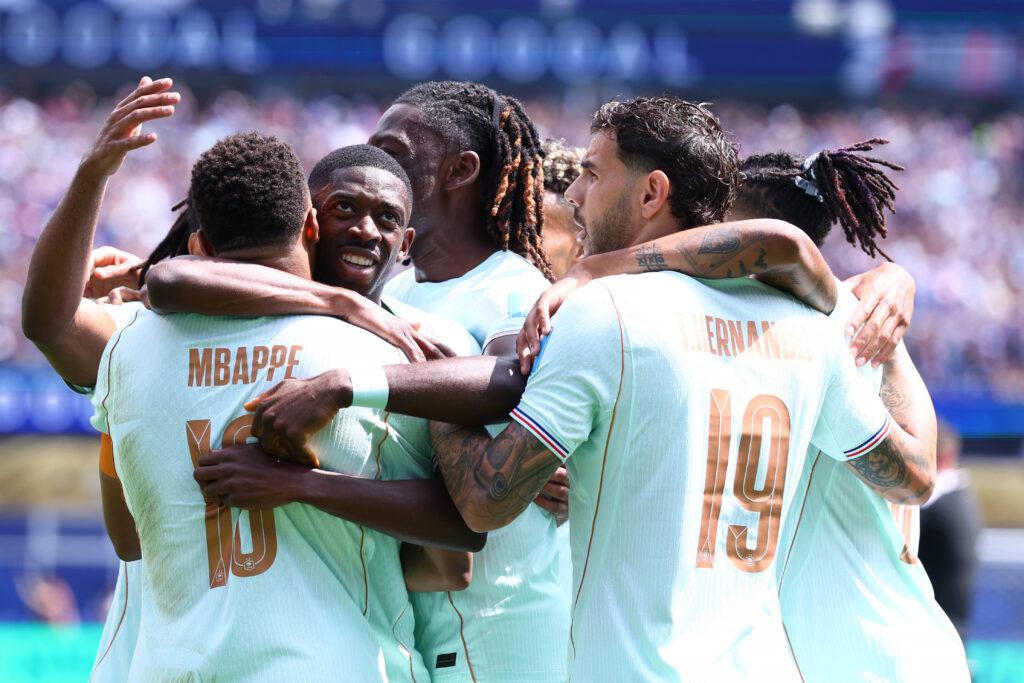
At Gillette Stadium in Foxborough, 64,146 spectators witnessed a solo performance compressed into 65 minutes. In Matchday 3 of Group I at the FIFA World Cup 2026, France beat Norway 4-1, leading 3-1 at half-time and adding another goal after the break to seal the win. Referee Michael Oliver took charge, and the clearest storyline on the pitch was No. 10 Ousmane Dembélé — with just three shots, all on target, he completed a hat-trick and earned a perfect ScoreZ rating of 10.0.
An efficiency ledger of three shots, three goals
If this match were written up as a data report, Dembélé’s entry would be almost impossible to trim. Three shots, three goals, with a conversion rate and shot-on-target rate both at 100%. In the high-pressure context of the World Cup group stage, output like this — “every touch pointing to threat” — is more telling than simply taking more shots. France had 17 shots and eight on target across the match; Dembélé alone accounted for three of the decisive finishes. Norway had 10 shots and four on target; once the back line gave him space, there was no limiting the quality of his finishing.
A finer technical profile supports the same “ruthless efficiency” verdict: before leaving the pitch in the 65th minute, he completed 30 of 41 passes — six of six in his own half, 24 of 35 in the opposition half; two key passes showed he was still involved in link-up play beyond scoring, five of seven long balls found their mark, and one of three crosses reached its target. Fifty-one touches, only one dispossession, one serious touch error, and 15 possessions ending in loss of the ball — in a 4-1 win, that is an acceptable cost of vertical thrust. It is the classic risk-reward structure of the No. 10 in a 4-2-3-1 system: “stretch space, create transitions.”
Movement and offside: the rhythm control behind one warning
Dembélé's surges down the right were equally visible in this match's data: progressive carries and just one offside together outline how precisely he timed his forward runs. After France took a 3-1 lead into halftime, the game entered the "how to manage the advantage" phase; Dembélé did not get caught in pointless back-and-forth, instead trading a limited number of forward runs for high-quality shots—that is also the underlying logic behind why Deschamps felt confident enough to take him off early: the job was done, the scoreline had tilted, and there was no need to drain his physical reserves before the knockout rounds for the sake of personal stats.
Deschamps' Minute Management: The Trust Boundary After Going Ahead
From the locker room and coaching staff's perspective, the value of this match goes beyond Dembélé's individual brilliance. Deschamps' decision to withdraw him after 65 minutes was a public demonstration of "how to protect a core attacker when leading": France need their No. 10 to explode at key moments, but also to remain available over a longer campaign. According to on-site data, France held 57% possession and completed 545 passes at 86% accuracy, with the 4-2-3-1 functioning steadily; Norway had 43% possession and 409 passes at 82% accuracy, and failed to effectively suppress France's transitions when trailing. FIFA ranks France 1st and Norway 31st—the gap on paper did not automatically translate into goals; what truly separated the sides was France converting their limited chances into four goals while Norway could only answer with one.
Norway's Structural Defensive Dilemma
For Norway, the 0-4 away defeat (on-site technical stats: 10 shots, 4 on target, 4-3-3 formation) exposed a quality gap in their counter-pressing chain: when the opponent has a No. 10 who can complete a hat-trick in 65 minutes, simply compressing space is not enough—you must also continuously block his shooting lanes. Dembélé proved in this match that once he gained space to shoot rather than merely to pass, the punishment was instant and complete.
Conclusion: A Knockout-Stage Dress Rehearsal in "Perfect Sample" Form
ScoreZ 10.0 is not just a post-match number—it marks Dembélé simultaneously fulfilling the full responsibilities of finishing, link-up play, and stretching space on the World Cup stage. For France's long-term competitiveness, this matters more than any single scoreline: in the third round of Group I, it validated that peak output from the No. 10 role and the coaching staff's minute management can go hand in hand. Dembélé rewrote the scoreboard in 65 minutes, and Deschamps used that same substitution to send the entire squad a management signal on how to contain risk after taking the lead—this is the side of France's World Cup cycle more worth recording.