

















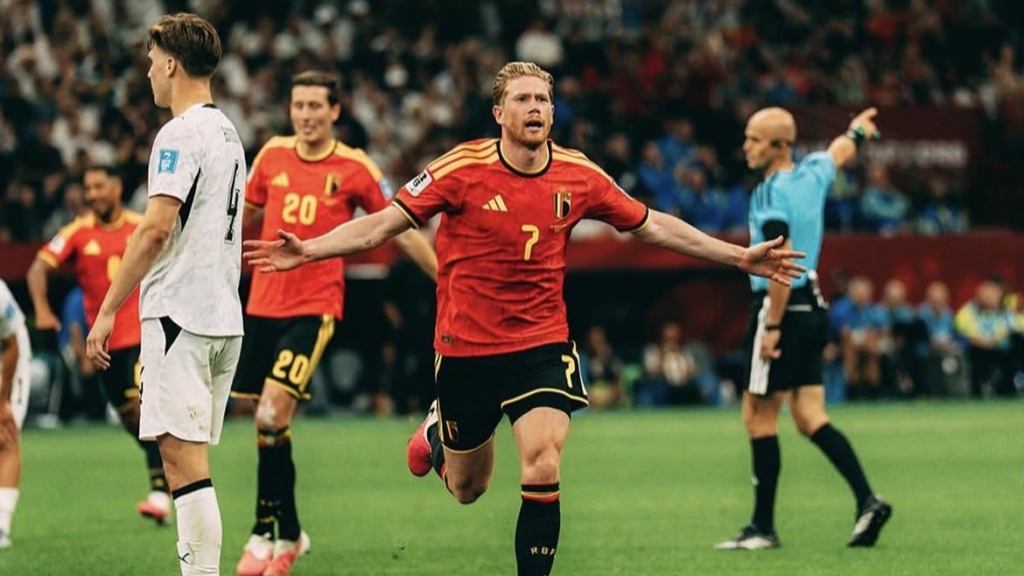
At BC Place in Vancouver, 52,497 fans witnessed a largely one-sided contest. Belgium beat New Zealand 5-1, with Kevin De Bruyne delivering a textbook "core output" in 72 minutes—1 goal, 4 key passes, and a 9.0 ScoreZ rating. For a team ranked ninth in the world, this was not just a big win, but exactly the kind of certainty needed in the final group-stage match.
When the game needed someone to spark it
In the last round of the World Cup group stage, the pressure is often less about the scoreline than the rhythm. Belgium took control from the opening whistle, finishing with 55% possession, 35 shots, and 10 on target—numbers that completely overwhelmed their opponents; New Zealand managed 6 shots with 2 on target and 45% possession, spending most of the match reactively reshaping their shape. De Bruyne's value lay in turning possession into threat.
He completed 41 of 47 passes, 33 of them in the opposition half; his 4 key passes led the team, while 2 of 4 crosses and 2 of 3 long switches constantly stretched New Zealand's 4-2-3-1 back line horizontally. His 12 ball carries covered 96.6 meters, 50.8 of them progressive, with a longest single carry of 26.18 meters—this was not blind surging forward, but the classic sequence of observe, accelerate, then deliver a purposeful pass. His 0.53 expected assists matched exactly what the eye could see on the pitch.
Shot volume itself is a tactical language
De Bruyne took seven shots in the match, the most on the team; two on target, three blocked, two off target, with 0.50 expected goals and 0.39 expected goals on target. Even when not all of them turned into goals, this shooting frequency kept reshaping defensive positioning—blocks tied up centre-backs, misses forced full-backs to cover, and teammates could find space in the “ripple effect.” Belgium’s five goals piled up further in the second half, exactly the result of that sustained pressure.
In the ScoreZ model, his passing value was normalized to 1.00 and his shooting value to 0.41, showing his contribution did not rest on that one goal alone. For a midfielder about to turn 35, this looked more like experience paying off: knowing when to hold the ball, when to switch play, and when to suddenly let fly from the edge of the box.
From Individual Brilliance to a Team Template
If you shift the lens from “star player stats” to “team development,” this match offered a replicable framework.
First, **place creativity in the right areas**. De Bruyne completed 33 successful passes in the opposition half, meaning the threat came where opponents least wanted to drop deep—not through pointless circulation in midfield. For any team looking to improve attacking quality, this is foundational: key touches need to be closer to goal.
Second, **create uncertainty in multiple ways**. Passes, crosses, long balls, dribbles, long shots—five methods alternating, defenders could not rely on a single strategy. New Zealand’s six shots all game was exactly the picture of being gradually suffocated by this “multi-channel pressure.”
Third, **a key player does not need 90 minutes, but must play the decisive phases**. Seventy-two minutes on the pitch was enough to set the tone early, control rhythm, deliver assists, and finish himself. For coaching staffs, how to protect key players across a congested schedule while keeping output at its peak is a more realistic challenge than simply chasing numbers.
After the Group Stage Finale, the Real Test Begins
The 5-1 scoreline was impressive enough, and New Zealand—ranked 85th by FIFA—was hardly an opponent to be brushed aside. Belgium needed a victory like this to confirm that its attacking system still functioned under pressure. De Bruyne's post-match "9 out of 10" performance, in essence, answered one question: when the team needed someone to piece together scattered attacking fragments into a complete threat, who could still step up.
In the next stage of the World Cup, opponents will be stronger, space tighter, and margins for error slimmer. Belgium has already used this win to prove they possess the core players who can shift the course of a match at decisive moments. Whether they can carry their group-stage form into the knockout rounds depends on whether the entire squad can match De Bruyne—every touch purposeful, every run angled to open space for the next pass.
For ordinary fans and amateur players, the most memorable takeaway from this match is not the 9.0 rating itself, but the simple yet hard-to-master logic behind it: the value of elite players often lies in making their teammates' jobs easier. When passing, shooting, progression, and decision-making are all firing at once, victory is no longer a fluke—it becomes a structure that can be repeated.