










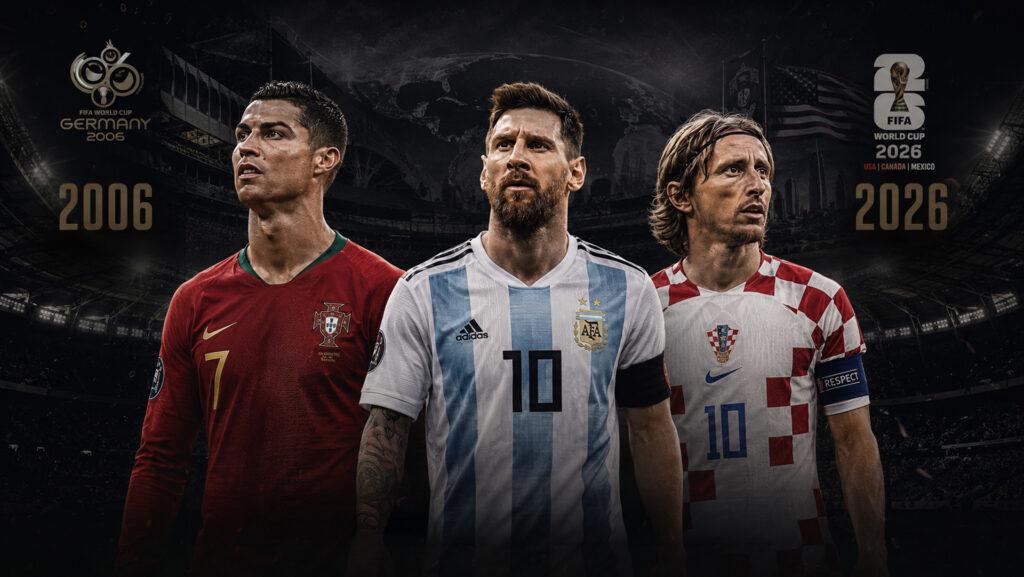
Question: Twenty Years of Format Changes—Who Will See the World Cup Through to the Finish?
As the World Cup schedule stretches toward 2026, a rarely discussed legacy of the tournament format has come to light: three of the five Ballon d'Or winners—Cristiano Ronaldo, Messi, and Modrić—will be the only overlapping players to have actually taken the pitch between the 2006 Germany tournament and the 2026 USA-Canada-Mexico joint edition. Mexican goalkeeper Ochoa was named to the 2006 squad but never appeared, so he does not make this special list. Over twenty years, VAR was introduced, substitution slots were expanded, and attacking movement was quantified—rules and tactics were overhauled again and again, yet these three men have remained at the heart of the tournament's narrative.
Anxiety: The "Last Dance" Pressure Outlined by the Data
Cristiano Ronaldo's Portugal career spans five World Cups: 2006—6 appearances, 1 goal, average rating of 7.18; 2018 in Russia—4 goals, rating of 7.90, his most productive edition; 2022 in Qatar down to 6.54, but still contributing 1 goal. Across 22 matches, 8 goals and 2 assists, his role has shifted from the heavy ball-carrying of his early years to finishing in the box and set-piece threat. Over the past year, his monthly ratings have mostly ranged between 7.2 and 7.9; his shooting frequency in the opening phases remains high, and penalties continue to provide a reliable floor.
Messi, meanwhile, charted a different path for Argentina. In his 2006 debut, he scored one goal and provided one assist in three appearances; in 2014, he scored four goals and led the side to the final; in 2022, he registered seven goals and three assists with an 8.53 rating, finally lifting the World Cup. Across the World Cup, he has 26 appearances, 13 goals and eight assists. Over the past year, his ratings have held steady between 8.0 and 9.3—of the three, he is the one whose form has stayed closest to peak levels. Site data shows Argentina are provisionally ranked third in the FIFA rankings with 1,874.81 points; Portugal are fifth with 1,763.83, with both having moved up and down from the previous edition.
Modrić, as the third Ballon d'Or winner, likewise underscored this span. His club and international run from 2006 to the present has made him one of the most enduring symbols of Croatian football's global rise. Compared with Ronaldo's shift toward efficiency and Messi's return to championship glory, the Croatian midfielder's value lies more in tempo control and serving as an anchor of major-tournament experience—especially critical while the next generation of midfielders have yet to fully take the reins.
Solution: Role Division and Key Watchpoints on the 2026 Pitch
From a policy perspective, the coexistence of all three itself illustrates the tension between FIFA player protection, compressed schedules and lengthened club seasons. How veteran cores are fitted into 26-man squads and how fitness is allocated within the five-substitution framework have become core issues for associations preparing for 2026. In Portugal's recent qualifiers, back-to-back 0-0 draws against Norway and Wales mean their breakthrough solutions in attack still need testing; database figures show Argentina, by contrast, displayed the maturity of their high press in a win built on 20 shots, eight on target and 73% possession, with the 4-4-2 running smoothly. In the same window, Portugal's win—18 shots, eight on target, 62% possession—reflected more direct vertical progression within the 4-2-3-1.
For Ronaldo, movement between the center-backs in Portugal’s opener against DR Congo remains the key to unlocking the defense—expected touches may fall short of his 2010 peak, but every run is worth tracking. Messi, meanwhile, must prove as defending champion that the miracle of 2022 was not the end of the road. Modric’s role is more understated: using experience and passing tempo to withstand the grind of a fast-paced group stage.
At the 2026 World Cup jointly hosted by the United States, Canada and Mexico, all three host nations have secured automatic berths. On this brand-new stage, whether the three “old classmates” from 2006 can deliver a true last dance will shape not only the final chapter of their individual legends, but also offer institutional-level reference points for player selection and youth development policy ahead of the next World Cup.