

















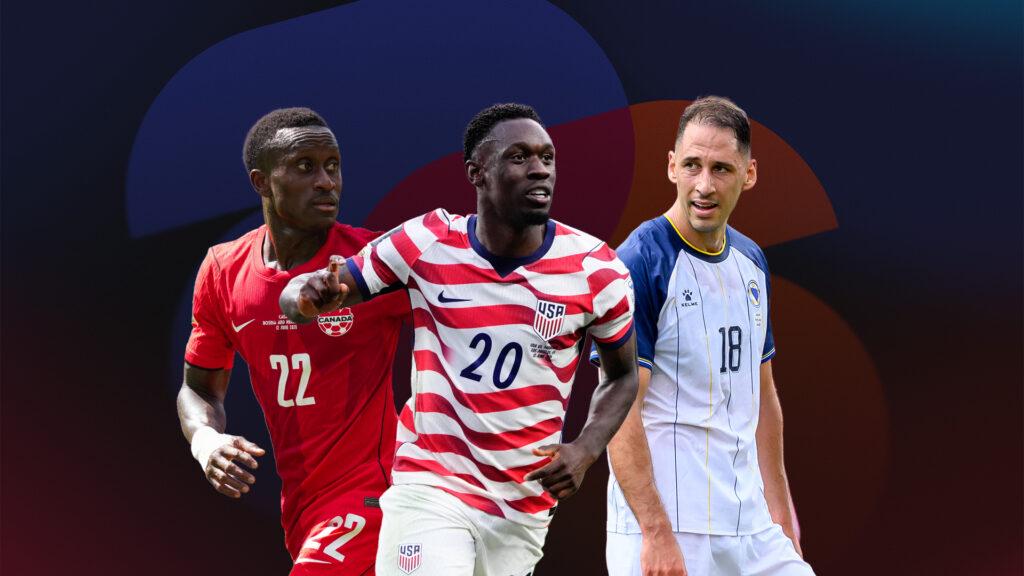
The 2026 FIFA World Cup is in full swing, and our on-site reporting shows that the Team of the Day for June 12 has been officially announced. The two matches that day—Canada vs. Bosnia and Herzegovina and the United States vs. Paraguay—served as the core sample for the selection; up front, United States international Balogun topped the list with a 9.1 rating, while Canada striker Larin, teammate full-back Laryea, plus Pulisic, Freeman and others also made the cut, sketching out a picture of heavy workloads at both ends of the pitch that day.
How two grueling matches produced the XI
The best XI was not simply a roll call of goal scorers; running distance, duel frequency, pass completion rate and defensive positioning were all compressed into the same evaluation framework. Both June 12 fixtures went the full 90 minutes, and the cumulative load on players’ muscles and nervous systems showed up directly in the post-match rating curves. Bosnia and Herzegovina’s centre-back pairing of Kolašinac, Muharemović and Katić all earned places, showing that the day’s selection favoured defensive performances built on low error rates and high duel success rather than attacking numbers alone.
Looking at the standings picture, hosts United States currently sit 16th in the FIFA rankings, Canada are 30th and Paraguay 40th. In the group stage, several sides were locked in stalemates—the U.S. drew 0-0 with Türkiye and Australia in succession, while Canada also failed to break the deadlock against Qatar and Switzerland; Paraguay likewise finished level with Türkiye and Australia. Under a packed schedule, the ability to keep producing technically under high-intensity duels was the underlying logic behind that day’s Team of the Day.
Attack: Balogun’s breakout and Larin’s focal role
Balogun's 9.1 rating led all players, a score that typically means he delivered at a high level simultaneously in finishing, off-the-ball movement, and pressing/recovery runs. Forwards operating at World Cup pace average dozens of short sprints per 90 minutes, with every run into the box demanding coordinated hip-and-knee drive; maintaining shot quality with center-backs tight on his shoulder points to effective activation of proximal muscle groups and controlled landing mechanics—critical for reducing soft-tissue injury risk in high-intensity competition.
Larin's 7.6 saw him partner Balogun up front as a focal point and second-ball outlet. Strikers tend to engage in physical duels in the box more often than wide players; Larin's ability to quickly shift possession after contact and create second-phase chances for teammates—this kind of "clear decision-making after collisions" is exactly the physical asset coaches value most during congested schedules. Against Paraguay's 9 shots, 1 on target, and 35% possession, the US front line clearly held the edge in pressing intensity and transition speed, which gives context to Balogun and Larin's high ratings.
Pulisic: The "Load Hub" Linking All Three Thirds
Pulisic's 7.4 came from the central attacking role, tying together the US final third. Shifting from winger to inside forward lengthens lateral carrying and adds direction changes, sharply increasing eccentric load on the hamstrings and groin; on the day he retained possession in the attacking third, pinned defenders, and played key switches—his rating trailed Balogun's, but tactically he shouldered a heavier volume of decisions. With the US registering 16 shots, 6 on target, and 65% possession, Pulisic was the hinge in this high-press passing system.
Midfield: Tillman and Bašić Dictate the Rhythm
US midfielder Tillman scored 7.5, while Bosnia midfielder Basic notched 7.4, with the pair together forming the "stabilizing layer" of the midfield triangle. At the World Cup, midfielders average more than 100 passes and dozens of tackles and interceptions per match; when muscle fatigue builds through the second half, the pass error rate spikes sharply. Tillman kept a compact position between the lines and cut down on wasteful back-and-forth runs—essentially managing his fitness reserves through sensible movement patterns. Basic, meanwhile, eased unnecessary acceleration sprints from teammates through steady distribution. This "trade rhythm for stamina" approach is precisely the survival formula in a congested group stage.
Bosnia's Iron Wall: The Physical Mechanics Behind the Center-Back Line's Collective High Ratings
The defensive core was handled entirely by three Bosnians: Katic on 8.1, Kolasinac on 7.9, and Muharemovic on 7.8. Center-back is one of the most collision-heavy positions on the pitch; every aerial duel involves stability in the cervical-thoracic chain and cushioning on landing. The trio's ratings all climbed that day, showing they had developed an understanding on timing their marking, winning aerial battles, and playing the first pass out: cutting down needless close-quarters grappling and using positioning to shut down passing lanes early. That not only lowers the risk of yellow cards and injuries, but also saves energy for the counter-attack phase.
For Canada, facing a physically aggressive opponent like Bosnia, front-line players needed more off-the-ball movement to prise open space. Larin and Laryea both making the cut on the same day indirectly confirms that Canada's attack did not see its technique break down when the intensity of physical contest ramped up.
Complementary Flanks: The Price of Laryea and Freeman's Box-to-Box Runs
Canada right-back Laryea’s 8.1 was the highest flank rating of the day. In modern football, full-backs are often tasked with a dual brief of “attacking width plus defensive recovery”; over a single match, shuttling up and down the pitch across both halves can easily exceed 10 kilometers. Laryea remained a threat in the final third while his recovery positioning held firm—a two-way workload that constantly tests the hamstrings and calves. On the other flank, Freeman made the team with a 7.2, giving the United States width and balance. His rating owed more to disciplined defensive positioning and sound passing choices than to high-risk dribbling; with the lead in hand, that risk-managed approach still merits a high score.
Goalkeeper Crepeau: The Defensive Logic Behind a Low Score
Canada goalkeeper Crepeau’s 6.8 was the lowest in the lineup, but that does not equate to a poor display. Goalkeeper ratings depend heavily on shot volume and save difficulty: when the back line holds its shape and opponents’ long-range efforts lack quality, a keeper’s numbers can look flat. Crepeau spent much of the day as the last organizational link at the back, with short-pass initiation and timing of advanced positioning also factored into the rating system. For Canada, against a backdrop of consecutive group-stage draws, how the goalkeeper and center-back pairing split pressing risk will directly shape fitness reserves heading into the knockout rounds.
Squad Takeaways: The Fitness Ledger in a Packed Schedule
Three trends emerge from the day’s best XI: first, host nation the United States rode front-foot pressing and transition speed to a four-goal win over Paraguay, lifting front-line ratings with results to back them up; second, Bosnia and Herzegovina’s center-back pairing built a low-error back line through physical duels and positional nous, proving that toughness on the World Cup stage does not mean recklessness; third, Canada’s Laryea, Larin, and Crepeau all made the cut, showing the Maple Leaf can keep its system intact even as the intensity of challenges rises.
The pressure on the upcoming schedule shows no sign of easing: the United States still has tough tests such as Turkey to navigate in the closing stretch of the group stage, while Canada must continue to measure itself against Europe’s elite; if Paraguay hopes to turn its qualification prospects around, it must lift its finishing efficiency from single-digit shots on target in the remaining matches. For the players in the squad, high ratings mean their bodies have already been pushed into a high-workload zone—rotation, recovery, and muscle management will become the hidden battleground for coaching staffs over the next 48 hours. We will continue to track World Cup position-by-position rating trends and physical workload metrics, breaking down the sports science behind those standout performances for our readers.