

















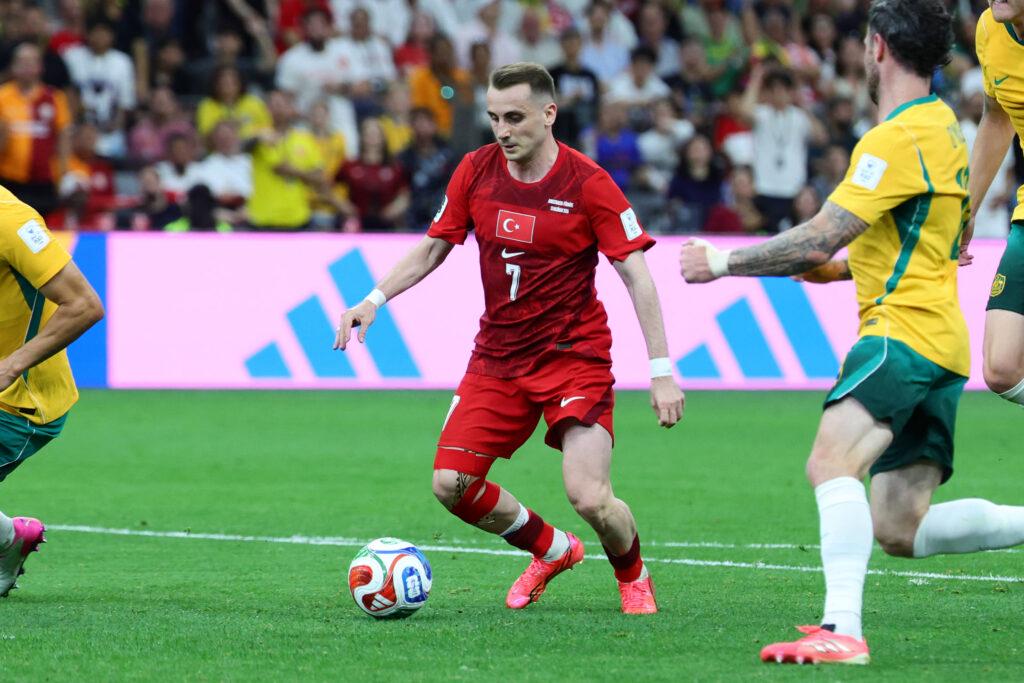
In the opening match of Group D at the 2026 World Cup, Australia defeated Turkey 2-0 at BC Place in Vancouver, with 52,497 fans in attendance. The Socceroos claimed all three points thanks to sharper finishing, while Turkey dominated possession but came away empty-handed—a collective drought from their front line proved the main reason for defeat.
Dominating Possession, Lacking Finishing
Site data shows Turkey enjoyed 72% possession, with 30 shots and 8 on target, a 90% pass completion rate, and a 4-2-3-1 formation—substantial attacking investment across the board. Yet against Australia's compact 5-4-1 defensive setup, every threat broke down at the final pass and final shot. By stark contrast, Australia managed just 28% possession, 9 shots and 4 on target, yet scored two goals and kept a clean sheet—efficiency proved the cruel dividing line in this match.
On FIFA rankings, Turkey sit 22nd, up three places from the previous edition with 1,599.04 points; Australia rank 27th with 1,580.67 points. The gap in paper strength is not wide, but World Cup group-stage football is about seizing your chances. Dropping points in the opening Group D fixture has sharply narrowed Turkey's margin for error in their bid to advance from the group.
Aktürkoğlu: A Painful Night on the Path to Growth
Leading the line, Kerem Aktürkoğlu turned in a disappointing performance. Over 85 minutes he had just 21 touches and took 3 shots—1 on target, 1 off target, and 1 blocked, with 2 from inside the box and 1 from outside. His expected goals (xG) stood at 0.286, expected goals on target (xGOT) at just 0.172, he missed one big chance, and his conversion rate was 0%.
The passing numbers were equally disappointing: 6 of 11 passes completed for a 54.5% success rate—3 of 3 in his own half, but only 3 of 8 in the opposition half; 1 key pass, 1 shot-creating action, an expected assists (xA) figure of 0.036, no assists delivered, and no accurate crosses. Three carrying runs covered roughly 31 meters in total, with two counting as progressive carries and the longest single carry reaching 9.12 meters—he could get to the edge of the box, but that one decisive, match-winning final ball never came.
In physical duels he drew two fouls, suggesting he could occasionally find pockets of space, but his touch frequency was too low to sustain pressure on Australia's center-back pairing. For a striker carrying such high expectations, this level of output simply isn't enough on the World Cup stage. Development is never a straight line, but going blank in the opening group match means the pressure will land immediately on him and the coaching staff.
Collective Slump from the Young Attack
All four Turkish front-line players finished with ratings at or below the passing mark. Arda Güler, Orkun Kökçü, and Yılmaz also failed to unlock the game, with link-up play and finishing both falling flat. Individually these youngsters are capable enough, but under the high-intensity rhythm of a World Cup, the chemistry between them clearly hasn't gelled—broken passing lines, overlapping runs, hesitancy on the final ball—and those issues combined to turn 30 shots into zero goals.
From a developmental perspective, this was an expensive lesson on the biggest stage: the flair that works at club level demands steadier decision-making and colder execution at the World Cup. The Joseph-style academy philosophy is blunt—talent only pays off through contributions that matter in the moments that matter, not possession numbers on a spreadsheet.
The Socceroos' Defensive Report Card
Australia committed 12 fouls, won five corners, and picked up zero yellow cards—a disciplined defensive performance. With less than 30% possession, they willingly surrendered the ball, clogged the center, shut down the half-spaces, and kept Turkey pinned to long-range efforts and hopeful crosses from the edge of the box. Behind the 2-0 scoreline was a back line fully dialed in—for an opening World Cup match, that pragmatism matters more than flash.
For Australia, this victory got their Group D campaign off to a strong start. They still have other opponents in the group to come, and every match will be a tough test; Turkey, meanwhile, must quickly rediscover their form up front in their remaining two group games, or their No. 22 FIFA ranking will be hard to translate into a ticket out of the group.
What to Watch Next
Group D's race won't be settled by one defeat, but the growth curve of Turkey's young players has been thrust into the spotlight. Whether Aktürkoğlu can bounce back in the next match, and whether Arda Güler and company can turn individual quality into team goals, will directly shape the Crescent-Stars' chances of advancing. Australia, for their part, must keep building on this "less possession, more efficient scoring" approach — at the World Cup, results always speak louder than performances.