









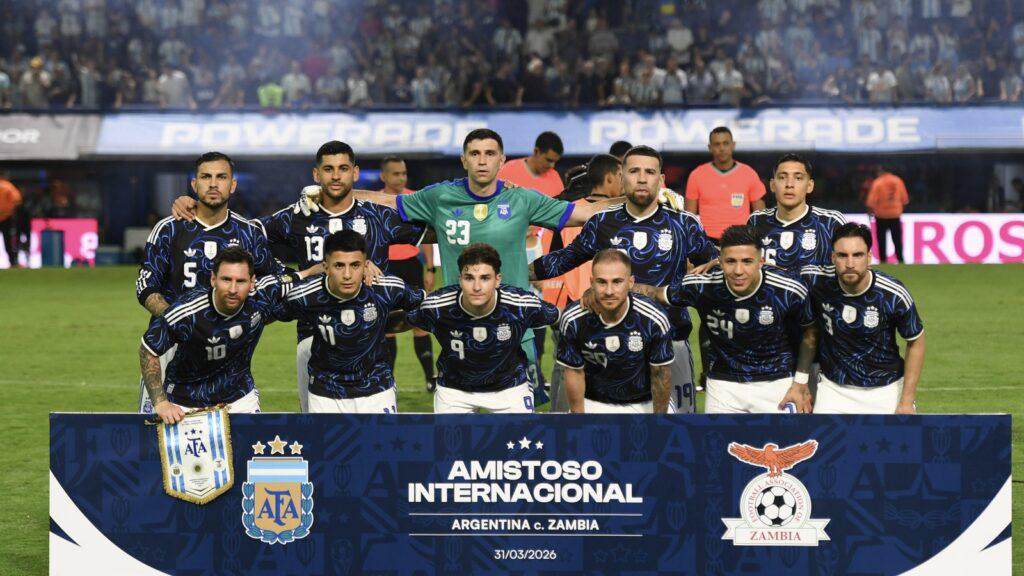
As the 2022 Qatar World Cup champions, Argentina will head to the 2026 USA-Canada-Mexico World Cup as the top seed in Group J. Their group opponents are Algeria, Austria and Jordan—all three will put “knock off the defending champions” at the top of their pre-match rallying cry. Scaloni’s squad still boasts world-class firepower in Messi, Lautaro Martínez, Mac Allister and Álvarez, but fixture density, the squad deadline and the historical curse of back-to-back titles will together decide whether this title defence stays on solid ground.
Group J outlook: seed advantage and opponents’ motivation
From the draw, Argentina’s role in Group J is to be “targeted by everyone.” Algeria, Austria and Jordan are not traditional title favourites, yet they are more than capable of producing attritional games in the group stage—for the defending champions, the cost of every point can turn into a fitness bill before the knockout rounds. Site data shows Argentina are currently third in the FIFA rankings on 1,874.81 points, down one place from the previous update; Austria in the same group are 24th, Algeria 28th, and Jordan 63rd having risen one spot recently. The gap on paper is clear, but World Cup group stages are never a case of “the rankings table translated straight into the scoreline.”
Jordan have posted three consecutive 0-0 draws in recent fixtures tied to the 2027 season cycle, with a tight tempo and a high price for mistakes—this kind of “low-scoring grind” does not suit title contenders: when you dominate possession but struggle to score, the round-trip running of your key forwards is magnified. Austria and Algeria more closely match typical European and African intensity levels—they will pose sustained tests to Argentina’s midfield link play and wide recovery speed. From a fixture-load perspective, three group games played at full intensity over 90 minutes will directly affect rotation room in the round of 16; if Scaloni insists on high pressing, he must reserve “plug-and-play” fitness subs in his 23-man squad, not just stack attacking star names.
Venues and travel: the real cost from Miami to North American pitches
In a Joel-style on-the-ground view, the “invisible opponents” at the 2026 World Cup are often travel, climate, and venue changes. Messi plays for Inter Miami, whose home ground is Chase Stadium in Fort Lauderdale, Florida, with a capacity of 21,550; the national team, meanwhile, must hop between multiple North American cities, moving from a late-club-season recovery window straight into national-team camp, with almost no true “full rest week” in between. For a 37-year-old captain who will still be the attacking fulcrum, this is not simply a question of form but of how training load is distributed—minutes in friendlies are, in essence, either being spent or banked, and Scaloni has to balance that ledger.
Jordan’s home ground is Amman International Stadium, capacity 25,000; the high altitude and dry climate are extra variables for a side coming from South America. If Argentina only face those demanding conditions late in the group stage, the medical and recovery staff will need to roll out hydration, stretching, and sleep-management plans in advance; such details never show on the scoreboard, yet they often decide whether key players can still explode in the knockout rounds. For fans, the focus is not only “can they beat Jordan,” but “what fitness toll did victory cost.”
Historical weight: the three-peat dream and the back-to-back curse
Argentina have appeared at the World Cup 18 times and won it three times: 1978, 1986, and 2022. To recreate the smiles of 2022 at the final whistle, they must first confront a cold statistic: in 96 years of World Cup history, only Italy (1934, 1938) and Brazil (1958, 1962) have successfully defended the title. Most other champions fall short the next time around; for opponents in the dressing room, the “defending champions” tag is the equivalent of a free rallying cry.
Meanwhile, Argentina remain reigning champions of the Finalissima and Copa América — the psychological edge from winning major tournaments is real, but it also means every friendly is scrutinized under a microscope. Scaloni's tactical discipline is central to the legacy of their 2022 triumph; if midfield control slips in 2026, the back line will be forced to weather more one-on-one sprints, which shifts pressure directly onto Emiliano Martínez — penalty duels and in-game management under pressure remain the fuse that protects Argentina's floor.
Squad countdown: the brutal cut from 55 to 26
As of late May, Argentina had yet to submit their final 26-man squad to FIFA. Scaloni has used pre-tournament friendlies to refine the list, trimming the 55-man preliminary pool to 35; big names such as Ángel Correa and Paulo Dybala have already been dropped in this round. Under the rules, the final squad can be confirmed as early as 29 May, or delayed until 1 June without penalty and without reverting to a provisional list — meaning the final week could still bring tweaks driven by medical assessments, tactical reshuffles, or opponent intelligence.
From a fixture-recovery standpoint, this squad is not just a ranking of quality but also a redundancy sheet for injuries. Lautaro Martínez (28, Inter Milan) has 80 caps and 36 goals for Argentina and is the steadiest finisher up front; Mac Allister and Álvarez supply the link play and depth of movement ahead of them. Correa and Dybala's omissions send a clear signal: Scaloni prefers players who can repeatedly execute pressing tasks in high-intensity games over attack-minded playmakers who need the ball stacked at their feet. For a defending champion, a "third midfielder" on the bench is often worth more than a "fourth striker."
Key players: Messi as the hub, the goalkeeper as the safety net
Messi remains captain and the focal point of the attack. Even if the matchday squad may still change with last-minute adjustments, he and Lautaro, Mac Allister, and Emiliano Martínez (33, Aston Villa) remain the names closest to being “untouchable starters.” Lautaro’s goal-scoring efficiency has been proven at major-tournament level; Mac Allister’s driving runs and distribution set the tempo for Argentina’s transitions from defense to attack; Emiliano Martínez has turned “penalty-shootout mind games” into a repeatable technical craft. Messi’s workload with Inter Miami stacked on top of national-team camps sits at the center of the squad’s entire fitness-management plan—saving a minute in a friendly can sometimes matter more than scoring another goal in a warmup.
Professional judgment and watchpoints on the title-defense path
Problem: Argentina’s biggest risk is not “failing to beat weaker sides” but “winning the group stage at a prohibitive physical cost,” leaving core midfielders and full-backs with sprint counts near their seasonal red line by the knockout rounds. Agitate: If Jordan and Algeria drag matches into low-scoring, high-intensity rhythms, Scaloni may be forced to burn his first-choice players early in the final group match; and historical data show back-to-back titles are extremely rare, with any psychological edge wiped clean the moment a brutal first knockout tie arrives. Solution: Watch the 26-man squad Scaloni names before June 1—depth among midfield substitutes, rotation at centre-back pairs, and the minutes-management clauses around Messi will say more about Argentina’s title-defense plan than any friendly goal.
Readers should watch three things closely next: whether the final squad brings back immediate contributors carrying injury risk, the opening intensity against Austria in the first group match, and travel-and-recovery reporting when Jordan play at home. Argentina remain among the 2026 World Cup title favorites, but between being a favorite and actually defending the crown lies an entire equation built on fatigue, rotation, and history.