















There is a particular weight to a manager's first true turnaround — not the kind built on dominance from the opening whistle, but the kind forged when a team must absorb a punch, reorganize under pressure, and find conviction when doubt is loudest. For Carlo Ancelotti, that moment finally arrived in Houston.
Brazil's 2-1 victory over Japan in the FIFA World Cup 2026 Round of 32 was more than a place in the next round. It was the first time the Italian had guided the Seleção back from a deficit to win since taking charge — a benchmark that had stubbornly eluded him through the early chapters of this tournament and the preparatory cycle that preceded it.
Coming from behind always carries a different emotional texture. Players speak of relief mixed with vindication; coaches speak of proof. On Sunday, both narratives converged around a single substitution, a repositioned forward, and ninety-six minutes of accumulated patience that finally broke Japan's resistance.
The Pattern Ancelotti Could Not Crack
Leadership narratives are often judged by how a coach responds when the scoreboard turns against his team. Before facing Japan, Ancelotti had watched Brazil fall behind on four separate occasions since assuming control. The responses had been mixed: resilience produced draws against Tunisia and Morocco, but the Seleção could not complete the turnaround against Bolivia or France.
That history mattered because it shaped the psychological environment inside the camp. Brazil entered Houston ranked sixth in the FIFA standings, having built momentum with commanding performances in the group stage — including a 3-0 win over Haiti and a 3-0 victory at Scotland. Yet the knockout round introduces a different calculus. One lapse in concentration, one moment when a team that has learned to chase games cannot find the equalizer, and a summer's work collapses.
Japan arrived as a credible obstacle. Ranked eighteenth globally, the Samurai Blue had navigated their own group with efficiency — a 4-0 dismantling of Tunisia, a 1-1 draw with Sweden, and the structural discipline that comes from operating in a 3-4-2-1 system built to absorb pressure and strike on transition. Ancelotti knew this would not be a procession.
When Brazil fell behind, the old questions resurfaced. Could this squad translate individual quality into collective recovery? Could the bench provide not just fresh legs but a tactical reframe? Those were the decisions that would define Ancelotti's night.
A Mid-Match Gamble That Changed the Geometry
The match data told the story of Brazilian control even before the decisive intervention. Ancelotti deployed a 4-3-3 and saw his team generate nineteen shots to Japan's five, seven on target against two, and complete sixty-nine percent of possession with a pass success rate of ninety-two percent across 682 attempts. Japan, compact in their 3-4-2-1, managed only 315 passes at eighty-three percent accuracy and committed thirteen fouls as they fought to slow the tempo.
Control, however, is not conversion. Brazil had the ball, the territory, and the territorial rhythm — yet they still needed someone to convert pressure into breakthrough.
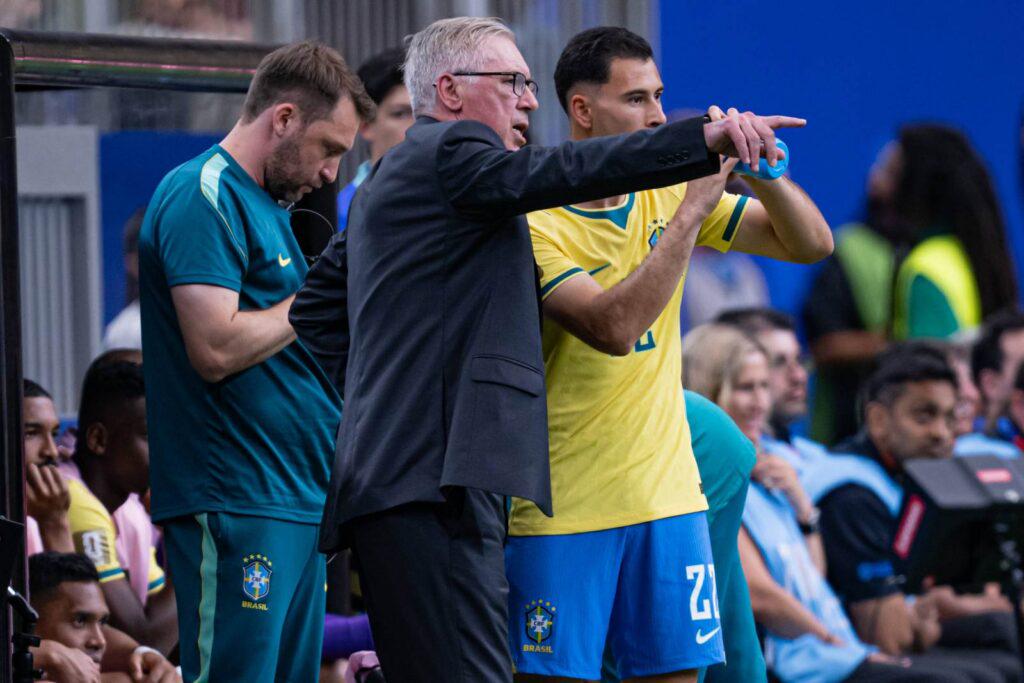
In the sixty-sixth minute, Ancelotti made the call that will linger in this tournament's tactical archive. He removed Matheus Cunha and introduced Gabriel Martinelli. The substitution was not a like-for-like refresh on the flank. Ancelotti repositioned the Arsenal forward into a more central role, altering the attacking reference point and forcing Japan's back line to recalculate their spacing.
It was a classic Ancelotti decision: read the flow of the match, identify where the opposition's structure was stiffest, and deploy a player whose movement could stress a different seam. Martinelli had been among the most debated names when the World Cup squad was announced — a selection that carried scrutiny because every Brazil roster invites comparison across generations. On this night, the manager's faith became the plot point.
Martinelli Delivers When the Clock Demanded Composure
Brazil's equalizer arrived through the persistence Ancelotti had publicly demanded — the refusal to panic when the margin was narrow and the knockout stakes were absolute. Then, in stoppage time, Martinelli struck from that central zone to complete the comeback and seal a 2-1 win that sent the Seleção into the Round of 16.
The numbers reflected a team that had earned its outcome. Brazil's nineteen attempts and six corners were the product of sustained occupation rather than hurried desperation. Japan's two shots on target were a reminder of how efficiently Hajime Moriyasu's side had protected their lead for long stretches — and how costly one late lapse became.
After the final whistle, Ancelotti framed the victory in terms that revealed his leadership priorities.
"We played well and deserved to win. The team stayed patient. We have plenty of quality both on the pitch and on the bench. It's great to see the players performing at such a high level individually," he said.
The quote was not mere post-match politeness. It was an articulation of the process he had been trying to install: trust the structure, trust the depth, and trust that individual brilliance would arrive if the collective maintained its composure.
Martinelli, for his part, could not contain his emotion. The forward, appearing in his second World Cup and continuing to build his international résumé, had become the face of Brazil's progression on the night he was needed most.
"I have no words to describe how happy I am to see the Brazilian people celebrating this qualification. The team effort made the difference. We gave everything for 96 minutes and fully deserved this victory. We kept fighting until the end. We scored the equaliser and then found the winner with a great move," Martinelli said.
His words captured the arc Ancelotti had pursued for weeks — not a solo act, but a collective refusal to accept the previous pattern of falling short when trailing.
The Paquetá Injury That Complicates the Next Decision
Every managerial triumph carries a footnote that can reshape the next chapter. For Ancelotti, that footnote was Lucas Paquetá.
Brazil's first-choice attacking midfielder was forced off at half-time against Japan with an injury. Paquetá is now a major doubt for Sunday's Round of 16 encounter against either Norway or Ivory Coast — a fixture that will demand the same tactical clarity Ancelotti displayed in Houston, but potentially without one of his primary connectors between midfield and attack.
The injury introduces a selection puzzle that tests the depth Ancelotti praised after the Japan win. If Paquetá cannot recover in time, the manager the midfield or promote another creative presence. Neymar and Danilo Santos represent experienced alternatives within the squad framework; Endrick offers a different attacking profile should Ancelotti prefer a more direct adjustment.
These are not abstract choices. They are the decisions that separate a Round of 32 escape from a deep tournament run. Ancelotti's first comeback victory has lifted a psychological burden, but the next match will ask whether that confidence can be replicated against a fresh opponent without a fully fit midfield hub.
What the Win Means for Brazil's World Cup Trajectory
Martinelli's central role and late heroics have inevitably boosted his case to start in the Round of 16. A player who entered the squad under scrutiny leaves Houston with a defining contribution — proof that positional flexibility and mental resilience can matter as much as reputation.
For Brazil, the broader significance extends beyond one night in Texas. The Seleção have shown they can win when the template requires patience and tactical intervention rather than early dominance. That identity may prove essential in the knockout rounds, where margins shrink and managers are judged by the adjustments they make when the initial plan meets resistance.
Ancelotti has spent a career mastering those moments. Against Japan, he finally authored one with Brazil.
The comeback duck is broken. The leadership test, however, continues — and the next answer may depend on whether Paquetá can return, and whether Martinelli's Houston role becomes a template or a one-night solution.