

















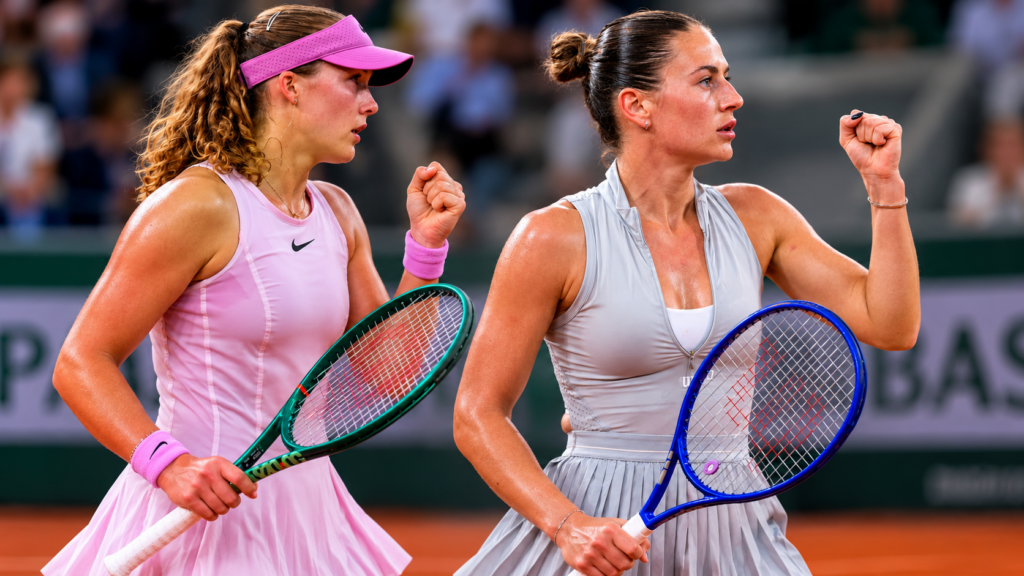
The first women's singles semifinal of the 2026 French Open pits No. 15 seed and current world No. 11 Kostyuk against No. 8 seed and current world No. 7 Andreeva on Philippe-Chatrier Court. The winner goes straight to the final—either extending a five-match clay winning streak to six, or handing momentum to the other side. Underneath this clash lie two very different approaches to the points that matter most.
Two paths to the semifinals
Both stand 1.75 m tall and play right-handed, yet they ground out the first five rounds of the French Open in different ways. Kostyuk, 21, is more the aggressive baseliner: fast tempo, momentum swinging back and forth. Andreeva, 19, is the all-court problem-solver who trims risk on clay with cleaner patterns and more mature shot selection. Clay lengthens rallies and magnifies placement and return quality; in semifinal tension, who blinks first is often not about one stroke, but whether you dare change the plan under pressure.
Kostyuk: the attacking ledger in a high-pressure rhythm
Kostyuk has been in form this spring and arrived in Paris on a five-match winning run. Through five rounds she has posted a 58.6% first-serve percentage and 68.6% first-serve points won, with an average of 4.4 aces and 4.8 double faults per match—intent on serve is fierce, and clearly volatile. Her 47.5% second-serve points won is still enough on clay whenever she can force short balls. Offensively she has piled up 170 winners and 178 unforced errors—a clear plus-minus attacking profile: willing to go for it, and willing to pay the price. On return she has created 61 break points at a 45.9% conversion rate, showing she prefers sustained pressure for initiative rather than waiting for the opponent to ease up.
Andreeva: lowering variance through choice
Andreeva has advanced on a five-match winning run as well, but she has looked the steadier of the two: on the points that matter, she relies less on brute-force solutions and more on patterns and rhythm to drag opponents into exchanges they dislike. Both her ranking and her seeding (No. 7 or No. 8) sit above Kostyuk’s, so the semifinal is her chance to etch this rise onto a Grand Slam stage—on Chatrier, crowds usually reward proactive variation and the courage to strike first, and both players have those weapons in their kit.
What Chatrier Magnifies
This is the 2026 French Open women’s semifinal—clay, the big showcourt, a place in the final—three variables stacked together, so line calls cost more than in earlier rounds. Clay rewards patience and ball quality, yet a semifinal still demands that you take your chances when they appear; coaches and players alike must keep toggling in real time between attacking first and grinding out rallies. If Kostyuk sticks with her high-variance game, her break-point volume is already an edge, but a rise in unforced errors would hand back the openings she creates herself; if Andreeva keeps choosing her shots maturely, she must absorb Kostyuk’s first burst of pace and use depth and return quality to pull the match into the longer exchanges where she is more comfortable.
Under Pressure: Who Can Rewrite the Script
Tactically, this is not a pure power bash. Kostyuk’s key decision is whether first-serve aggression can buy her short enough balls for her 47.5% second-serve points-won rate to hold up the rest of her game; she has already piled up 61 break points, and the semifinal is where conversion efficiency matters—if she lifts that 45.9% conversion rate another notch, she can drag the match into her rhythm. Andreeva’s key decision is whether, when Kostyuk speeds up and momentum swings, she still plays in “clean mode”—giving away fewer cheap points, using placement and variation to break up Kostyuk’s run of consecutive attacks and pull the match back into territory she can control.
The expert read: Kostyuk is buying probability with offense, Andreeva stability with shot selection; clay semifinals tend to reward whoever can string together two set wins, not a one-set spike. Whoever makes one fewer rash play on break points and one more smart change of pattern moves closer to the final.
What to Watch—and What Comes Next
The match was played on Philippe-Chatrier Court. After the first point, watch first-serve percentage, break-point conversion, and the winners-to-errors ratio—these map directly onto the decision lines above. If Kostyuk keeps the serve aggression and return pressure she showed through the first five rounds, the match will tilt fast and chaotic; if Andreeva holds rally control, it will feel more like “who gifts the unforced error that shouldn’t happen.” Either way, this is the opening semifinal of the Roland Garros women’s draw, with a place in the final still up for grabs—every change of plan on the big points will speak louder than the numbers on the rankings sheet.