

















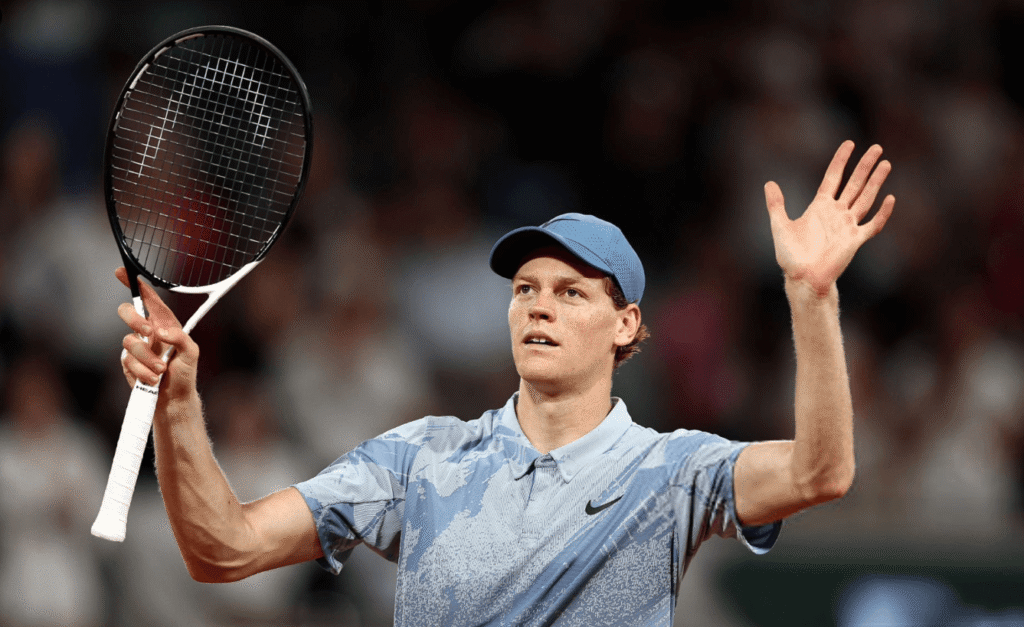
On May 26, 2026, top seed and world No. 1 Jannik Sinner defeated French wild card Clément Tabur 6-1, 6-3, 6-4 in straight sets on Court Philippe Chatrier in Paris, completing his 2026 French Open men’s singles first-round debut. There were no tiebreaks; Sinner did not face a single break point, and in his clay-court opener he executed “control the rhythm, limit errors” to the fullest.
Key Decision: Setting the Tone in the First Set
Sinner pushed from the opening game with a “secure serve first, then attack the return” approach. In the first set he won 17 return points to Tabur’s 2; he converted all three break chances to close out 6-1. For the world No. 1, this was not showmanship—it was dragging his opponent into the baseline rhythm he knows best, giving Tabur less time to build momentum in front of the home crowd.
Tabur is ranked No. 171 in the world and reached Philippe Chatrier on a wild card; the crowd noise favored the home player, but he had almost no breathing room on return. Sinner’s 100–65 points won and 18 games to 8 wrote “what the favorite should do” into the numbers: press angles from the baseline, extend rallies, and keep the gap from ever closing.
Serve and Return: The Divide Behind the Scoreline
Serving stats explain why Tabur could lift his level in the last two sets yet still could not turn the match. Sinner fired 8 aces to Tabur’s 2, with only 1 double fault; first-serve percentage 66%, first-serve points won 80%, second-serve points won 73%—still winning seven in ten on the second serve, so any lead had insurance. Tabur’s first-serve percentage of 63% was not poor, but points won behind the first serve were only 61%; under pressure on the second serve, his win rate dropped to 42%.
The return numbers were even more telling: Sinner won 39% of points on first-serve returns and 57% on second-serve returns; Tabur managed just 20% and 26%, respectively. On the break column, Sinner converted 5 of 13 break points, while Tabur failed to create a single break point all match. Each man served 13 games; those five breaks were the difference — Sinner’s plan was clear: don’t gamble on long rallies, use return quality to rewrite the scoreboard directly.
Selection and Path: The Gap Between a Wildcard and the Top Seed
From a player-development standpoint, this match was a head-on collision between two French Open pathways. Sinner arrived as world No. 1 and top seed, aiming to replicate his hard-court dominance on clay at a Grand Slam; Tabur embodied the classic “home wildcard plus low-ranking upset bid” profile — he had the crowd and the stage, but clearing the bar simultaneously on returns and baseline margin for error ratchets the difficulty up exponentially.
Winners 41 to 20 — Sinner had 23 forehand winners and 10 backhand winners, with 33 baseline winners to Tabur’s 18; Tabur had 14 forehand and 4 backhand winners. Neither player’s stats included volley winners, drop-shot winners, return winners, or overhead smash winners, pointing to a pure baseline war of attrition. Sinner committed 20 unforced errors all match, keeping that figure in an acceptable range; Tabur raised his intensity in the final two sets, but the gap was never closed — exactly the blueprint top players set in opening rounds of majors when they refuse to hand over momentum.
Looking Ahead
A straight-sets win without facing a break point allowed Sinner to keep physical toll to a minimum, preserving energy and mental bandwidth for the rounds ahead at Roland Garros. For the title contenders, the first round is about building a serve-plus-return loop, not padding stats — and that is exactly what he delivered today.
His next opponent will depend on how the draw unfolds, and fans can keep watching Sinner’s first-serve points won and break-point conversion—if his second-serve win rate stays around 70%, his clay-court title defense narrative in Paris will carry more weight. Tabur is out, but the wildcard was still valuable exposure at a major; whether he can bring the lessons from Chatrier back to Challengers and qualifying will decide if he can climb out of the 170s in the rankings.
Take: Sinner never gave the home wildcard a window to “steal a set on momentum.” The issue was not that Tabur lacked fight, but that his return games were a tier below. Roland Garros is a long grind, and this kind of first-round “quick-strike” win is actually the most economical start for the world No. 1.