

















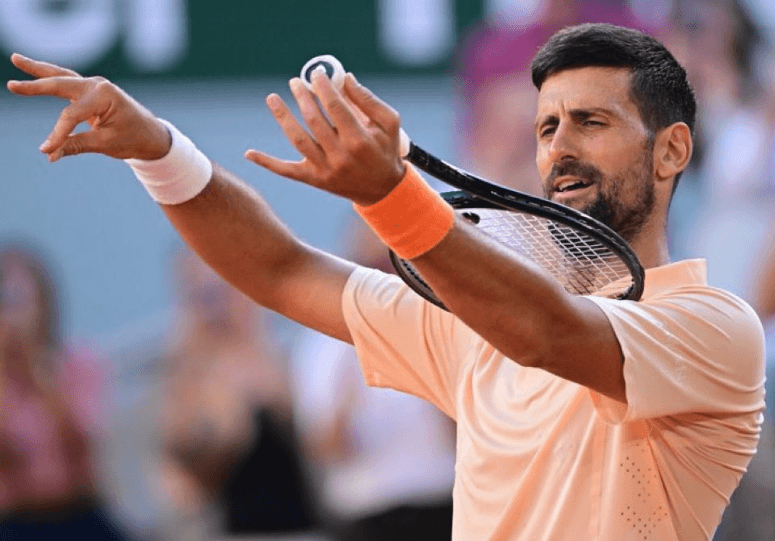
Third seed Novak Djokovic beat home player Valentin Royer 6-3, 6-2, 6-7(7), 6-3 on Philippe Chatrier Court, sealing a place in the 2026 French Open round of 64 in about three hours on clay and advancing to the third round. Royer clawed back one set with a 9-7 win in the third-set tiebreak, but Djokovic still held the initiative on the big points; this opener felt more like a full-intensity scouting run than a walk in the park.
Game plan: set the tone first, then ride out the swings
For Djokovic, the biggest call between the French Open first and second rounds was not chasing flawless, flashy tennis but getting his serve and rhythm established on clay first. He took the first two sets 6-3 and 6-2, briefly pushing his first-serve points won rate to 93%, and used two breaks to pull the match into a “seed controls rally length” pattern. That is his familiar playbook: cut unnecessary risk and keep piling pressure on the opponent’s second serve and in the rallies.
The third set was a different test. Both men broke twice, Djokovic hit five double faults in the set alone, Royer pushed his second-serve return points won to 71%, and won the tiebreak 9-7. For the 38-year-old Djokovic, still chasing Grand Slam records, the real value of that set was a reminder: opponents on clay do not fold automatically because of the ranking gap, especially in the home atmosphere in Paris, where any lapse gets magnified.
By the numbers: first serve is the dividing line, breaks shape the match
Both players finished with 10 aces apiece—on the surface, the serving firepower looked even—but first-serve points won told the story: Djokovic won 69 of 89 first serves (78%), Royer 46 of 69 (67%). More decisive was conversion—Djokovic converted all six break chances, Royer only two; at the same time Djokovic saved five of seven break points, while Royer held only three of nine. On service points overall Djokovic led 90 to 67, having served two more games, which shows he was more willing on his own serve to trade “safe” for “control.”
The return game was almost a dead heat: the pair split 43–44 points won on return, and Royer’s resilience showed up clearly in the numbers. Yet whenever Djokovic’s first serve found its spot, rally control tilted unmistakably his way. Royer held a slight edge on second-serve points won, 51% to 47%, but that was not enough to offset the gap on first serves and break efficiency—in so many clay-court matches, you do not lose the grind; you lose whoever gives up a service game first.
Why Royer could stretch the match to four sets
The gap between Royer’s world ranking and his seeding was real, but in Paris he turned in a performance that was “capable of learning and fighting back.” In the first set he hit 80% of his first serves, yet won only 60% of first-serve follow-up points and 40% on second serves—suggesting the issue was not the serve motion itself but the first shot after the serve. In the second set he won just 7% of points on first-serve returns, almost locked down by Djokovic’s pressuring return game; by the third he had raised his second-serve return win rate to 71% and seized two breaks as Djokovic’s double faults piled up—a classic payoff from high-intensity clay training in match play: not sustained dominance, but dragging rallies into a length that suited him when his opponent wobbled.
For the French Tennis Federation and readers tracking domestic prospects, Royer’s lesson was concrete: stealing a set in a tiebreak against a top seed is already a signal of ability; to turn threat into victory, he still needs to convert “occasional highlights” into “stability in key games.” Djokovic’s 6-3 in the fourth set was essentially an experience-driven reset: he cut back the third-set rhythm of errors in sync with his opponent and pulled the match back toward the serve-protection pattern he prefers.
Four-set arc: from lockdown to loosening, then the close
In the opening set, Djokovic won 77% of points on his first serve with just one double fault, and one break was enough for a 6-3 scoreline; Royer could still hold in the early stages of his service games, but he lacked efficiency when trying to stay on terms. In the second, Djokovic’s first-serve points-won rate jumped to 93%, and two breaks produced a 6-2 set that all but shut down Royer’s path back into the match. The third was the only truly even stanza of the day, with breaks traded on both sides before a 9-7 tiebreak. In the fourth, Djokovic tightened up again on serve and in the big moments, closing it out 6-3 and keeping the risk of the match being “stretched out” to a single set.
Post-match view: seeds want control, not perfection
From a career standpoint, for veterans like Djokovic the first two rounds of a major are never about padding the stats sheet; the real aim is to test, at the lowest possible physical cost, whether movement, sliding, and shot selection are still at championship level. By pushing Djokovic into a tiebreak, Royer actually gave him an early taste of the mental and rhythm swings clay can bring—more useful prep for the heavy matches that may lie ahead than cruising through in straight sets.
Into the third round, Djokovic’s Roland Garros run moves into a stretch of denser opposition. For fans, three signals in the next match are worth tracking: whether first-serve percentage can hold around 75%, whether double faults stay under control, and whether break-point conversion can match this performance. Royer leaves with a clear upgrade list: carry the decisiveness he showed in the tiebreak into break chances in ordinary games.
The clay at Philippe Chatrier remains on the slow side, and three hours across four sets showed Djokovic’s body and decision-making held up to first-round intensity; on the French Open path, he again followed a “press first, allow margin, then close” script—and wrote the standard expected of a title contender into the scoreboard.