

















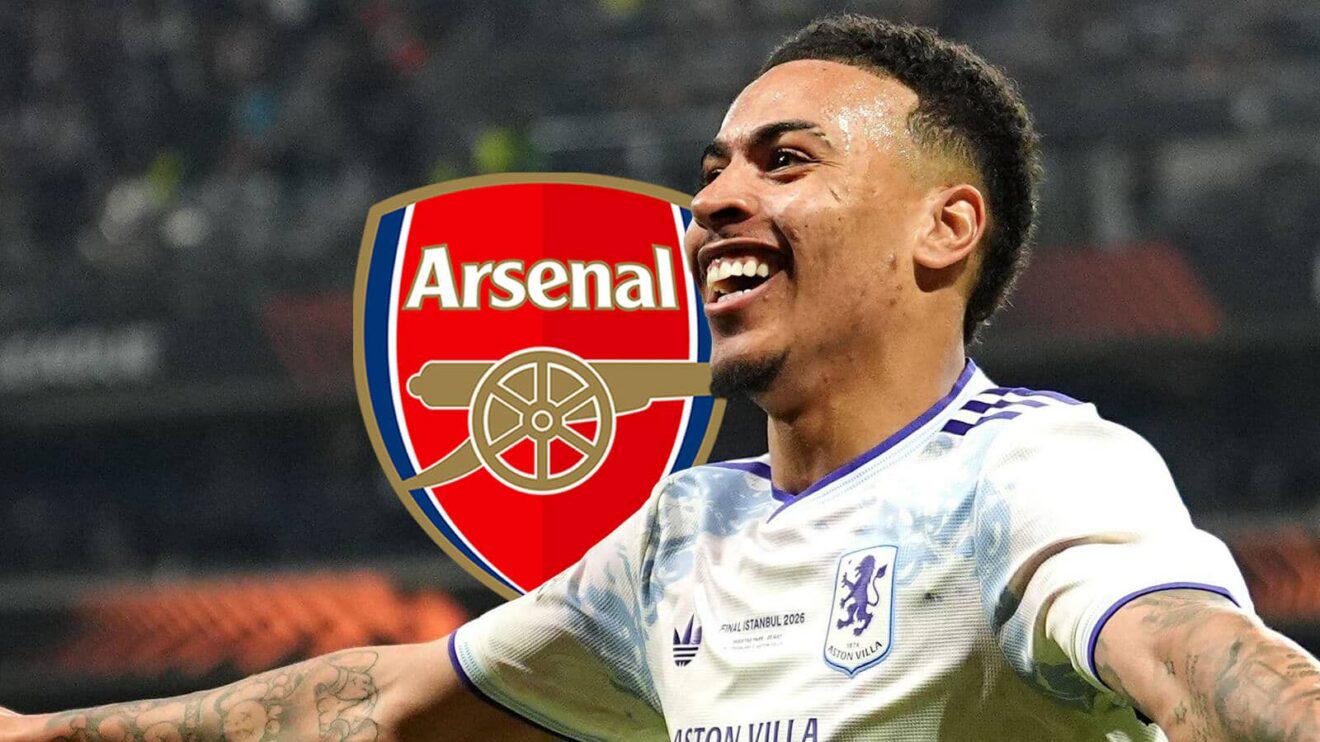
Arsenal's summer recruitment is beginning to read less like scattergun speculation and more like a sequenced development plan. At the front of that queue sits Morgan Rogers, the Aston Villa attacker whose rise from Middlesbrough to England duty has made him the club's priority for elevating the forward line ahead of the 2026-27 campaign. In parallel, the pursuit of Newcastle United captain Bruno Guimaraes would add a different layer entirely — not just quality, but leadership in the engine room.
The two tracks are distinct in profile and price, yet they share the same internal logic: identify players who can absorb multiple roles, protect squad depth, and keep Mikel Arteta's system flexible as competition intensifies across the Premier League and in major tournaments.
Why Rogers Fits the Left-Side Blueprint
Arteta's interest in Rogers is not a cosmetic upgrade. Internal planning has positioned the England international as a direct answer to the left-wing brief currently occupied by Gabriel Martinelli, with the added capacity to operate as a No. 10 when structure demands it. That dual utility matters in a squad built around positional rotations rather than fixed stations.
Rogers' development arc strengthens the case. Since leaving Middlesbrough for Villa in February 2024, he has compiled 31 goals and 29 assists across 125 appearances — numbers that place him among the most productive young attackers in the division over that span. The pathway itself is instructive: Championship production, Premier League adaptation, then international recognition with England at the World Cup, where the national side currently sits fourth in the FIFA rankings.
That progression mirrors the kind of talent pipeline Arsenal have increasingly favored — players who have already stress-tested their decision-making at multiple levels before arriving in North London.
Contract Momentum and the Fee Gap
While Rogers remains on international duty, movement on personal terms has reportedly accelerated. Sources close to the negotiations indicate significant progress in recent days, with an agreement in principle understood to be in place on a five-year contract. That step matters because it removes the most volatile variable in any high-value deal: player willingness.
The club-to-club phase is where friction remains. Aston Villa's valuation has been framed at around £130 million, while Arsenal are expected to open closer to £100 million. A settlement near £116 million has been floated as a realistic midpoint. Those figures are not trivial, but they reflect the market's pricing of a 23-year-old who can anchor a wide channel and still influence central phases.
Outgoing movement helps explain the timing. Leandro Trossard is set to depart for Besiktas in a deal worth around €20 million, creating both a roster slot and wage bandwidth. Rogers is earmarked for that vacancy, which turns the transaction into a vertical swap rather than mere accumulation.
Guimaraes and the Newcastle Rebuild Question
If the Rogers pursuit answers Arsenal's need for forward-line evolution, the Bruno Guimaraes chase addresses a separate but equally strategic priority: controlling midfield tempo against top-half opponents. Reports on Wednesday indicated that Guimaraes has informed Newcastle United of his desire to join Arsenal, a declaration that shifts the conversation from rumor to negotiation.
For Newcastle, the timing is brutal. Within the past year, the club have already parted with Alexander Isak, Sandro Tonali, and Anthony Gordon — three players who defined distinct phases of their recent competitive identity. Losing Guimaraes would sting more than any of those exits. He is not only the captain but the connective tissue between defensive transition and final-third entry at St. James' Park.
Arsenal's opening offers of £55 million and £60 million have been rejected, which suggests Newcastle are holding out for a fee that acknowledges both his on-pitch value and his symbolic importance. The gap between bid and ask will determine whether this becomes a headline double deal or a one-window triumph built around Rogers alone.
How the Moves Interlock
Viewed together, the two targets sketch a coherent squad architecture. Rogers supplies vertical threat and creative overload from the left, with positional versatility that allows Arteta to preserve system integrity when injuries or rotations bite. Guimaraes would deepen the central spine, offering press resistance and progressive passing that complement Arsenal's existing midfield profiles rather than duplicate them.
Neither signing is a standalone luxury. Rogers replaces outgoing wide production. Guimaraes would fill a leadership void that becomes more expensive to solve later if Newcastle hold firm or another club enters late. The sequencing — player agreement first on Rogers, club negotiation ongoing on both fronts — suggests recruitment chiefs are managing risk by securing the most time-sensitive piece while keeping the larger structural addition alive.
What Success Would Mean for 2026-27
Securing Rogers alone would already represent a statement of intent: backing a homegrown England talent with Premier League proof and international experience at the World Cup. Adding Guimaraes would elevate the project from targeted reinforcement to squad recalibration, pairing a high-ceiling attacker with a proven midfield conductor.
The financial outlay would be substantial — potentially exceeding £170 million combined if both deals land near reported valuations. Yet the alternative cost is familiar to top clubs: entering a season one creative hub short, then paying a premium in January or falling behind in the title race.
For now, Arsenal sit at a hinge point. Personal terms with Rogers appear largely resolved. Guimaraes has made his preference known. Villa and Newcastle still hold the leverage that price tags confer. The coming days will reveal whether Arteta's dual-track vision becomes a completed blueprint or a summer defined by winning the battle for one transformative talent while conceding ground on the other.