

















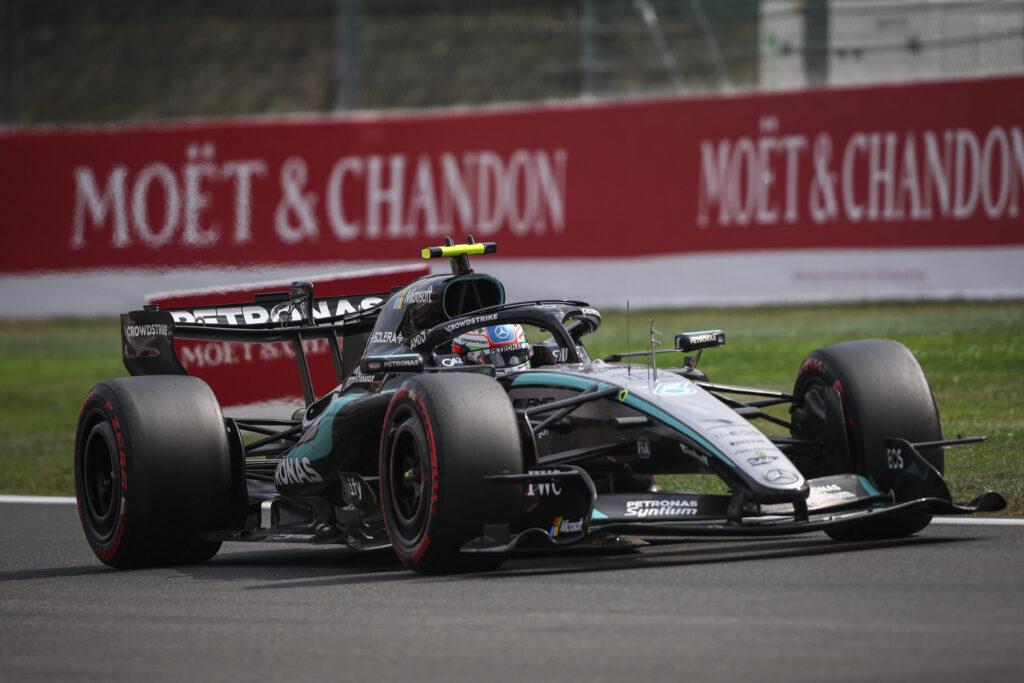
The Belgian Grand Prix weekend at Spa-Francorchamps arrived with a clear headline before Sunday even began. Andrea Kimi Antonelli topped Practice 2, led Practice 3, and then converted that momentum into pole position for Mercedes in qualifying. Max Verstappen had set the early pace for Red Bull Racing in Practice 1, but the Italian's final qualifying lap of 1:44.361 proved untouchable, beating Verstappen by 0.317 seconds. With Sprint Qualifying and the Sprint race both canceled, every operational and competitive decision now points toward a straight 44-lap Grand Prix on Sunday.
Weekend structure and what changed at Spa
Round 10 of the 2026 Formula 1 season sits in the Ardennes at one of the calendar's most demanding venues. Spa-Francorchamps measures 7.004 km per lap, and Sunday's race is scheduled for 44 laps over a full distance of 308.052 km. That is a conventional Grand Prix format, but the path to it was not.
Organizers had originally built the weekend around a Sprint format. When Sprint Qualifying and the Sprint itself were canceled, the competitive schedule compressed into a familiar rhythm: three practice sessions, qualifying, and the race. For teams, that shift removes one high-stakes scoring opportunity and one extra parc ferme checkpoint. For broadcast and fan planning, it concentrates attention on Saturday qualifying and Sunday's long run rather than spreading intensity across two race days.
The cancellation also changes how championship points flow through the weekend. Without a Sprint, there is no Saturday afternoon shake-up of the order and no separate reward for short-race execution. Every strategic investment in long-run pace, tire degradation management, and race-start positioning now carries directly into Sunday's main event.
Track conditions and why setup work stayed straightforward
Spa's reputation for unpredictable weather did not materialize across the early sessions. Conditions remained mostly dry, which allowed teams to log meaningful mileage and compare setup directions without constant weather pivots.
Practice 1 ran under sunny skies with an air temperature of 24°C and a track surface at 36°C. Practice 2 moved to cloudy conditions at 23°C air and 33°C on track. Practice 3 stayed cloudy with 21°C air and a slightly warmer 34°C track surface. Qualifying returned to sunshine at 22°C air and a toasty 38°C track.
That progression matters for engineers in plain terms. A stable, dry surface lets teams focus on balance through Eau Rouge and the long Kemmel straight rather than guessing grip levels lap to lap. When track temperature climbs between sessions, downforce levels and tire warm-up behavior shift subtly. Teams that read those changes and adjust wing angles or brake balance accordingly gain lap time without dramatic car overhauls.
Friday practice: two teams, two different rhythm leaders
Verstappen sets the early reference in FP1
Max Verstappen led the opening session, putting Red Bull Racing on top out of the box. With the track dry and the sun out, grip built steadily through FP1. The combination of warm air and a 36°C track created a stable baseline for initial balance checks rather than weather gymnastics.
Verstappen's pace established an early reference for the field to chase into the afternoon. It was a clean run to the flag and a confidence-building start for Red Bull. Spa's long lap always magnifies small setup choices, and FP1 offered quality data on how the car behaved through high-speed corners and under braking into Les Combes.
Antonelli builds confidence through FP2 and FP3
Andrea Kimi Antonelli took control of Practice 2, clocking the fastest time for Mercedes as clouds rolled in. Cooler air at 23°C and a 33°C track seemed to suit the package. The dry surface kept programs consistent, and Antonelli put the laps together cleanly through Spa's high-speed stretches.
Practice 3 reinforced the trend. Antonelli again topped the timesheets under cloudy skies, signaling strong balance and growing confidence through sectors where precision matters as much as outright power. For Mercedes, back-to-back session leadership is more than a headline. It suggests the car responds predictably to setup tweaks and that the driver is operating inside a comfortable window rather than fighting the machine.
Qualifying: setup calls, tow tactics, and a decisive final lap
Qualifying did not follow a straight line for Antonelli. He took time to find rhythm during the hour-long session, adjusting his approach as the track evolved. After a front wing flap change ahead of Q2, the car felt sharper on the limit without becoming unstable through the fast corners.
The decisive Q3 phase turned into a tactical duel as much as a pure pace contest. Verstappen benefited from a slipstream tow from Red Bull teammate Isack Hadjar on his final run. Hadjar, carrying a 30-place grid penalty for exceeding power unit allocations, was positioned to sacrifice his lap and help Verstappen gain speed on the long flat-out run toward the final chicane. Verstappen later said the tow was worth roughly three tenths and kept him on the front row rather than dropping toward the midfield.
Antonelli answered immediately. His final lap of 1:44.361 was the fastest of the weekend and secured pole by 0.317 seconds over Verstappen's 1:44.678. It was his sixth pole in ten races this season and the largest qualifying margin any driver has held for pole so far in 2026.
Lando Norris briefly looked like a threat, setting a strong time before abandoning his last attempt after a trip through the gravel at Turn 13. He qualified third on merit at 1:44.801 but will start 13th after a 10-place grid penalty, reshaping the midfield fight behind the front two. George Russell finished fourth for Mercedes, Charles Leclerc fifth for Ferrari, and Lewis Hamilton sixth, separated from Leclerc by just two thousandths of a second.
Grid picture and what Sunday demands
Antonelli starts from P1 with Verstappen alongside him on the front row. Russell lines up fourth, giving Mercedes two cars in the top four despite Norris's penalty reshuffling positions further back. The tow Verstappen used in qualifying cannot be replicated on the grid, where race starts reward reaction time, traction, and positioning into Turn 1 and through the uphill run to Les Combes.
For Antonelli, the challenge is translating pole into race control at a circuit where slipstreams and DRS trains can compress gaps quickly. He acknowledged after qualifying that Max starting next to him makes the launch critical, with the fight likely extending through the opening laps toward Turn 5.
Championship context adds another layer. Antonelli leads teammate Russell by 25 points in the drivers' standings, and a clean Sunday would extend that advantage at a venue where mistakes are costly and recovery is never guaranteed. With no Sprint to reset the order, Saturday's result is the foundation everything else builds on.
Training rhythm meets race-day execution
From a team-performance perspective, this weekend illustrates how session-to-session consistency can foreshadow qualifying success. Antonelli did not arrive at pole from a single heroic lap. He built through FP2 and FP3, read changing track temperatures, and made a targeted aerodynamic adjustment that paid off when Q3 demanded maximum commitment.
Mercedes enters Sunday with the front-row advantage and a car that has looked predictable through Spa's most demanding sections. Red Bull arrives with a proven tow playbook and a driver who still extracted a front-row slot despite Antonelli's superior peak lap. The canceled Sprint simplified the schedule, but it also removed a safety valve. Sunday's 44 laps will decide the Belgian Grand Prix without a second chance.